Are sinus infections contagious? That’s usually the first thing people want to know at Fort Worth ER either because they’re sick and have a house full of kids, or because someone around them is sick and they’re already feeling that familiar pressure building behind their eyes. The honest answer is: it depends entirely on what’s causing the infection, and that distinction matters more than most people realize.
Here’s the fast version, and we’ll build on it: the sinus infection itself doesn’t spread, but the virus or bacteria behind it often can. Knowing which type you’re dealing with, and how long you’re contagious, changes everything about how you manage the next week.
What Is a Sinus Infection, Really?
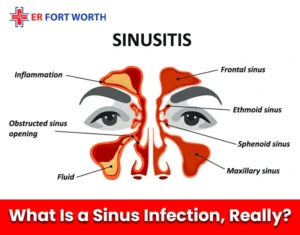
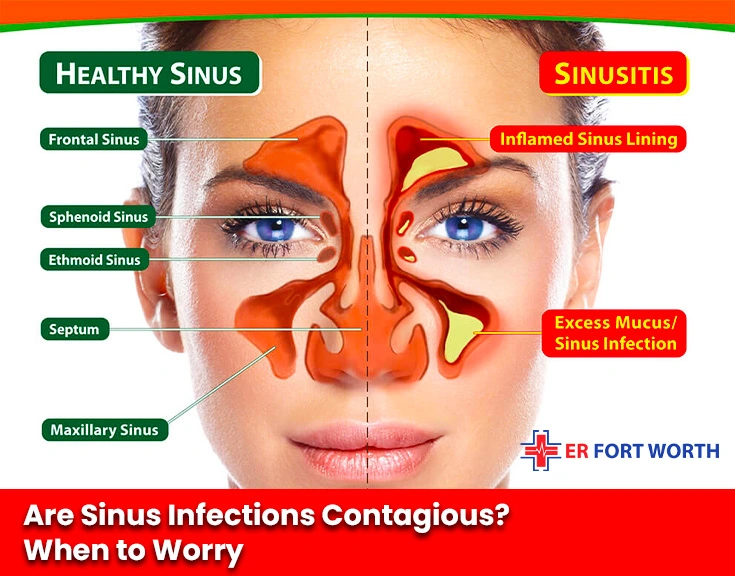
Your sinuses are four pairs of air-filled cavities behind your forehead, cheeks, nose, and eyes. They’re lined with mucus-producing tissue that, under normal circumstances, drains freely and keeps things clean. A sinus infection, sinusitis, happens when that tissue becomes inflamed, the drainage pathways get blocked, and fluid builds up in those cavities. Bacteria, viruses, or even fungi can then multiply in that trapped fluid.
What does it actually feel like? Not just “congestion.” It’s the pressure, a deep, dull ache behind your cheekbones or above your eyebrows that gets worse when you lean forward. It’s waking up with a headache that your coffee doesn’t touch. It’s thick discharge that won’t drain no matter how many times you blow your nose. It’s the kind of facial fullness that makes your teeth ache on the upper jaw. If that sounds familiar, you’re probably dealing with sinusitis.
Are Sinus Infections Contagious? The Real Answer
Is a sinus infection contagious? Not directly but you cannot “catch” sinusitis from someone the way you catch a cold. What you can catch is the underlying virus or bacteria that triggered their sinusitis, and that trigger can then cause sinusitis in you.
Think of it this way, sinusitis is what happens when an infection takes root in the sinuses. The infection itself can spread. The sinusitis it causes is your body’s individual response to it.
Are bacterial sinus infections contagious?
This is the question that trips most people up, and most articles get vague here. Are bacterial sinus infections contagious? In most cases, no ,or at least, far less so than viral ones.
Here’s why: bacterial sinusitis usually develops as a secondary complication. A viral upper respiratory infection weakens the sinus environment, and then bacteria, often already present in your respiratory tract, take advantage of the disruption and overgrow. That bacteria is harder to transmit through casual contact than a respiratory virus.
That said, some bacterial pathogens involved in sinusitis, like certain strains of Streptococcus pneumoniae or Haemophilus influenzae, can spread through respiratory droplets. Whether they cause sinusitis in someone else depends on that person’s immune state, exposure duration, and other factors.
The practical takeaway: if your sinus infection is bacterial, your contagion risk is lower than in the early viral phase, but good hygiene still matters, especially around young children, elderly family members, and anyone immunocompromised.
How Long Are Sinus Infections Contagious?

This is the most searched question about sinus infections, and the least directly answered by most articles. Here’s a clear breakdown.
If it started as a virus (most cases do): You are most contagious during the first 2–3 days of symptoms, when the viral load is highest and you may still think it’s just a cold. Contagion typically drops significantly after day 5–7, though you may still be transmissible through day 10 in some cases.
When it transitions to bacterial: How long are sinus infections contagious once bacteria are involved? Much less. Bacterial sinusitis, typically diagnosed when symptoms persist beyond 10 days without improvement, or worsen after initial improvement, carries a significantly lower transmission risk than the viral phase that preceded it.
The timeline most people need:
- Days 1–3: Most contagious, treat as if you have a virus
- Days 4–7: Contagion dropping, but still practice caution
- Days 7–10: If symptoms are persisting or worsening, something else may be going on
- Beyond 10 days: Likely bacterial, lower contagion risk, but now it’s time to see someone
Go to the ER Now, Symptoms That Mean This Is More Than a Sinus Infection
Most sinus infections are miserable but manageable. The following symptoms are not. If you or someone in your household has any of these, come in now or call 911:
- Swelling around one or both eyes, especially if the eyelid is drooping or won’t open
- Vision changes, double vision, blurring, or pain with eye movement
- Severe headache that is the “worst of your life” or comes on suddenly
- Neck stiffness with fever, this combination needs to be ruled out for meningitis immediately
- Confusion, personality changes, or unusual drowsiness
- High fever (103°F or above) that isn’t coming down with medication
- Facial swelling spreading beyond the sinus area
- Symptoms that improved and then sharply worsened, this “double-sickening” pattern often signals bacterial superinfection
What can be managed at home:
- Facial pressure and congestion that is stable, not worsening
- Mild fever under 101°F responding to OTC medications
- Thick nasal discharge without spreading facial swelling
- Symptoms under 10 days in an otherwise healthy adult
Even at home: if you’re not trending better after 7–10 days, come in. Waiting two weeks on a bacterial sinus infection is two weeks of unnecessary misery and risk.
Viral vs. Bacterial Sinus Infection, Can You Tell Without a Test?
This is the question patients ask us constantly, and it deserves a straight answer.
You often can’t tell definitively without evaluation, but there are patterns that point one way or the other:
More likely viral:
- Symptoms began alongside or immediately after a cold
- Runny nose started clear, turned yellow or green within a few days
- Mild to moderate pressure and congestion
- Improving by day 7–10
More likely bacterial:
- Symptoms persist beyond 10 days without improvement
- You started feeling better, then got worse, the “double-sickening” sign
- Facial pain is severe and localized, particularly one-sided
- High fever appearing after the first week of illness
- Thick, discolored discharge that isn’t clearing
The color of discharge alone doesn’t diagnose bacterial sinusitis, this is one of the most common misconceptions we encounter. Green mucus can be viral. What matters more is the duration, the trajectory, and the severity of symptoms.
Are sinus infections contagious? quick reference guide
| Type | Contagious? | Common causes | Duration | Key notes |
| Viral sinusitis | Yes | Rhinovirus, influenza, COVID-19, RSV | 7–14 days | Most common type. Contagious for the first 2–3 days of illness. |
| Bacterial sinusitis | Rarely | S. pneumoniae, H. influenzae, M. catarrhalis | 10+ days | Usually develops after viral URI. The bacteria themselves are not typically spread person-to-person. |
| Fungal sinusitis | No | Aspergillus, Mucor, Candida | Weeks–months | Occurs mainly in immunocompromised individuals. Not transmitted between people. |
Sinus Infections in Fort Worth, What We See at the ER
In Tarrant County, sinus infections follow a predictable seasonal rhythm that anyone who’s lived here for a year or two recognizes.
Mountain cedar season, December through February, is the most aggressive annual trigger. The cedar pollen count in North Texas during peak season is among the highest recorded anywhere in the country. Patients who have allergies already come in with sinuses primed for infection; all it takes is one exposure to a common cold virus to tip them into full sinusitis. Every January and February we see a wave of sinus-related ER visits from families across Fort Worth who assumed cedar season was just making them stuffy.
Spring oak and elm pollen continues the cycle into March and April. Summer heat and ozone, North Texas air quality advisories are real and relevant for sinus sufferers, keeps the inflammation rolling. Fall brings mold from decaying leaves, another underappreciated trigger.
The pattern we see most often: a patient who managed their allergies all season, caught a mild cold at work or their child’s school, and now two weeks later is sitting in our waiting room with severe facial pain and a fever because what started viral has gone bacterial.
If that trajectory sounds familiar, don’t wait another week.
What Happens at Our Fort Worth ER for a Sinus Infection

People hesitate to come to the ER for a sinus infection because they worry it’s not “serious enough.” The answer is: come in when your symptoms cross the lines we described above. When they do, here’s what happens:
- Assessment, we evaluate symptom duration, progression, fever pattern, and any red-flag signs. We’re specifically looking for signs of spread beyond the sinuses.
- Exam, nasal examination, lymph node check, ear and throat assessment, and evaluation of facial and periorbital areas.
- Imaging if needed, CT scan of the sinuses if we’re concerned about abscess, orbital involvement, or intracranial spread. We don’t CT every sinus infection, only when the clinical picture calls for it.
- Labs if indicated, to assess for bacterial infection, elevated white cell count, or other markers of systemic involvement.
- Treatment, appropriate antibiotics if bacterial infection is confirmed or strongly suspected, pain management, and guidance on supportive care.
- Discharge plan, you leave knowing exactly what to watch for, when to return, and what a normal recovery timeline looks like.
If You’re in Fort Worth and It’s Getting Worse
Sinus infections are usually something you can ride out at home. But if your symptoms have crossed into the red-flag territory above, or if you’ve been miserable for more than 10 days and nothing is improving, don’t keep waiting. ER of Fort Worth is open 24 hours a day, every day. No appointment, no referral needed. We’ll figure out what’s going on and make sure you’re not dealing with something that needs real treatment.