
If you’re asking when is allergy season because your eyes are swollen, your throat is scratchy, and you haven’t slept in two nights, you’re already in it. In Fort Worth and across North Texas, allergy season isn’t a single window on the calendar. It’s three overlapping waves that, in bad years, feel like one long siege from December through October.
Most of the time, it’s miserable but manageable. But sometimes symptoms cross a line. We want to help you know exactly where that line is.
What’s Actually Happening in Your Body During Allergy Season
Here’s the thing, your immune system isn’t broken. It’s just confused. When pollen gets into your airways, your body treats it like an invader, flooding your system with histamine. That’s what causes the swelling, the mucus, the itching. Your body is genuinely trying to flush something out.
The frustrating part is that pollen is harmless. You’re suffering through a full immune response for something that’s not actually a threat. And if you have asthma or a history of severe reactions, that same immune response can escalate fast.
Why Does Allergy Season Feel Worse Some Years Than Others?
After a wet spring in DFW, the kind where it rains two weeks straight in March, pollen counts can spike dramatically once the sun comes back out. Plants that held off during cool, damp weather release everything at once. Add wind, and the air in Tarrant County becomes a pollen delivery system.
Climate patterns are also shifting the seasons longer. What used to end in May sometimes now lingers into June. What started in January now sometimes kicks off in mid-December. It’s not your imagination, and it’s not just you.
When Is Allergy Season in Fort Worth and North Texas?
This is where it gets specific, and where a lot of generic allergy guides fail you. When is allergy season in Texas looks nothing like the national average. We don’t get a clean spring window. We get rounds.
The Fort Worth Allergy Calendar: Month by Month
December – February: Cedar fever season. Mountain cedar, technically Ashe juniper, releases pollen in massive clouds during winter. Fort Worth and the Hill Country corridor get hit hard. Cedar fever is real: intense nasal congestion, sinus pressure, fatigue, and watery eyes. It’s miserable, and it starts earlier than most people expect.
March – May: Oak and grass pollen. This is when the spring surge hits. Oak trees release heavy, sticky pollen across Tarrant County. By April and May, grasses join in. This is often the worst stretch of the year for people with multiple sensitivities.
June – August: Relative relief, but not for everyone. Summer is quieter in terms of tree pollen, but mold spores rise with the heat and humidity. Some grasses are still pollinating. People who thought they were through the worst can get caught off guard.
September – November: Ragweed. The fall wave. Ragweed is everywhere in North Texas, roadsides, fields, open lots. It pollinates late August through the first hard frost, which in Fort Worth might not come until November or even December.
When Does Allergy Season Start in Texas?
Honestly? It never fully stops. But when does allergy season start in any meaningful sense is late December or January, when cedar counts climb. If you’ve got a cedar sensitivity, you don’t get much of a winter break. Most Fort Worth residents with pollen allergies have symptoms for eight or nine months of the year.
When Is Allergy Season Over in Texas?
The clearest answer: after the first hard frost in fall. That’s when ragweed stops releasing pollen. In Fort Worth, that might be late November, or, in mild years, December. Then cedar starts up again shortly after. When is allergy season over is genuinely a moving target here.
What Does It Actually Feel Like? (Allergies vs. Something Else)
Here’s what we see constantly at our Fort Worth ER: someone comes in convinced they’re “dying” because their symptoms are so severe, and it’s allergies. Or they’ve been suffering through what they assumed were allergies for two weeks, and it’s actually a sinus infection or pneumonia. The symptoms overlap enough to confuse anyone.
Classic allergy symptoms feel like: a relentless drip at the back of your throat, eyes that itch so badly you can’t stop rubbing them, sneezing that comes in waves, that foggy-headed feeling from sinus congestion. No aching muscles, no chills, no real exhaustion, just upper-respiratory misery.
Can Seasonal Allergies Cause a Fever?
No, not a true fever. If your temperature is 100.4°F or above, that almost certainly means infection, not allergies. Allergies can make you feel feverish, warm, run-down, fuzzy, but they don’t raise your core temperature. A fever on top of allergy-like symptoms means it’s time to get checked. Our ER team can run a rapid test to rule out flu, strep, or sinus infection.
How Do I Know If It’s Allergies or a Sinus Infection?
Duration and quality of symptoms are your best clues. Allergies tend to follow patterns, worse outdoors, better inside, worse in the morning when pollen counts peak. A sinus infection usually brings facial pain, thick discolored mucus, and that deep ache behind your eyes that doesn’t let up. If you’ve been “treating allergies” for more than 10 days and you’re getting worse instead of better, that’s a reason to come in.
When Should You Go to the ER Right Now?
This is the question that matters most, and it shouldn’t be buried at the bottom of a long article. The following symptoms are not allergy symptoms. They are emergencies.
Come to our Fort Worth ER immediately if you have:
- Difficulty breathing or wheezing that won’t stop, not just a stuffy nose, but actual struggle to draw a breath
- Throat tightening or a feeling like something is closing off, this can be anaphylaxis and moves fast
- Severe swelling of the lips, tongue, or face, especially if it came on after exposure to food, insect stings, or medication
- Hives that are spreading rapidly combined with any breathing change or dizziness
- Chest tightness or chest pain, don’t assume it’s mucus pressure, get evaluated
- Dizziness, lightheadedness, or fainting, signs that the reaction is affecting circulation
- Confusion or altered mental state, in older adults especially, this is a red flag
- Fever over 100.4°F alongside respiratory symptoms, this is likely infection, not allergies
- A child whose symptoms are rapidly worsening, kids can deteriorate quickly, trust your gut as a parent
You can probably wait if:
- You’re sneezing a lot but breathing easily
- Your eyes are itchy and watery but your vision is fine
- You’re congested but have no fever
- You’ve felt this way before and antihistamines usually help
- Your symptoms started after being outside and improve when you come indoors
The middle ground is always a judgment call. When you’re not sure, especially with a child or an elderly family member, we’d rather you come in and go home reassured than stay home and wish you hadn’t.
When Is Allergy Season Bad Enough to Come In?
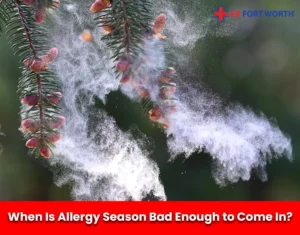
Most patients who come to our Fort Worth ER during cedar season or the spring pollen surge aren’t having a life threatening reaction. They’re exhausted. They haven’t slept. They’ve tried two or three antihistamines and nothing touched it. They want someone to actually look at them.
That’s a real and legitimate reason to seek care, especially when symptoms have lasted more than a week with no relief, or when you’re not sure if something else is going on.
We’ve noticed that during the heavy oak pollen weeks in April, we see a real uptick in patients who also have underlying asthma. Pollen is a known asthma trigger. If you’re using your rescue inhaler more than twice a week, that’s a signal to be evaluated, not something to push through on your own. See our ER’s approach to respiratory care and asthma management.
What Happens When You Come to Our Fort Worth ER?
We’ll start with a real conversation, what you’re feeling, how long it’s been happening, what you’ve already tried. Depending on your symptoms, we may run a rapid flu or strep test, check your oxygen levels, listen to your lungs, or run basic labs if there’s any concern about infection or a more serious reaction. We also have IV fluids available if dehydration from prolonged mucus loss or poor intake is part of the picture.
No waiting weeks for an appointment. No phone trees. Walk in, get seen, get answers.
You Don’t Have to Tough It Out, We’re Here in Fort Worth, 24/7
Allergy season in North Texas is no joke. Cedar fever in January. Oak pollen in March. Ragweed in September. If you’re in the middle of it and something feels off, breathing is harder than it should be, or you’ve been symptomatic for two weeks with no end in sight, come see us.
ER of Fort Worth is open around the clock, every day of the year. No appointments, no long waits. We’re not here to see you only in emergencies, we’re here when you’re not sure, when you’re worn down, and when you need a real answer from someone who will actually look at you. Walk in. We’ve got you.
Frequently Asked Questions
When Does Allergy Season Start?
In Fort Worth, the practical answer is December, when mountain cedar begins releasing pollen across Central and North Texas. For people sensitive to oak or grass, when does allergy season start shifts to March or April. The short version: there’s no clean start date in this part of the state.
What Month Is Most Common for Allergies?
April is the single most active month for allergies across the U.S. and in Fort Worth, it’s especially brutal, with oak and grass pollen both peaking at the same time. If you’re wondering when is allergy season at its worst, April through May is your answer for most of North Texas.
What Are the 7 Allergy Symptoms?
The seven most common seasonal allergy symptoms are sneezing, runny nose, nasal congestion, itchy eyes, watery eyes, itchy throat, and post-nasal drip. During peak allergy season in Texas, most patients experience three or four of these at once, rarely all seven, but enough to make a normal day genuinely miserable.
What Month Is Worst for Allergies?
April is widely considered the worst month for allergies in the U.S., and Fort Worth is no exception, but in Texas, March through May functions as one extended high-pollen window. When allergy season in Texas hits its spring peak, pollen counts from oak, elm, and grass can stack on top of each other with almost no relief between them.
What 8 Foods Cause 90% of Allergies?
The eight foods responsible for roughly 90% of allergic reactions are milk, eggs, peanuts, tree nuts, wheat, soy, fish, and shellfish. Unlike seasonal allergies, where when allergy season starts determines your symptoms, food allergies can trigger reactions year-round, and severe reactions to these foods are one of the most common reasons patients visit our Fort Worth ER.