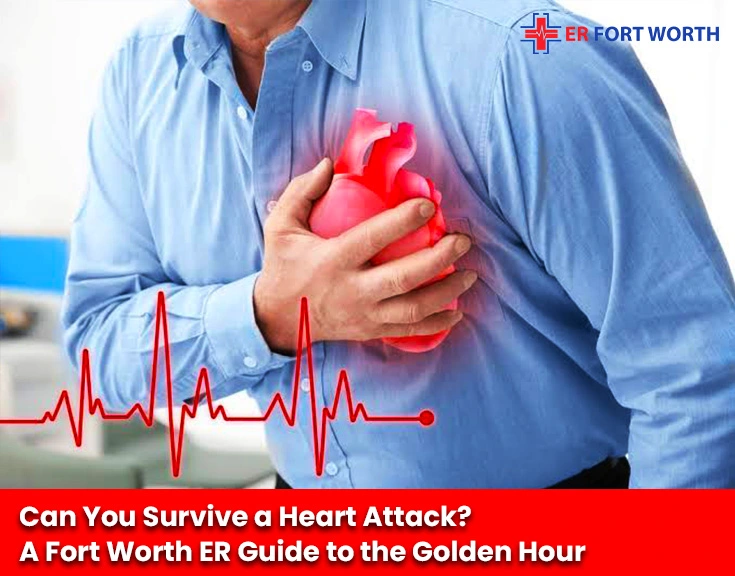
Can you survive a heart attack? Yes, and most people do. A fifty-year analysis of national heart data found that survival has flipped almost completely: back in 1970, someone over 65 having a heart attack had roughly a 60% chance of leaving the hospital alive. Today that number is over 90%.
That’s not luck. It’s faster ambulances, better drugs, and ERs built around one idea: time is muscle. The sooner you get help, the more of your heart you keep.
So if you’re reading this because your chest hurts right now, or because someone you love is clutching their chest in the next room, stop scrolling for a second. If the pain is bad, if it’s spreading to your arm or jaw, if you feel like something is wrong: call 911. You can finish this article in the waiting room. We mean that.
If you have a minute before that decision needs to be made, here’s what’s actually happening in your body, what the real odds look like, and what we do the moment you walk through our doors at ER of Fort Worth, including for chest pain that won’t go away even when you have told yourself it’s probably nothing.
What Is a Heart Attack, Really?
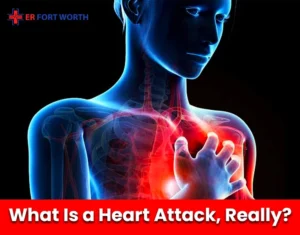
Here’s the simple version. Your heart muscle runs on blood the same way the rest of your body does, fed through three main coronary arteries. A heart attack happens when one of those arteries gets blocked, usually by a clot that forms on top of plaque that’s built up over years, and the part of the muscle downstream from that blockage stops getting oxygen.
Without oxygen, heart muscle starts to die. Not instantly. Over minutes and hours. That’s the whole reason speed matters so much: every minute the artery stays blocked, more muscle is lost, and it doesn’t grow back.
Doctors call this myocardial infarction, which just means “death of heart muscle.” If you want the deeper biology, Wikipedia’s entry on myocardial infarction is a solid free reference. We will not repeat a textbook here. We want you to understand the one thing that matters: blocked artery, dying muscle, and a clock that starts the second the blockage happens, not when you decide to come in.
Can You Survive a Heart Attack? Here’s What the Real Numbers Say
Can you survive a heart attack? For the vast majority of people today, yes. Researchers at Stanford Medicine, working with American Heart Association mortality data, found that heart attack deaths have dropped nearly 90% since 1970. That’s not a typo. Nearly nine in ten of the heart attack deaths that used to happen are now being prevented.
The catch is that survival is not a flat number. It depends heavily on how fast you get treated. AHA and ACC treatment guidelines set a target of 90 minutes or less from the moment you walk into the ER to the moment a blocked artery is reopened, what cardiologists call “door-to-balloon time.” Hospitals that consistently hit that window see meaningfully better outcomes.
So the honest answer is: your odds are good, and they get better the faster you act. That’s the entire point of this page.
What a Heart Attack Actually Feels Like
Movies get this wrong constantly. Most heart attacks don’t look like someone clutching their chest and collapsing. They feel like pressure, like someone is standing on your chest, or like a tight band wrapped around it. Some people describe it as heartburn that won’t quit. Others feel almost nothing in the chest at all and just feel “off.”
What we hear constantly in our Fort Worth ER is some version of: “I thought it was just indigestion.” That’s not embarrassing. It’s common, and it’s exactly why we would rather you come in and be wrong than stay home and be right.
The discomfort can spread to the jaw, neck, shoulders, or down one or both arms. It can come with sweating, nausea, or a wave of dizziness that seems to come from nowhere. Some people just feel exhausted, like they couldn’t climb a flight of stairs if their life depended on it, which, in this case, it might.
Signs of a Heart Attack in Men
In men, the signs of a heart attack in men tend to follow the textbook pattern more often: chest pressure, pain radiating down the left arm, shortness of breath, cold sweat. Men in their 50s and 60s are the group we see most during evening hours at our Fort Worth ER, often arriving two or three hours after symptoms started because they assumed it would pass.
Why Women’s Heart Attack Symptoms Get Missed
Women are less likely to get the classic crushing chest pain and more likely to show up with nausea, vomiting, jaw pain, back pressure, or just unusual fatigue, symptoms that get waved off as stress more often than they should. The American Heart Association has flagged this gap directly: women’s heart attack symptoms are real, they’re common, and they’re underdiagnosed because they don’t match the textbook version.
If something feels wrong in your chest, back, or jaw and it isn’t going away, that’s reason enough to get checked, regardless of which symptom list it does or doesn’t match.
Stroke vs. Heart Attack: How Can You Tell?
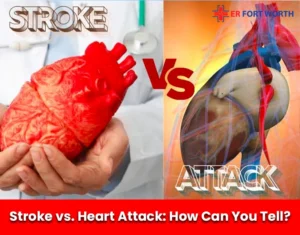
Stroke and heart attack get confused because both feel like an emergency happening somewhere vital, but they’re different problems with different playbooks.
A heart attack is a blocked artery in the heart. Symptoms center on the chest, arms, jaw, and breathing. A stroke is a blocked or burst blood vessel in the brain, and the symptoms show up in the face, speech, and limbs: sudden drooping on one side of the face, slurred speech, sudden weakness on one side of the body, or sudden confusion.
The quick test for stroke is F.A.S.T.: Face drooping, Arm weakness, Speech difficulty, Time to call 911. The quick test for a heart attack is simpler: chest pressure that doesn’t go away, especially paired with arm, jaw, or breathing symptoms.
Here’s the part that matters more than the difference: you don’t need to diagnose yourself correctly to call 911. Both are emergencies. Both have a clock running. Tell the dispatcher what you’re feeling and let trained paramedics sort out which one it is.
Stop Reading If Any of These Apply to You Right Now
So Can You Survive a Heart Attack If You Try to Wait It Out?
Honestly? Sometimes. But “sometimes” is a terrible bet when the alternative is calling 911. Every hour you wait is heart muscle you don’t get back, and a meaningful share of the people who don’t survive a heart attack die specifically because they waited at home, hoping it would pass.
Here’s when you stop hoping and start moving:
- Chest pain or pressure lasting more than a few minutes, especially if it doesn’t ease up with rest.
- Pain spreading to your jaw, neck, shoulder, back, or one or both arms, this spread is a classic warning sign, not a coincidence.
- Sudden shortness of breath, even if you don’t notice any chest pain alongside it.
- Cold sweat, nausea, or lightheadedness with no clear cause, especially showing up together.
- A feeling of impending doom, patients describe this as just knowing something is badly wrong, even before the pain fully sets in.
- In women: unusual fatigue, jaw pain, or pressure between the shoulder blades, often dismissed as stress, rarely is.
- Symptoms that come and go over hours, this is not reassuring. It’s often a sign the artery is partially, then fully, blocking.
If you are nodding along to more than one of these, this is not the moment to finish your coffee or wait for morning.
You Can Probably Wait, But Still Get Checked, If…
Not everything needs a 911 call. Mild, brief chest discomfort that’s clearly tied to a pulled muscle, heartburn after a big meal, or anxiety you recognize from past episodes usually falls into the “get checked when you can” category rather than the “go now” one. The exception: if it’s new, if it’s worse than anything you’ve felt before, or if you genuinely can’t tell the difference, treat it like the real thing. If you’re unsure which category you’re in, our guide on when to go to the ER vs. urgent care can help, though chest pain itself is never an urgent-care visit. We’d always rather see you for nothing than not see you for something.
| If any of the symptoms above apply to you right now: stop reading and call 911, or come to ER of Fort Worth immediately. We’re open 24/7, no appointment needed, and we’d rather check and be wrong than have you wait and be right. |
What Actually Decides Who Survives a Heart Attack
Survival is not random. A handful of factors do most of the work.
Speed is the biggest one. Patients who get to a hospital and into treatment within that 90-minute door-to-balloon window have measurably better outcomes than those who wait. This is the single factor you have the most control over.
CPR matters too, especially if a heart attack triggers cardiac arrest, a related but different emergency where the heart stops beating altogether. Bystander CPR can double or triple a person’s odds of surviving cardiac arrest, according to the American Heart Association, which is part of why we recommend everyone learn the basics, even just hands-only CPR.
Collateral circulation, basically backup blood vessels some people’s hearts build over years, can also buy time during a blockage. You can’t control whether you have it. You can control how fast you call for help.
Underlying health matters as well. Diabetes, high blood pressure, and smoking history all affect how much damage a blockage causes and how well the heart recovers afterward. None of that is destiny, but it’s part of the picture your ER team is working with the moment you arrive.
| Every minute of delay costs heart muscle that doesn’t come back. Our Fort Worth ER team is ready right now, walk in any time, day or night. |
Heart Attack Treatment: What Happens the Moment You Walk In
Treatment for heart attack at our ER moves fast, on purpose. The second you tell our triage nurse “chest pain,” you skip the waiting room. You’re on a monitor and getting an EKG within minutes, because that single test tells us a lot about whether your heart is in trouble right now.
Alongside the EKG, we run cardiac enzyme testing at our ER, a blood test that checks for troponin, a protein your heart releases into your bloodstream when muscle cells are damaged. Rising troponin levels confirm a heart attack even when the EKG looks ambiguous, which happens more often than people expect.
If the tests point to a blocked artery, the goal becomes reopening it through clot-busting medication, angioplasty, or both, depending on what’s blocking and where. This is where heart attack treatment in Fort Worth benefits from being fast and close: rapid lab turnaround and continuous cardiac monitoring mean you’re not waiting around for basic answers.
None of this requires you to have already diagnosed yourself correctly. Tell us what you are feeling. We’ll take it from there.
What Happens at Our Fort Worth ER

Across the Fort Worth metro, whether you are coming from Keller, Burleson, Mansfield, Crowley, or anywhere in between, the path through our doors looks the same. No appointment. Chest pain gets you seen immediately.
Tarrant County summers push extra strain on hearts that are already working hard, and we see that reflected in our volume every July and August. Winter has its own spike: cold weather tightens blood vessels and adds load to a heart that may already be struggling, which is part of why we staff for it.
Once you are in a room, you’re on continuous cardiac monitoring, which means we catch changes in real time instead of checking in every twenty minutes. On-site labs and imaging mean we are not sending your blood out and waiting hours for results, that data comes back fast, because in this specific emergency, fast is the entire job.
What we see all the time is people who tell us afterward that they almost didn’t come in. Almost never works out. We’d rather you walk in for nothing than stay home for something.
Patient Testimonials
| “I honestly thought it was just severe heartburn at first. Within minutes, the chest pressure became unbearable and my family rushed me to ER of Fort Worth. The emergency team acted immediately, explained every step clearly, and helped stabilize me fast. Today, I’m grateful to say yes, you can survive a heart attack when you get emergency care quickly.” — Marcus T., 58, Burleson “I was terrified when my left arm went numb and I started struggling to breathe. The doctors at ER of Fort Worth recognized the warning signs right away and began treatment immediately. Their fast response made all the difference in my recovery and gave me confidence during the scariest moment of my life.” |
| Can you survive a heart attack? For most people who act fast, yes, and that’s the whole message of this guide. If you’re in Fort Worth, Keller, Burleson, Mansfield, Crowley, or anywhere across the metro and something feels wrong in your chest right now, we’re ready.. ER of Fort Worth is open 24 hours a day, seven days a week, with no appointment needed and a team built around getting you from the door to treatment fast. Come now. |
Frequently Asked Questions
What is the survival rate for a heart attack?
Today, roughly 90% of people who reach a hospital for a heart attack survive to leave it, up from about 60% in 1970, according to a Stanford Medicine analysis of national heart data. Survival depends heavily on how fast you’re treated, which is why getting to an ER quickly matters more than almost anything else.
How long does a heart attack last, and how fast can it turn deadly?
A heart attack can last minutes to several hours, and the danger builds the whole time an artery stays blocked. Heart muscle starts dying within minutes of blood flow stopping, and damage gets worse every hour treatment is delayed. There’s no safe length of time to wait and see; earlier treatment consistently means less permanent damage.
What are the warning signs of a heart attack in men?
In men, the signs of a heart attack in men typically include chest pressure or squeezing, pain spreading to the left arm or jaw, shortness of breath, and cold sweat. Symptoms often build gradually rather than hitting all at once, which is exactly why so many men wait too long before calling for help.
Stroke vs. heart attack, what’s the difference?
A heart attack blocks blood flow to the heart and causes chest, arm, or jaw symptoms. A stroke blocks or bursts a vessel in the brain and causes facial drooping, slurred speech, or sudden weakness on one side. Both are emergencies; call 911 and describe your symptoms, and paramedics will sort out which one it is.
Can a loop recorder detect a heart attack?
Not directly. A loop recorder tracks heart rhythm over weeks or months to catch arrhythmias like atrial fibrillation; it isn’t built to diagnose an active heart attack. That’s done in the ER with an EKG and a troponin blood test. If you have one, it can still record useful rhythm data afterward for your cardiologist.
What should I do if I think I’m having a heart attack and I’m alone?
Call 911 first; don’t drive yourself if you can avoid it. Unlock your door for paramedics, then sit or lie down and stay as calm as possible while you wait. If aspirin is nearby and you’re not allergic, chewing one can help, but calling for help always comes first.