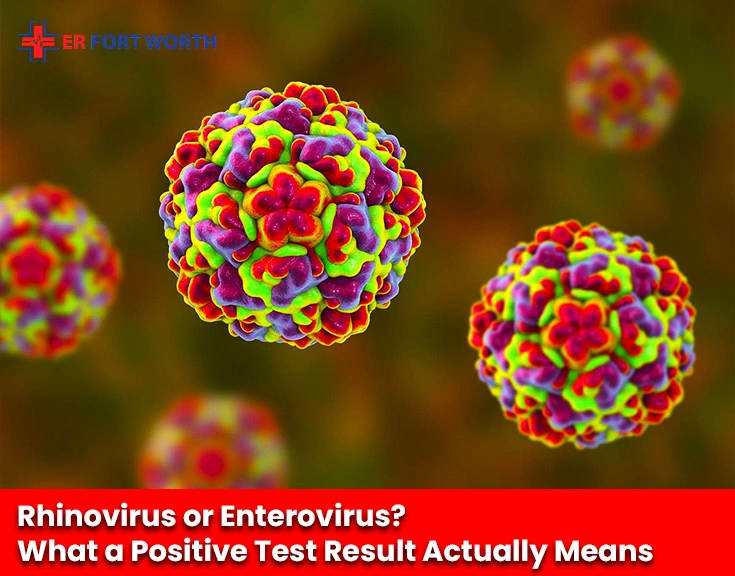
“Rhinovirus or enterovirus” usually isn’t a phrase people go looking for out of curiosity, it’s what’s sitting on a lab report in front of them, right after a swab at urgent care, the pediatrician’s office, or here at the ER. Here’s the short version: most respiratory panels report rhinovirus and enterovirus together as a single result because the test can’t reliably tell the two apart on its own, and for the vast majority of people, that combined result means a bad cold, not a crisis.
That said, it’s not always that simple. Enterovirus is the wider-reaching half of this pairing, it’s the one behind viral meningitis, the one that can hit kids with asthma harder than a typical cold, and the reason a positive result in a baby under three months old gets treated differently no matter how mild things look. If your child is struggling to breathe right now, don’t keep reading, ER of Fort Worth’s emergency services team is open 24/7 and can see you immediately. For everyone else, here’s what this result actually means and how to tell which situation you are in.
Rhinovirus vs. Enterovirus: What’s the Difference?
So what’s the real difference between rhinovirus and enterovirus? Both belong to the same viral family, Picornaviridae, which is exactly why a combined-panel test groups them together instead of teasing them apart. They share a similar structure and are studied together within that genus, but once you get past the family resemblance, the two behave pretty differently in practice.
Rhinovirus almost always stays in the upper respiratory tract, nose, sinuses, throat, and behaves like, well, a cold. Symptoms usually run their course within one to two weeks. Enterovirus is the more unpredictable cousin: most infections are just as mild, but the same virus family is behind hand-foot-mouth disease, viral meningitis, and occasional heart or brain complications in a small number of cases.
| Feature | Rhinovirus | Enterovirus (non-polio) |
|---|---|---|
| Typical illness | Common cold, runny nose, sore throat, cough | Ranges from a mild cold to hand-foot-mouth disease, viral meningitis, or (rarely) heart or brain involvement |
| Contagiousness | Highly contagious via droplets and contaminated surfaces | Highly contagious via respiratory droplets and the fecal-oral route |
| Severity range | Narrow, almost always mild | Wide, mild cold up to serious complications in a small subset of cases |
| Most affected group | All ages, peaks in fall and spring | Infants, children, and teens most often infected, complications concentrate in infants and the immune-compromised |
| Peak season | Year-round, rising in early fall and spring | Peaks in summer and early fall |
That’s the honest difference between rhinovirus and enterovirus in one table: same viral family, very different ceiling on how sick either one can actually make someone.
Not sure what your test result means, or how your child is really doing? Our Fort Worth ER team can evaluate them and rule out the more serious stuff today, walk in any time.
What Are the Enterovirus Symptoms in Children?
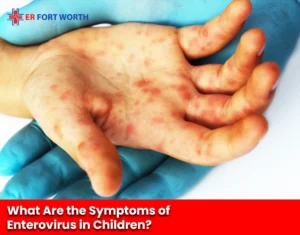
Enterovirus symptoms in children usually start the way any cold does, fever, runny nose, sore throat, maybe a cough that hangs around. Where it gets more specific is the rash. Coxsackievirus, one of the enteroviruses in this family, causes the blistery mouth sores and hand-and-foot rash known as hand, foot, and mouth disease, and that pattern alone can point a pediatrician toward enterovirus over rhinovirus.
What actually matters isn’t the name on the report, it’s how the child is doing. Fussy and feverish but drinking fluids and mostly acting like themselves between fever spikes? That’s the pattern behind most enterovirus symptoms in children, and it clears up the same way a cold does: time, fluids, and rest. Vomiting or diarrhea that won’t stop, a rash that’s spreading fast, or a kid who won’t wake up easily is a different story, covered in the red-flag section below.
Is Rhinovirus Enterovirus the Same as RSV?
No, and it’s worth spelling out, since RSV gets so much of the headline attention every fall. RSV is a separate virus that tends to hit the lower respiratory tract harder, which is why it’s more associated with bronchiolitis and pneumonia in infants. Rhinovirus and enterovirus usually stay milder and higher in the airway, though EV-D68 is a notable exception that can cause serious breathing trouble, especially in kids with asthma.
The tricky part? Early symptoms overlap enough that you genuinely can’t tell RSV, rhinovirus, and enterovirus apart just by looking at a feverish, congested kid. That’s exactly why combined respiratory panels test for all three, plus flu and COVID, at once. Testing, not guessing, is the only way to know which virus you are actually dealing with.
How Is Rhinovirus Enterovirus Treated?

Here’s the honest answer: there’s no antiviral and no vaccine for most rhinovirus/enterovirus infections, so Human rhinovirus/enterovirus treatment means managing symptoms while the body clears the virus on its own. That’s fluids, rest, fever and pain control by category, and humidified air to ease congestion and coughing.
For most people, kids included, that’s the whole plan, and it works. Watch for what doesn’t fit that pattern: breathing that gets harder instead of easier, a fever that won’t break, or symptoms getting worse on day five instead of better. That’s when Human rhinovirus/enterovirus treatment stops being a home project and starts being an ER conversation.
Rhinovirus Or Enterovirus in Babies and Young Children
Human rhinovirus/enterovirus in babies is a genuinely different situation than the same infection in an older kid, and it comes down to one number: three months. An infant under three months old with any fever, even 100.4°F, even if they otherwise seem fine, needs to be seen, full stop. Their immune systems haven’t caught up yet, and a fever that would be a non-event in a five-year-old can be the only sign of something that needs same-day evaluation in a newborn.
Beyond that threshold, Human rhinovirus/enterovirus treatment in babies looks a lot like it does for anyone else, fluids, rest, fever control, humidified air, but the watch list is tighter. Fewer wet diapers, a soft spot that looks sunken or bulging, or a baby who’s harder than usual to wake up all move a routine cold into “come get checked” territory. Fort Worth families dealing with a daycare bug that won’t quit should treat that under-three-months line as non-negotiable, not a suggestion.
What Does a “Rhinovirus Or Enterovirus Positive” Test Result Mean?
If you are holding a report that says “Rhinovirus/enterovirus positive,” here’s what’s actually going on: most multiplex respiratory PCR panels use the same probe for both viruses because they’re genetically close enough that quickly telling them apart isn’t practical. The lab isn’t being vague on purpose, most standard panels genuinely can’t distinguish rhinovirus from enterovirus.
So how serious is rhinovirus/enterovirus based on that result alone? Less than you’d think. A positive result doesn’t tell you which of the two viruses it is, and it definitely doesn’t predict how sick someone will get. What matters more is the person in front of you, how they’re breathing, how they’re feeding or drinking, how alert they are, not the four words printed on the report.
One data point worth knowing: in a peer-reviewed pediatric study comparing rhinovirus/enterovirus to other respiratory viruses in hospitalized children, RV/EV infections showed a severity profile broadly comparable to other common respiratory viruses in the same age group. That’s reassuring context, not a green light to skip evaluation if your child actually looks sick.
Rhinovirus/Enterovirus in Adults
Rhinovirus/enterovirus in adults is almost always milder and shorter than it is in kids, mostly because adult immune systems have already met dozens of versions of both viruses. A few days of congestion, sore throat, and fatigue is the typical course, and most adults never need anything beyond fluids and rest.
Human rhinovirus Or enterovirus contagious periods run about as long as any cold, roughly a week for respiratory spread, though enterovirus can shed in stool for weeks afterward. Adults with asthma, COPD, a weakened immune system, or who are pregnant are the exception worth a closer look, since the same infection that’s a mild nuisance for a healthy adult can trigger a genuine flare in someone with underlying lung disease.
Can Rhinovirus Or Enterovirus Cause Meningitis?
Rhinovirus enterovirus meningitis is a real, if uncommon, complication, and it’s specifically an enterovirus issue, not a rhinovirus one. Non-polio enteroviruses are a recognized cause of viral meningitis, an infection of the tissue covering the brain and spinal cord.
This isn’t a self-diagnosis checklist, it’s a list of signs to have evaluated, not signs to search and reassure yourself about. A stiff neck, a severe headache that doesn’t respond to usual pain relievers, unusual drowsiness or trouble waking up, confusion, or sensitivity to light are what separate a routine case from one that needs to be looked at now. Most enterovirus infections never go anywhere near meningitis, but when those specific signs show up, that’s not a wait-and-see situation.
When Rhinovirus Or Enterovirus Symptoms Need More Than Home Care
Most rhinovirus/enterovirus cases genuinely don’t belong here, this list isn’t meant to turn every cold into an ER visit. It’s meant to flag the smaller, real subset of cases where waiting it out isn’t the right call.
Come in for evaluation if:
- Trouble breathing, wheezing, or fast breathing at rest, especially in a child with asthma
- Any fever in an infant under three months old, regardless of how mild other symptoms seem
- A stiff neck, severe headache, unusual drowsiness, confusion, or sensitivity to light
- Signs of dehydration, dizziness, very little urination, no tears when crying, confusion
- Symptoms getting rapidly worse instead of plateauing or improving
- A known underlying condition (asthma, COPD, immune compromise) with new or worsening respiratory symptoms
- Bluish lips or face, or chest pain
Any single item on that list is reason enough to come in, you don’t need several of them stacked up before it’s worth getting seen.
This is probably fine to manage at home if:
- Symptoms are mild and the person is drinking fluids normally
- No fever in an infant under three months old
- Symptoms are improving or holding steady, not worsening
- No underlying breathing or immune condition
That combination describes most rhinovirus/enterovirus cases that come through a Fort Worth ER waiting room every fall and winter, which is exactly why we don’t push every case through the same funnel.
If any of the above apply, come to ER of Fort Worth. We can evaluate breathing, check for signs of meningitis, and get you real answers, open 24 hours a day, 7 days a week. No appointment. No referral needed.
What Happens at Our Fort Worth ER for Severe Respiratory Infection Treatment
Across Tarrant County, respiratory season runs long, and rhinovirus/enterovirus results show up on local lab reports right alongside RSV, flu, and COVID all winter. Whether you are coming from Burleson, Keller, Mansfield, or Crowley, our ER is minutes away and set up for exactly this kind of visit, not a multi-day wait for answers.
If you are searching for severe respiratory infection treatment near me, here’s the actual visit: a breathing and symptom assessment, on-site testing so you are not waiting days for lab results, and a clear plan, whether that’s a same-day discharge with home-care instructions, or, in the smaller number of cases that need it, further treatment. We are not trying to turn a cold into a production, we are trying to give Fort Worth families a real answer instead of a guess.
Testimonial 1: Rhinovirus or Enterovirus
[“When my child’s test came back positive for rhinovirus or enterovirus, I was worried because I didn’t really understand what the result meant. We brought them to ER of Fort Worth for an evaluation, and the medical team explained the result and checked their symptoms carefully. By the time we left, we had a much clearer understanding of what was happening and a home-care plan for the next steps.”]
Testimonial 2: Rhinovirus or Enterovirus
[“I initially thought my symptoms might just be a rhinovirus or enterovirus infection, but when I developed a concerning symptom, including difficulty breathing, I decided not to wait it out. I went to ER of Fort Worth to be evaluated. The team assessed my symptoms, explained what they found, and helped me understand what to watch for at home and when to seek additional care.”]
What to Do Next
The short answer is this: most rhinovirus/enterovirus results mean a bad cold and a few days of home care. For the smaller group with real red flags, our Fort Worth ER team is ready when you are, 24/7, no appointment needed, with on-site testing and real answers the same day. You can also handle check-in online before you even leave the house, so your visit starts the moment you walk in.
Frequently Asked Questions
Is rhinovirus enterovirus serious?
Usually not. Most rhinovirus/enterovirus infections are mild colds that clear up with rest and fluids. A smaller subset, mainly infants under three months, kids with asthma, and cases involving meningitis symptoms, can be serious and needs evaluation. How the person is doing matters more than the test result alone.
Is rhinovirus very contagious?
Yes. Rhinovirus spreads easily through respiratory droplets and contaminated surfaces, and it can survive on hard surfaces for hours. Good hand hygiene and disinfecting shared surfaces are the most effective ways to limit spread, especially in households with young children or daycare exposure.
How is rhinovirus enterovirus treated?
There’s no antiviral or vaccine for most cases, so treatment is supportive: fluids, rest, fever and pain control by category, and humidified air. Most people recover within one to two weeks without any specific medical treatment beyond managing symptoms at home.
Is rhinovirus enterovirus the same as RSV?
No. RSV is a separate virus that more often affects the lower respiratory tract in infants, while rhinovirus and enterovirus usually stay milder and higher in the airway. Symptoms overlap enough early on that testing, not guessing, is the only reliable way to tell them apart.
What does a rhinovirus/enterovirus positive test result mean?
It means the panel detected one of two closely related viruses but can’t specify which, since most tests use the same probe for both. A positive result alone doesn’t predict severity, how the patient is actually doing, especially breathing and alertness, matters far more than the label on the report.
What should I do about a baby with a positive rhinovirus/enterovirus result?
Any fever in an infant under three months old needs evaluation, regardless of how mild other symptoms look. For older babies, watch feeding, wet diapers, and alertness, fewer wet diapers or unusual drowsiness are reasons to get checked rather than wait it out.
What are the symptoms of rhinovirus/enterovirus in adults?
Typically a short, mild illness, congestion, sore throat, cough, and fatigue for a few days. Adults with asthma, COPD, a weakened immune system, or who are pregnant should watch more closely, since underlying conditions can turn a mild infection into a bigger flare-up.