TL, DR
- Swine flu (H1N1) is one type of influenza A, not a separate illness. Influenza A also includes H3N2.
- Symptoms usually start about two days after infection, and most people recover in a few days to under two weeks.
- Call 911 for severe symptoms, like trouble breathing or persistent chest pain. Most flu can be managed at home.
- Antiviral drugs work best when started within one to two days, so people at higher risk should call a clinician early.
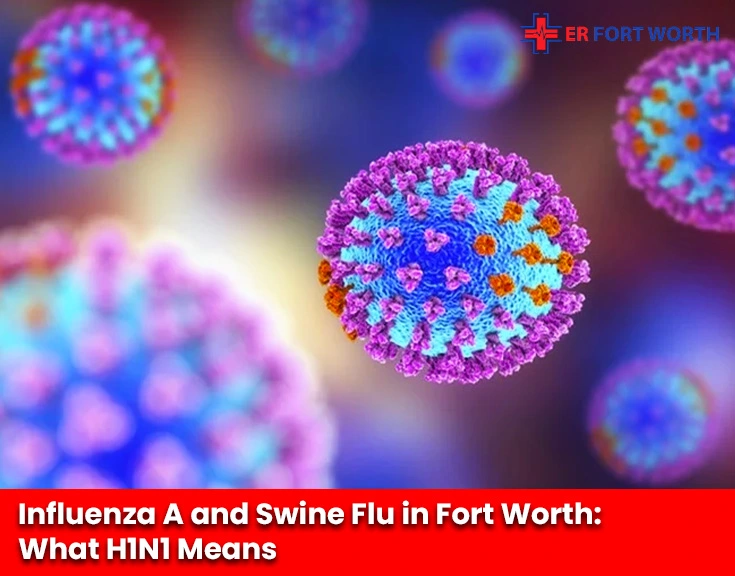
Influenza A and swine flu aren’t two different illnesses. Swine flu, or H1N1, is one subtype of influenza A, and influenza A also includes other subtypes, like H3N2.
The 2009 pandemic virus earned the “swine” nickname because it carried genes from flu viruses that normally infect pigs, mixed with bird and human flu genes. Flu hasn’t been shown to spread through properly handled, cooked pork.
Most flu can be managed at home. If you are not sure how sick you are, or you are at higher risk, our ER Of Fort Worth team offers flu treatment in Fort Worth. Read on for what to watch for and when to call 911.
Is swine flu the same as influenza A?
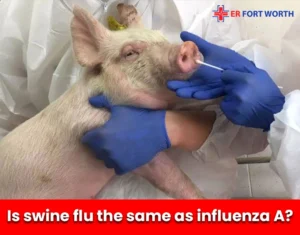
Swine flu (H1N1) is one type of influenza A, so it’s part of that family but not the whole family. Influenza A also includes other subtypes, like H3N2. Think of influenza A as the group and H1N1 as one member. Here’s how the pieces fit together.
- Influenza viruses come in four types: A, B, C and D. Types A and B cause the seasonal flu epidemics we see each winter.
- Influenza A is split into subtypes. Two routinely circulate in people: A(H1N1) and A(H3N2).
- A(H1N1)pdm09 is the 2009 pandemic virus. It has circulated seasonally since 2009, and today’s H1N1 viruses descend from it.
- A(H3N2) is the other subtype in circulation.
- Variant viruses (like H1N1v or H3N2v) are pig flu viruses found in people. They get a “v” added to the name.
- Influenza B has no subtypes. It has two lineages, Victoria and Yamagata, and Yamagata hasn’t been detected since March 2020.
- Influenza A is split into subtypes. Two routinely circulate in people: A(H1N1) and A(H3N2).
Before 2009, an older seasonal H1N1 virus circulated. The 2009 virus got its own name, A(H1N1)pdm09, to tell the two apart.
Why is it called swine flu?
In 2009, a new H1N1 virus spread between people around the world. Scientists found it carried genes from flu viruses that normally infect pigs, plus bird and human flu genes. The name “swine flu” stuck. Today CDC calls it A(H1N1)pdm09 and treats it as a regular seasonal flu virus.
Can you get swine flu from eating pork?
Flu hasn’t been shown to spread through properly handled, cooked pork. Variant flu usually reaches people through close contact with infected pigs, such as at agricultural fairs or on farms. Normal food safety rules still apply, and CDC points people to USDA guidance for handling pork safely.
What is variant swine flu?
Variant flu happens when a flu virus that normally spreads in pigs infects a person. It’s uncommon, usually mild, and mostly linked to contact with pigs. Person-to-person spread is rare. Seasonal flu shots aren’t designed to protect against variant viruses, and the same antiviral drugs used for seasonal flu are recommended.
Most cases have happened in children, often after time near pigs at fairs. CDC has guidance for fair exhibitors and organizers, including for people at higher risk of flu complications. It also recommends a seasonal flu shot for people who have contact with pigs.
Swine flu symptoms
Flu symptoms usually come on suddenly. Common ones include fever or chills, cough, sore throat, runny or stuffy nose, body aches, headache and tiredness. Not everyone gets a fever. Vomiting and diarrhea can happen, and they’re more common in children than adults.
Illness from variant flu has mostly been mild, with symptoms like seasonal flu. A high or lingering fever can feel scary. If you want help sorting it out, see our page on fever treatment in Fort Worth.
What causes swine flu, and how does it spread?

Influenza viruses cause flu. They spread mainly through droplets when someone with flu coughs, sneezes or talks. Less often, you can pick up the virus from a surface and then touch your mouth, nose or eyes. Seasonal flu is caused by influenza A or B viruses.
How long is swine flu contagious?
People with flu can spread the virus starting about one day before symptoms and up to five to seven days after getting sick. They are most contagious in the first three days. Young children and people with weakened immune systems may stay contagious longer.
Swine flu incubation period
The incubation period for flu is usually about two days. Symptoms can start one to four days after infection. That’s CDC’s timing for seasonal flu, which includes H1N1. You can spread the virus about a day before you feel sick. Plan around it if someone at home is ill.
Swine flu recovery period
Most people with flu recover in a few days to less than two weeks. Fever commonly lasts three to four days. You can go back to normal activities once your symptoms have been getting better for 24 hours and you haven’t had a fever, without using fever-reducing medicine.
After that, CDC advises extra precautions for five days, like good hygiene, cleaner air, a well-fitted mask, distance or testing around others. If you get a fever or feel worse, stay home again.
Warning signs: when to call 911 or get emergency care
Most flu can be managed at home, but some symptoms are emergencies. Call 911 for severe symptoms like trouble breathing, persistent chest pain, confusion or a seizure. For other warning signs on these lists, get medical care right away. CDC says the lists aren’t complete, so trust your instincts too.
If breathing is hard, you need emergency care for shortness of breath. For anything else on these lists, our emergency services are available.
In adults:
- Trouble breathing or shortness of breath
- Persistent pain or pressure in the chest or abdomen
- Persistent dizziness, confusion, or being hard to wake
- Seizures
- Not urinating
- Severe muscle pain
- Severe weakness or unsteadiness
- Fever or cough that improves, then returns or gets worse
- Worsening of a chronic medical condition
In children:
- Fast or hard breathing
- Bluish lips or face
- Ribs pulling in with each breath
- Chest pain
- Severe muscle pain (refuses to walk)
- Dehydration: no urine for 8 hours, dry mouth, no tears when crying
- Not alert or interacting when awake
- Seizures
- Fever above 104°F not controlled by fever-reducing medicine
- Any fever in a child younger than 12 weeks
- Fever or cough that improves, then returns or gets worse
- Worsening of a chronic medical condition
Fine to manage at home if:
- Your symptoms are mild to moderate and slowly improving.
- You’re drinking fluids and urinating normally.
- None of the warning signs above apply.
- You’re not in a higher-risk group, or you’ve already talked to a clinician.
Call 911 for severe symptoms. Not sure whether something needs emergency care? Call us at 817-945-4200
Who’s at higher risk of serious flu complications?
Some people are more likely to get serious flu complications. CDC lists adults 65 and older, children younger than 5 (especially under 2), pregnant women, and people with chronic conditions or weakened immune systems. If you’re in one of these groups and get flu symptoms, call a provider early.
CDC’s list also includes asthma, chronic lung disease, heart disease, diabetes, kidney or liver disorders, neurologic conditions, blood disorders, stroke, a BMI of 40 or higher, and nursing-home residence. Pregnancy counts through two weeks after delivery. In recent seasons, 9 out of 10 people hospitalized with flu had an underlying condition. Young children need extra attention. See our pediatric care page.
What complications can flu cause?
Flu can lead to complications, especially in people at higher risk. Sinus and ear infections are moderate. Pneumonia is serious and can come from flu alone or from flu plus a bacterial infection. Flu can also make chronic conditions like asthma or heart disease worse. Learn more about pneumonia care if you’re worried about a cough that won’t improve.
Swine flu treatment
Treatment depends on how sick you are and your risk level. Most people at home need rest, fluids and symptom relief. Prescription antiviral drugs can shorten illness by about a day and work best when started within one to two days of symptoms. Antibiotics don’t treat flu.
Antiviral drugs
Antiviral drugs are prescription medicines that treat flu. CDC recommends four: oseltamivir, zanamivir, peramivir and baloxavir marboxil. They can ease symptoms and shorten illness by about a day. They work best when started within one to two days, but starting later can still help people who are higher risk or hospitalized.
- CDC says treatment should start as soon as possible for people who are hospitalized, very sick, or at higher risk. Mild illness in people who aren’t higher risk may also be treated, but most don’t need it.
- You can only get them with a prescription. COVID-19 antivirals don’t treat flu.
- In pregnancy, CDC recommends oseltamivir. Baloxavir isn’t recommended during pregnancy or breastfeeding.
- Your clinician decides which medicine fits and how to take it.
Urgent care vs ER for flu
Call 911 for severe symptoms. Go to an ER for the emergency warning signs above. Milder flu, especially if you’re at higher risk and want to ask about antivirals, can often be handled by a primary care doctor or urgent care visit. Most flu can be managed at home.
| Your situation | Where to go |
|---|---|
| Trouble breathing, seizure, confusion, persistent chest pain | Call 911 |
| Any other emergency warning sign in this article | ER, right away |
| Higher risk with flu symptoms, or unsure how sick you are | Contact a clinician early |
| Mild symptoms, drinking fluids, improving | Home care |
Influenza A vs Influenza B vs H1N1 vs H3N2 vs COVID-19
These five terms get mixed up a lot. Influenza A and B are types of flu virus. H1N1 and H3N2 are subtypes of influenza A. COVID-19 isn’t flu at all; a different virus, SARS-CoV-2, causes it. This table lays out the main differences.
| What it is | Key facts | In the 2026-27 flu shot? | |
|---|---|---|---|
| Influenza A | A flu virus type | Has subtypes. The only type known to cause pandemics. | Yes (H1N1 and H3N2 parts) |
| Influenza B | A flu virus type | No subtypes, two lineages. Changes more slowly than A. | Yes (B/Victoria part) |
| H1N1 | A subtype of A | Today’s viruses descend from the 2009 pandemic virus. | Yes (A(H1N1)pdm09-like) |
| H3N2 | A subtype of A | Changes faster than other seasonal flu viruses. | Yes (updated this year) |
| COVID-19 | Different illness (SARS-CoV-2) | Symptoms can take longer to start. Contagious for longer. | No (separate vaccines) |
Flu vs COVID-19 vs RSV
You can’t tell flu from COVID-19 by symptoms alone, because many of them overlap. A test is needed to confirm which one you have. Getting the right diagnosis matters because the treatments differ, and flu antiviral drugs don’t treat COVID-19. RSV is a third common respiratory virus.
Flu symptoms typically start one to four days after infection. COVID-19 symptoms typically start two to five days after infection, and up to 14 days.
Swine flu vaccine
The 2026-27 flu vaccines are designed to protect against three viruses: an H1N1 virus related to the 2009 pandemic virus, an H3N2 virus and a B/Victoria virus. All three parts were updated this year. CDC says everyone 6 months and older should get a flu vaccine every year. It doesn’t protect against variant swine flu viruses.
The H3N2 update targets the subclade K virus that spread widely last season.
Influenza A and swine flu in Fort Worth and Tarrant County
Flu activity was rising across Texas. In the week ending October 10, 2026, about 9% of flu tests at Texas hospital labs were positive, and nearly all positives were influenza A. Among the influenza A samples that were subtyped, every one was H1N1. Numbers change every week, so check the latest report.
Only about 18% of influenza A samples were subtyped, so this doesn’t prove H1N1 dominates. No variant flu infections and no pediatric flu deaths had been reported in Texas this season as of that week.
ER of Fort Worth is at 4561 Heritage Trace Parkway, Suite 117, Fort Worth, Texas, 76244 . Phone: 817-945-4200 . Hours: 24/7. On-site flu testing: Available. Neighbors in the area can also see emergency services near Keller, TX and Southlake emergency care.
What happens at an ER visit for flu symptoms
When you come in with flu symptoms, a clinician evaluates you and decides what care fits. Depending on your symptoms, that can include flu treatment, blood tests, or treatment for complications such as pneumonia. Testing options and wait times depend on your situation.
You can save time with online check-in.
If you are sent home, follow your discharge instructions. If your symptoms improve and then return worse, or any warning sign appears, call 911 for severe symptoms or come back for care.
What patients say
Hearing from other patients can help you know what to expect at an emergency visit for flu. Each experience is different, and these stories reflect individual cases, not guarantees of any result. Please read them as personal experiences, not medical advice.
“I was experiencing a high fever, body aches, chills, and severe fatigue that made it difficult to manage my daily activities. I decided to seek emergency care because my flu symptoms were getting worse. The medical team evaluated my symptoms, explained the testing process, and discussed the appropriate treatment options. Having access to emergency care in Fort Worth made the experience less stressful.”
— Michael R.
“When my child developed a high fever, persistent coughing, and extreme tiredness, I became concerned that it could be more than an ordinary seasonal flu. We visited the emergency room in Fort Worth for an evaluation. The medical team assessed my child’s condition, explained the findings, and discussed the next steps for care. Having medical professionals evaluate my child during a worrying time gave me greater peace of mind.”
— Sarah L.
When to get care for swine flu symptoms
If you or your child has emergency warning signs, call 911 right away. Most flu can be managed at home, and many people don’t need an ER visit. If you are at higher risk, or you are not sure how sick you are, contact a clinician early, since antivirals work best within one to two days.
ER of Fort Worth: https://eroffortworthtx.com/ Call: 817-945-4200
Frequently asked questions
How can I protect the people I live with while I’m sick?
CDC advises staying home and away from others, including people you live with who aren’t sick. If you can’t stay in a separate space, you can use extra tools, such as cleaner air, good hygiene, physical distance and a well-fitted mask, to help protect them. Take extra care around anyone at higher risk.
Do antibiotics help with swine flu?
No. Flu is caused by a virus, and antibiotics treat bacterial infections. CDC says antibiotics won’t help when they aren’t needed, and their side effects can still cause harm. A clinician can tell you if you have a separate bacterial infection, such as bacterial pneumonia, that needs a different treatment.
Do healthy adults need antiviral drugs?
Most don’t. CDC says people with mild flu who aren’t at higher risk may be treated with antivirals, but most don’t need them. Treatment is a stronger priority for people who are hospitalized, very sick, or at higher risk. If you’re unsure which group you’re in, ask a clinician early.
Can children take flu antiviral drugs?
Yes, depending on the medicine and the child’s age. CDC recommends oseltamivir for treating flu in children from birth, and the American Academy of Pediatrics recommends it from 2 weeks old. Other antivirals are approved for older ages. A child’s clinician decides which one fits and how to take it.
How is variant swine flu diagnosed?
A test can diagnose variant flu. State health departments can test for novel flu viruses, and if a variant virus is suspected, a respiratory sample is also sent to CDC for confirmation. Symptoms look similar to seasonal flu, so tell your clinician if you’ve been around pigs.
Is today’s H1N1 the same virus as the pre-2009 H1N1?
No. The 2009 pandemic virus got its own name, A(H1N1)pdm09, to separate it from the seasonal H1N1 viruses that circulated before the pandemic. The H1N1 viruses spreading now are descendants of the 2009 virus, and they’ve changed genetically over time. That’s why the shot includes an H1N1 part.
Can I have flu and COVID-19 at the same time?
It’s uncommon, but it can happen. CDC says people with both illnesses at the same time can have more severe illness than people with either one alone. A test that checks for both can help you get the right diagnosis and treatment sooner.