Reviewed by the emergency care team at ER of Fort Worth | 4561 Heritage Trace Pkwy, Suite 117, Fort Worth, TX 76244 | +1 817-945-4200
Call 911 immediately: For chest tightness with pain radiating to the arm, jaw, or back, cold sweat, shortness of breath that will not ease, nausea with chest pain, or fainting. When in doubt about sudden chest tightness anxiety vs heart, treat it as cardiac and call 911.
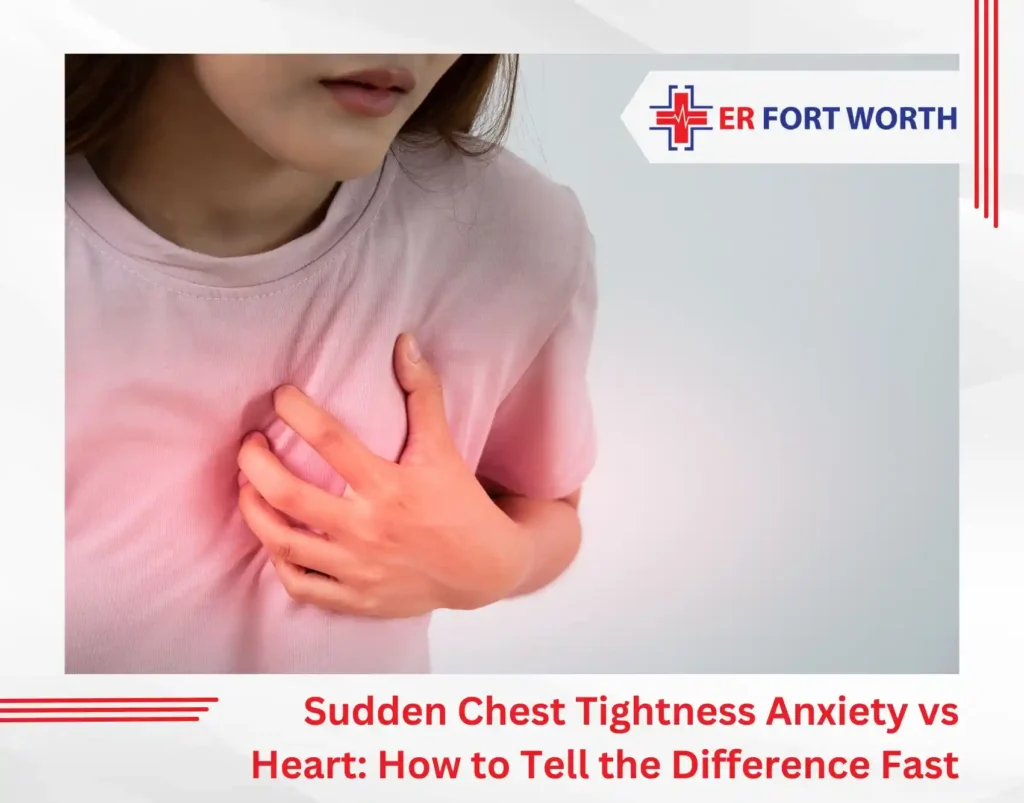
Sudden chest tightness anxiety vs heart is one of the hardest symptom comparisons to make at home. Both can feel almost identical: tight chest, racing pulse, shortness of breath, impending doom. The stakes are the real difference. A missed panic attack is uncomfortable. A missed heart attack is deadly.
Below is a symptom-by-symptom side-by-side guide, plus a 60-second self-check you can use when it happens. If any red flag applies, come straight to our Fort Worth ER.
Why Is Sudden Chest Tightness So Hard to Diagnose at Home?
Anxiety and cardiac events share many symptoms because they both trigger the body’s fight-or-flight response. Adrenaline floods the system, the heart beats faster, breathing speeds up, and the chest feels tight. The nervous system reacts the same way whether the alarm is emotional or physical, which is exactly what makes sudden chest tightness anxiety vs heart so hard to call.
The result: panic attack vs heart attack signs overlap by about 70 to 80 percent in the first minute. Only exam, EKG, and blood work reliably separate them.
The Mayo Clinic confirms that panic attacks can mimic heart attack symptoms so closely that even experienced patients cannot tell them apart without medical testing. This is why same visit EKG at the ER is the standard of care.
Symptom-by-Symptom: Anxiety vs Heart
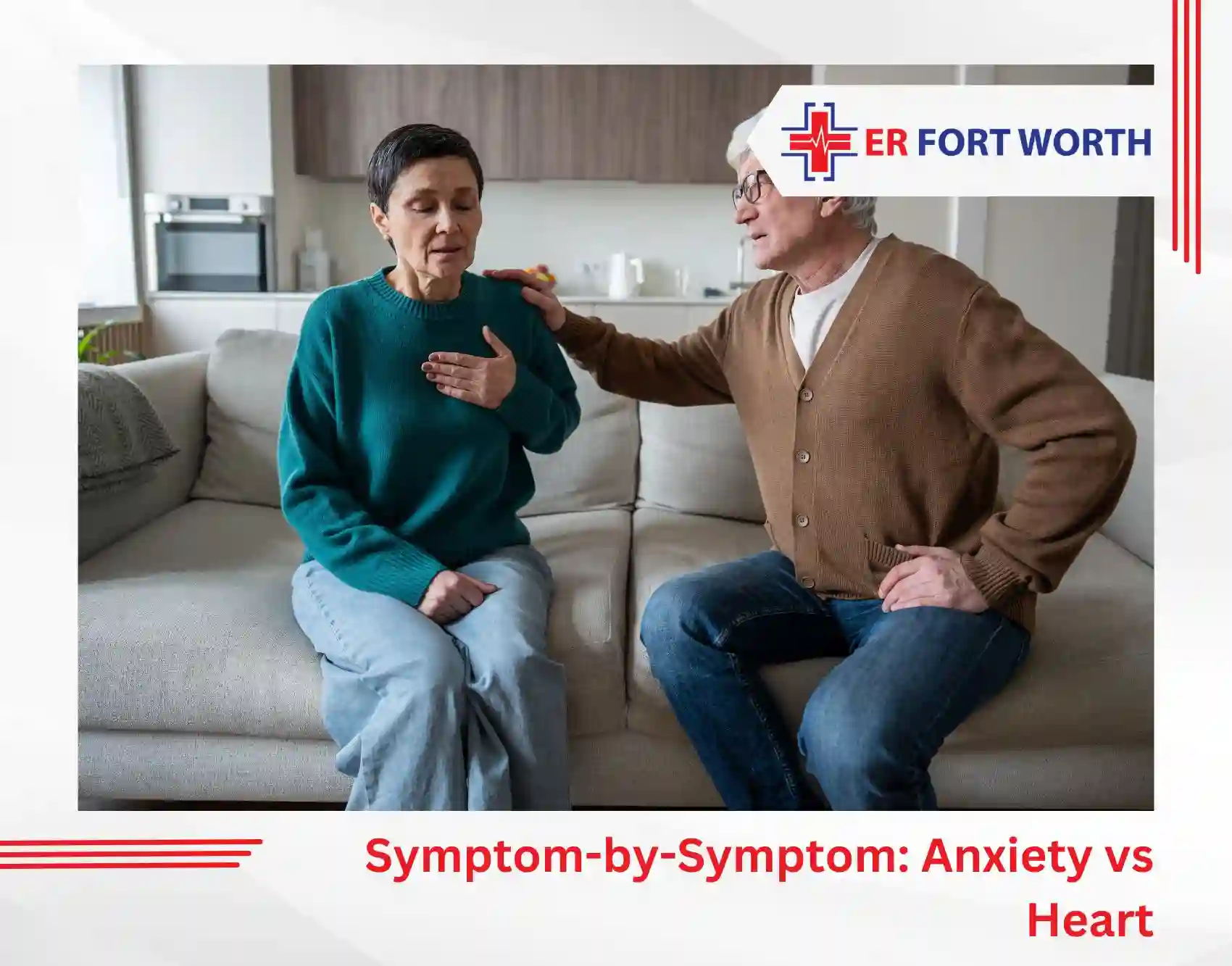
Here is how each symptom typically differs between an anxiety episode and a cardiac event. These are patterns, not guarantees. When in doubt, come in.
| Symptom 1: Onset | |
| Anxiety or Panic Attack | Heart Attack |
| Builds quickly during stress, often with no physical trigger. Peaks within 10 minutes. Can start out of nowhere, especially while at rest. | Comes on with physical exertion, emotional stress, or at rest. Builds steadily. Often lasts beyond 10 to 15 minutes. |
| Symptom 2: Pain Character | |
| Anxiety or Panic Attack | Heart Attack |
| Sharp, stabbing, or fluttery. Stays in the center of the chest. Changes with breathing or body position. Can feel electric or buzzing. | Dull pressure, squeezing, or heavy weight on the chest. Does not change with breathing or position. Classically described as an elephant sitting on the chest. |
| Symptom 3: Where It Spreads | |
| Anxiety or Panic Attack | Heart Attack |
| Pain usually stays localized in the chest. Occasionally spreads to the hands as tingling from hyperventilation. | Pain radiates to the left arm, jaw, neck, back, or upper belly. Any radiation pattern is a major red flag. |
| Symptom 4: Associated Symptoms | |
| Anxiety or Panic Attack | Heart Attack |
| Trembling, numbness in hands or lips (from fast breathing), feeling detached, intense fear, dizziness, tingling. Resolves fully within 20 to 30 minutes. | Cold sweat, nausea or vomiting, shortness of breath that does not ease, extreme fatigue, bluish lips, fainting. Does not resolve on its own. |
| Symptom 5: Response to Calming | |
| Anxiety or Panic Attack | Heart Attack |
| Slow breathing, grounding techniques, and reassurance usually ease symptoms within 10 to 30 minutes. | Does not improve with rest or breathing exercises. May get worse. Symptoms persist or escalate until medical treatment is received. |
A classic anxiety chest pain symptoms pattern tends to fade with calming. Cardiac chest tightness holds or worsens. If calming does not help within 15 minutes, treat it as cardiac.
The 60-Second Self-Check
Use this quick mental checklist when sudden chest tightness anxiety vs heart confusion strikes. If you answer YES to any question, treat the situation as cardiac and head to the ER.
Question 1: Is the pain radiating?
YES to arm, jaw, neck, back, or upper belly means ER now. Radiating pain is a classic cardiac feature that anxiety almost never produces.
Question 2: Is there cold sweat?
YES means ER now. Cold clammy sweat with chest tightness is a cardinal cardiac sign, especially in women. Anxiety can cause sweating, but it is usually warm nervous sweat.
Question 3: Does breathing deeply change the pain?
NO (pain does not change) is a cardiac red flag. Anxiety-driven chest tightness often improves with deep slow breathing. Cardiac pain is unaffected.
Question 4: Does the pain persist beyond 15 minutes of calming?
YES means ER. Panic attacks typically peak within 10 minutes and resolve by 20 to 30. Lasting chest tightness past 15 minutes points away from anxiety.
Question 5: Any known heart disease, high blood pressure, diabetes, or smoking history?
YES raises cardiac probability substantially. Risk factors matter. If any apply and chest tightness is new or severe, do not try to decide at home.
Two or more YES answers: Call 911 or come directly to the ER. The cost of being wrong about anxiety is a missed heart attack. The cost of being wrong about cardiac is a few hours of observation.
Why Waiting Out Chest Tightness Is Never Safe
Heart muscle starts to die within 20 to 40 minutes of a blocked artery. The faster the clot is opened, the more muscle survives. Delay converts a survivable event into a disabling or fatal one.
Anxiety treatment, by contrast, has no time pressure. If you come in for anxiety and get an EKG that is normal, nothing is lost. If you stay home with a heart attack and lose heart muscle, nothing can be undone. This asymmetry is why doctors tell patients that when chest tightness is cardiac, waiting even an hour matters.
The Cleveland Clinic emphasizes that the only reliable way to distinguish panic from cardiac events in the moment is professional evaluation. Patients should never try to decide at home when red flag signs are present.
Women often present differently than men. Our guide on chest pain in women covers the atypical presentation that leads to missed diagnoses in female patients.
Who Faces the Highest Cardiac Risk Behind Chest Tightness?
When chest tightness is cardiac, risk factors often provide the first clue. Some groups should default to ER evaluation rather than home self-check.
- Adults over 45 (men) or 55 (women): Baseline cardiac risk rises with age
- Known high blood pressure, diabetes, or high cholesterol: All raise arterial disease risk
- Current or former smokers: Smoking narrows and damages arteries
- Family history of heart attack before age 55 (men) or 65 (women): Strong genetic component
- People who are overweight or sedentary: Multiple cardiac risk factors stack
- Patients with chronic kidney disease or inflammatory conditions: Both raise cardiac risk independently
Older adults have a particularly high rate of silent or atypical cardiac events. Our guide on chest pain in older adults walks through the specific patterns to recognize.
What Happens at ER of Fort Worth for Sudden Chest Tightness?
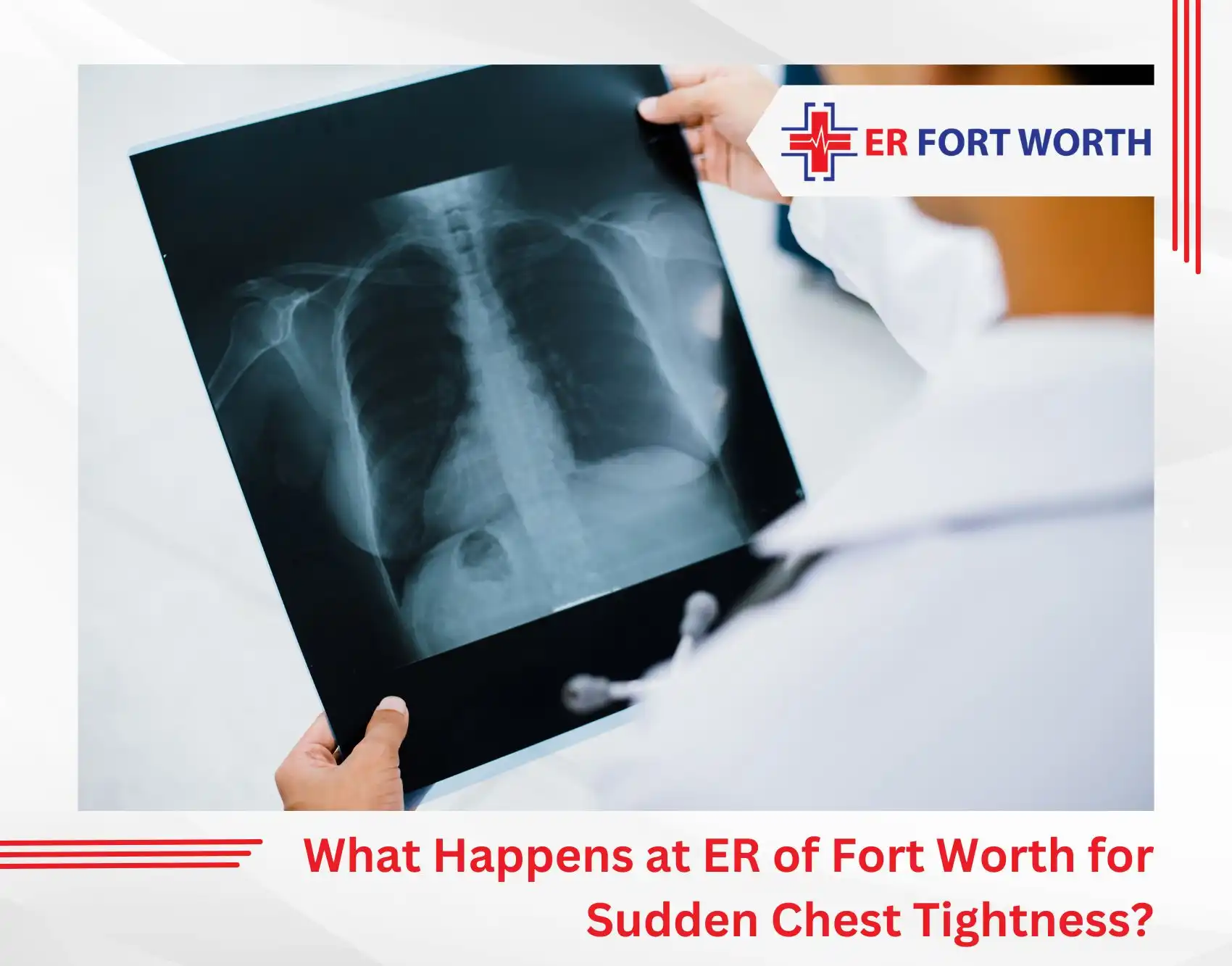
At ER of Fort Worth, evaluation for sudden chest tightness anxiety vs heart starts with an EKG within minutes of arrival. Our team runs same visit cardiac enzymes, chest imaging, and a focused physical exam to confirm or rule out cardiac causes before anxiety becomes the diagnosis.
Immediate workup
- 12-lead EKG within minutes
- Continuous cardiac monitoring
- Vital signs and oxygen saturation
- IV access and clinical exam
Same visit lab and imaging
- Troponin and cardiac enzyme tests
- Complete blood count and metabolic panel
- Chest X-ray to rule out lung causes
- D-dimer when pulmonary embolism is a concern
Most patients get definitive answers within an hour. If a cardiac event is confirmed, our board certified emergency physicians stabilize the patient and coordinate direct hospital transfer for catheterization or admission. If anxiety is the diagnosis, we offer calming support, referrals, and discharge planning.
For patients whose chest tightness comes with breathing changes after meals or asthma triggers, our guides on shortness of breath after eating and severe asthma attack cover related non cardiac causes we also evaluate.
Walk in for evaluation: ER of Fort Worth is open 24/7 for sudden chest tightness with same visit EKG, troponin, imaging, and cardiac monitoring. Call +1 817-945-4200 or walk in anytime.
Common Questions
Can anxiety alone cause real chest pain?
Yes. Anxiety chest pain symptoms are physically real due to muscle tension, fast breathing, and chest wall spasm. The sensation is genuine. The problem is that the same sensations can also indicate a heart attack, which only testing can rule out.
How do I know if it’s panic attack vs heart attack when I’m alone?
Alone and in doubt, treat it as cardiac. Call 911. Panic attack vs heart attack decisions should never be made solo at home when any red flag sign is present. The downside of over-caution is only an ER visit.
Can a young person have a heart attack with chest tightness?
Yes, though less common. Young adults with family history, drug use, inherited conditions, or clotting disorders can have heart attacks. When chest tightness is cardiac in a young patient, risk factors are the biggest clue. Sudden chest tightness anxiety vs heart decisions still favor ER evaluation at any age with red flag signs.
What should I do during a panic attack if I’m sure it’s not cardiac?
Slow your breathing to four seconds in, six seconds out. Ground yourself using sight, touch, and sound. If symptoms do not fully resolve within 30 minutes or recur frequently, come in for evaluation.
Does normal EKG rule out a heart attack entirely?
Not always. Some heart attacks only show up on repeat EKG or on troponin blood tests over several hours. If initial testing is normal but your symptoms persist, our team observes and retests before discharge.
Sudden Chest Tightness in Fort Worth? Walk Into Our ER 24/7
Sudden chest tightness anxiety vs heart is never a decision to make alone when red flags are present. Our Fort Worth ER provides same visit EKG, troponin testing, and imaging to confirm or rule out cardiac causes within one hour for most patients. Walk in anytime, no appointment needed.
- Address: 4561 Heritage Trace Pkwy, Suite 117, Fort Worth, TX 76244
- Phone: +1 817-945-4200
- Hours: Open 24 hours, 7 days a week, 365 days a year
- Insurance: Most major commercial plans accepted
- Wait time: Rapid triage with typical door to provider time under 15 minutes
Visit ER of Fort Worth for directions and facility details. Proudly serving Heritage Trace, Alliance, Keller, Watauga, Park Glen, Haslet, Saginaw, North Richland Hills, and surrounding North Fort Worth communities.
Call 911 now: For chest tightness with radiating pain, cold sweat, shortness of breath, nausea, or fainting. Do not drive yourself.
References
1.mayoclinic.org/diseases-conditions/panic-attacks/symptoms-causes/syc-20376021