Reviewed by the emergency care team at ER of Fort Worth | 4561 Heritage Trace Pkwy, Suite 117, Fort Worth, TX 76244 | +1 817-945-4200
Call 911 immediately: For insect bite infection spreading fast with red streaking toward the body, fever above 101 F, chills, confusion, severe swelling of the face or throat, difficulty breathing, or signs of shock. These may indicate sepsis or anaphylaxis.
An insect bite infection spreading fast is one of the most time-sensitive skin emergencies our team sees. What starts as a small red bump can become cellulitis within 24 hours, and in severe cases can enter the bloodstream and cause sepsis.
The good news: a spreading bite follows a predictable pattern you can track at home. Below is the exact method we teach patients, including a simple pen-marker trick that gives our ER team the clearest picture when you arrive.
How Do You Know If an Insect Bite Is Getting Infected?
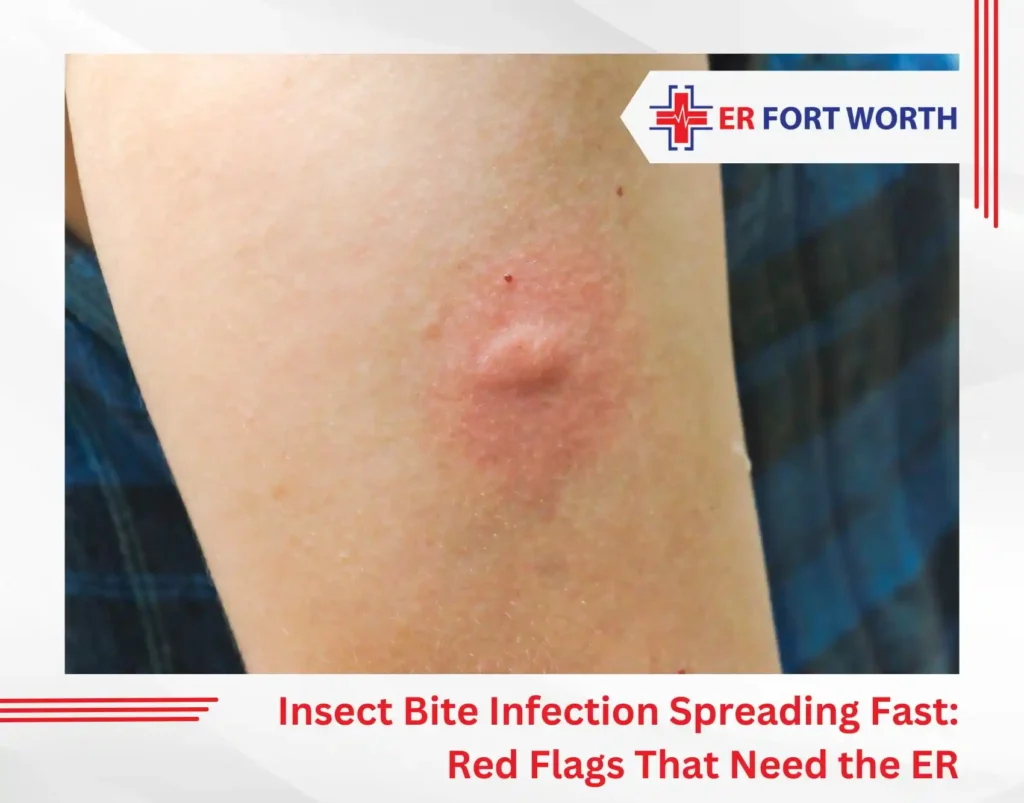
Insect bite infection spreading fast shows a specific pattern. Normal bite reactions peak within 24 to 48 hours and improve from there. Infected bites get worse over 24 to 72 hours and show signs that normal irritation does not.
Signs of infected bug bite
- Redness that expands beyond the original bite over hours
- Pain that increases rather than fades
- Warmth and swelling that keep growing
- Pus, cloudy fluid, or honey-colored crust
- Red streaking lines running away from the bite
- Hard tender lump under the skin (possible abscess)
- Fever, chills, or feeling unwell
- Swollen lymph nodes in the armpit or groin on the same side
According to the American Academy of Dermatology, any bite that becomes painful, red, warm, or oozing after 24 hours should be evaluated by a healthcare professional. Spreading redness is the clearest warning sign that bacteria have moved past the skin surface.
The Red Marker Line Method: Track the Spread in Real Time
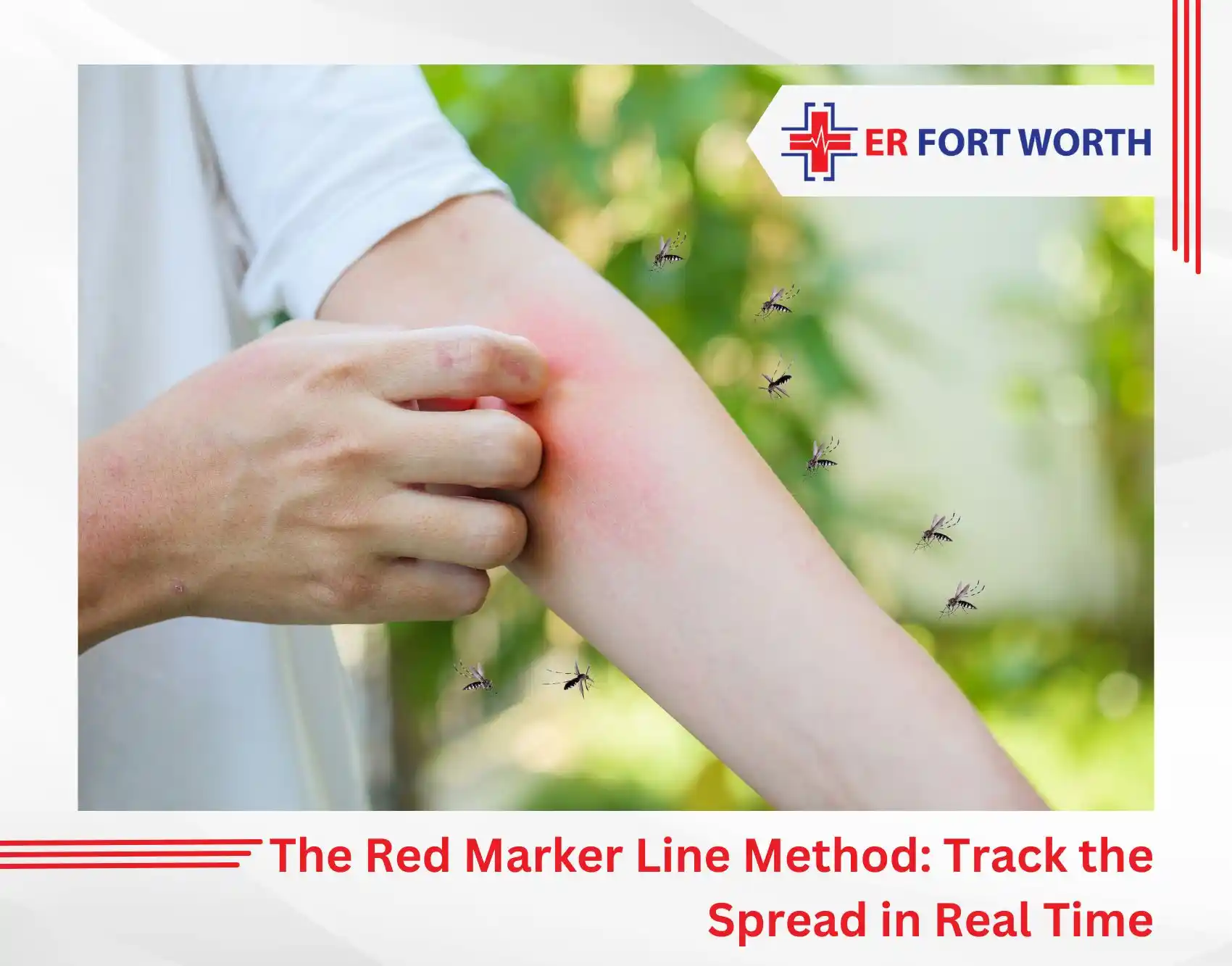
This is the technique we teach patients who are watching a bite at home. It gives our ER team objective evidence of how fast infection is spreading, which affects treatment decisions.
How to do it
- Step 1: Grab a permanent marker, ballpoint pen, or washable marker.
- Step 2: Trace the outer edge of the red area around the bite on the skin.
- Step 3: Write the current time next to the line.
- Step 4: Check back in 1 hour and 2 hours.
- Step 5: If redness expands past the line in that time, come to the ER.
Why this matters: A bite that spreads visibly past the marker in 1 to 2 hours is advancing much faster than the immune system can contain. Red streaking (lymphangitis) and rapid expansion both signal that bacteria are moving into deeper tissue.
Bring your marked skin to the ER if the lines show spread. Photos with timestamps on your phone also help the ER team see the rate of progression.
The 4 Stages of a Spreading Insect Bite Infection
Cellulitis from insect bite follows a predictable progression. Each stage has specific features, and knowing which stage you are at helps decide the next step.
STAGE 1: Normal Bite Reaction (Hours 0 to 24)
Small raised bump, mild itching or burning, redness smaller than a quarter, no fever, resolves on its own. This is immune response doing its job. No ER needed unless allergic reaction or multiple stings cause whole-body symptoms.
STAGE 2: Early Infection (Hours 24 to 48)
Redness larger than a quarter, growing beyond the bite, warmth, increasing pain, possible pus or crusting. No fever yet but the bite is clearly worse rather than better. Same day medical evaluation recommended.
STAGE 3: Cellulitis (Hours 48 to 72)
Red area several inches across, visibly expanding by the hour, hot to touch, swollen, firm, painful. May have red streaking lines moving away from the bite. Fever, chills, and swollen lymph nodes may appear. Same day ER.
STAGE 4: Severe Infection or Sepsis (Beyond 72 Hours Untreated)
Rapidly expanding red area, high fever, confusion, rapid heartbeat, low blood pressure, dark or blistered skin at the bite, cold clammy skin. The infection has entered the bloodstream. Call 911.
How Fast Is Too Fast?
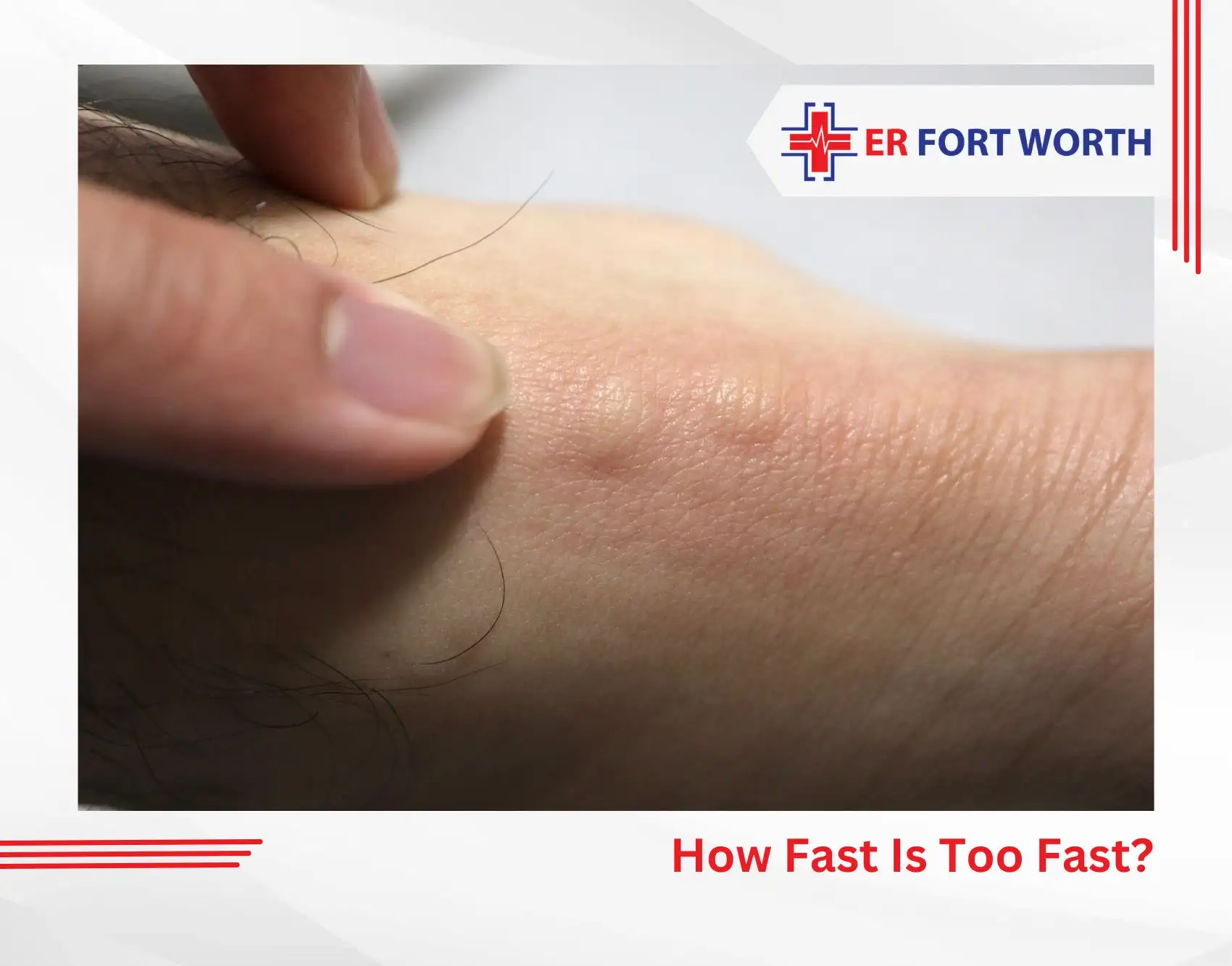
Speed of spread is one of the strongest predictors of severity. Here is how to interpret what you see in a 2 to 6 hour window, and when insect bite is emergency level based on rate alone.
| Spread Observed | What It Means | Action |
| No change in 6 hours | Stable. Likely normal reaction or well-contained infection | Monitor at home |
| Spreads less than 1 inch in 6 hours | Slow progression. Possible early infection | Same day clinic or ER |
| Spreads 1 to 2 inches in 2 to 4 hours | Rapid progression. Cellulitis likely | Same day ER |
| Red streaking toward body or armpit/groin | Lymphatic spread (lymphangitis). Serious infection | Immediate ER |
| Spreading plus fever, chills, confusion | Possible bloodstream infection (sepsis) | Call 911 |
The American Academy of Dermatology confirms that spreading redness, warmth, swelling, and skin that is painful to touch are the hallmark signs of cellulitis, which can progress to serious complications if not treated promptly.
Who Is at Higher Risk of a Rapidly Spreading Infection?
When insect bite is emergency level depends partly on who was bitten. Some people face higher risk of fast progression and should default to earlier ER evaluation.
- People with diabetes: Higher skin infection risk, slower healing, higher amputation risk from untreated infections
- Immunocompromised patients: Cancer treatment, HIV, transplant medications, long-term steroids
- Adults over 65: Weaker immune response, often atypical presentation
- People with chronic skin conditions: Eczema, psoriasis, lymphedema, chronic venous disease
- Patients with prior MRSA infection: Higher risk of resistant bacteria returning
- People with poor circulation: Peripheral artery disease, varicose veins, limb swelling
- Children under 2: Fast dehydration risk if infection becomes systemic
Any bite that occurs through broken skin or near an existing wound increases infection risk. Our guide on cuts and lacerations covers related wound care that can prevent secondary infection.
What Happens at ER of Fort Worth for a Spreading Insect Bite?
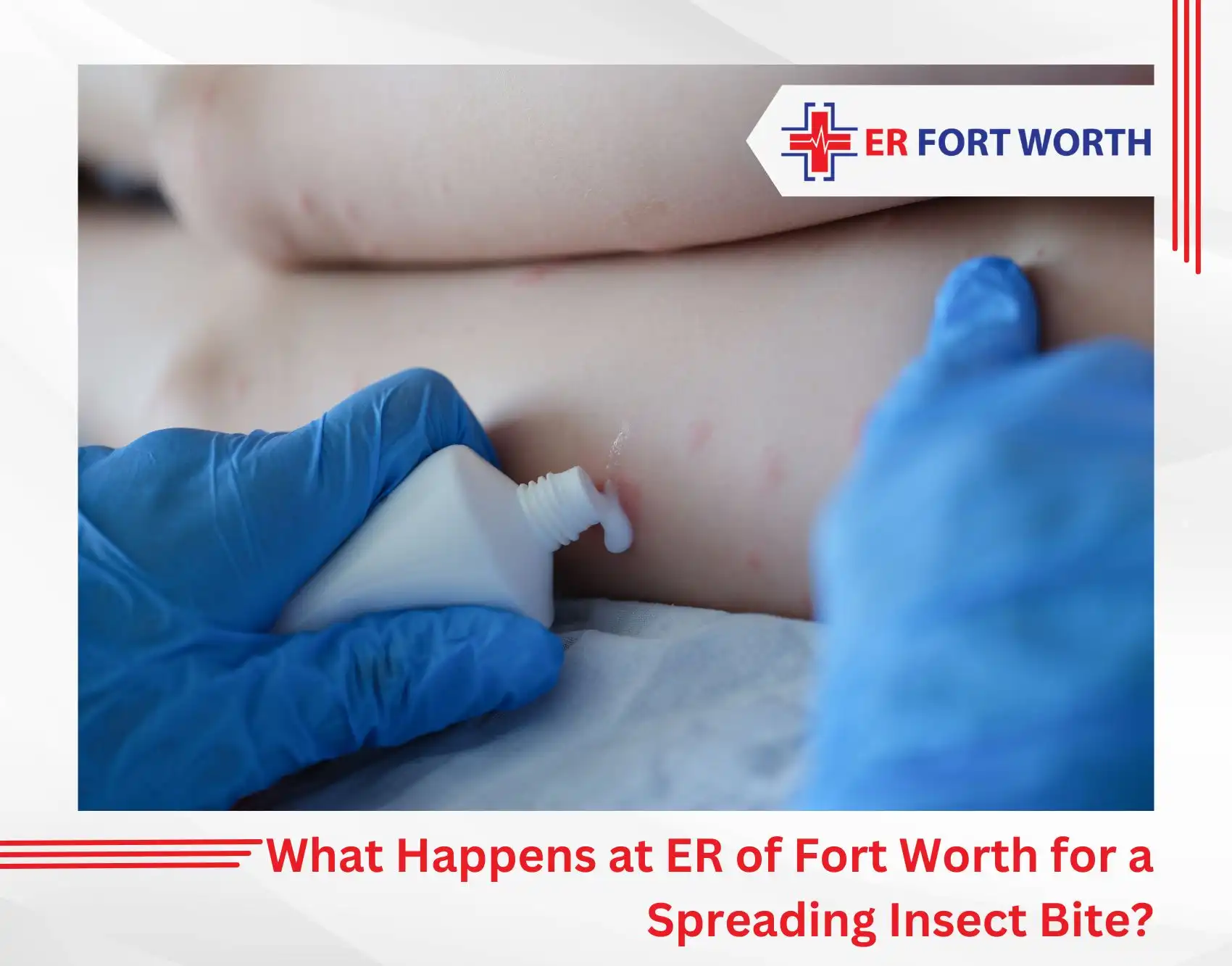
At ER of Fort Worth, evaluation for insect bite infection spreading fast starts with a focused skin exam and lab work to check for bloodstream involvement. Our team marks the leading edge of redness, measures the area, and documents the progression so treatment decisions are based on real evidence.
Immediate workup
- Vital signs including temperature, heart rate, and blood pressure
- Focused skin exam with measurement and marking of the red edge
- Lymph node check in the armpit or groin on the affected side
- Check for red streaking (lymphangitis)
- IV access if systemic infection is suspected
Same visit lab and imaging
- Complete blood count to look for infection markers
- Blood cultures when fever or sepsis is a concern
- Wound culture from any pus or fluid
- Imaging if a deeper abscess is suspected
If an abscess has formed, our abscess treatment service page details how our team drains and treats these infections on site. For patients whose rash pattern looks more like shingles than a classic bite, our guide on shingles what does it look like walks through that specific pattern.
For patients requiring extended IV care, admission, or specialty surgical consultation, our board certified emergency physicians coordinate direct hospital transfer. Follow-up wound care guidance is standard with every discharge.
After an ER visit for skin infection, our post-ER recovery guide covers what to watch for during the days that follow.
Walk in for evaluation: ER of Fort Worth is open 24/7 for insect bite infections with same visit lab, imaging, abscess drainage, and IV support. Call +1 817-945-4200 or walk in anytime.
Common Questions
What are the earliest signs of infected bug bite?
Earliest signs of infected bug bite include redness that expands beyond the original bite in the first 24 to 48 hours, warmth, increasing pain instead of improving pain, and pus or crusting. Red streaking lines are a late and serious sign.
Can an insect bite turn into cellulitis in one day?
Yes. Cellulitis from insect bite can develop within 24 hours when the bite breaks the skin and bacteria enter. In diabetics or immunocompromised patients, cellulitis from insect bite progresses faster, which is why early ER evaluation matters.
How do I tell cellulitis from a normal bug bite reaction?
Normal bites peak within 48 hours and improve. Cellulitis keeps expanding past 48 hours, with growing warmth, pain, and often fever. If redness grows visibly over 2 to 4 hours, treat it as cellulitis until proven otherwise.
Can I treat an infected insect bite at home?
Early localized infections sometimes respond to warm compresses and clean dressings. However, any sign of insect bite infection spreading fast requires professional evaluation. Knowing when insect bite is emergency level is the deciding factor between home care and the ER.
What does red streaking from a bite mean?
Red streaking means the infection is traveling through the lymphatic system (lymphangitis). This is a serious sign and warrants immediate ER care. The lymph nodes nearby may also swell and become tender.
Spreading Insect Bite in Fort Worth? Walk Into Our ER 24/7
Insect bite infection spreading fast is a time-sensitive emergency. Early ER evaluation prevents cellulitis from progressing to sepsis, and same visit wound care, lab, and imaging keep most patients out of the hospital. Walk in anytime, no appointment needed.
- Address: 4561 Heritage Trace Pkwy, Suite 117, Fort Worth, TX 76244
- Phone: +1 817-945-4200
- Hours: Open 24 hours, 7 days a week, 365 days a year
- Insurance: Most major commercial plans accepted
- Wait time: Rapid triage with typical door to provider time under 15 minutes
Visit ER of Fort Worth for directions and facility details. Proudly serving Heritage Trace, Alliance, Keller, Watauga, Park Glen, Haslet, Saginaw, North Richland Hills, and surrounding North Fort Worth communities.
Call 911 now: For red streaking toward the body, high fever, confusion, severe swelling of the face or throat, difficulty breathing, or signs of shock. Do not drive yourself.