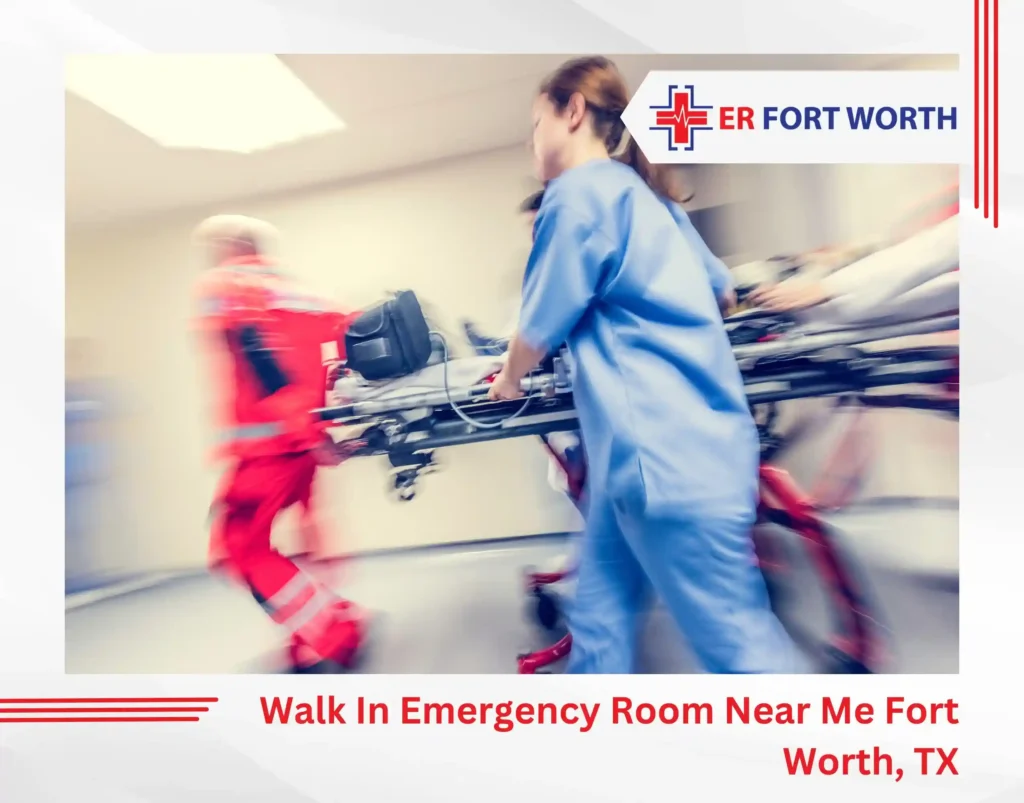
When something goes wrong, the last thing you should be doing is calling around for an appointment. You should be walking through a door. That’s the whole point of a walk in emergency room near me — no scheduling, no phone screening, no waiting until tomorrow. You arrive, you’re seen.
ER of Fort Worth, at 4561 Heritage Trace Pkwy, Suite 117, is a fully licensed 24/7 walk-in emergency room serving North Fort Worth, Heritage Trace, Alliance, Keller, Watauga, Park Glen, Haslet, Saginaw, and North Richland Hills. We accept walk-ins around the clock with no appointment, no referral, and no minimum age. Walk in any time or call +1 817-945-4200.
This guide explains exactly how the walk-in process works at our facility, what to bring, what to expect at each step, when walking in is the right call versus calling 911, and the critical differences between a walk-in ER and a walk-in urgent care clinic. If you’ve never walked into a freestanding ER before, this is everything you need to know.
1. What “Walk In Emergency Room Near Me” Actually Means
“Walk-in” gets used loosely in healthcare marketing — but in the context of an emergency room, it has a specific meaning. Here’s what you should expect when a facility describes itself as a walk-in ER:
No Appointment, Ever
True walk-in ERs don’t take appointments. Every patient is seen on arrival, in clinical priority order. You can call ahead so the team is prepared, but you’re never required to.
No Referral From a Primary Care Doctor
Unlike specialists or some imaging centers, you don’t need a referral, a prior authorization, or a phone consult before showing up. Walk in directly.
No Triage Screening by Phone First
Some facilities make you describe symptoms over the phone before they’ll see you. A true walk-in ER does triage in person, immediately upon arrival, by a clinical nurse — not a call center.
No Age, Membership, or Insurance Requirement to Walk In
We treat patients of every age, with or without insurance, regardless of where they live. Federal EMTALA law guarantees emergency screening and stabilization regardless of ability to pay.
In short: if a facility makes you do anything other than walk through the door, it’s not really a walk-in ER. We are.
2. Walk-In Emergency Room vs. Walk-In Urgent Care — The Critical Difference
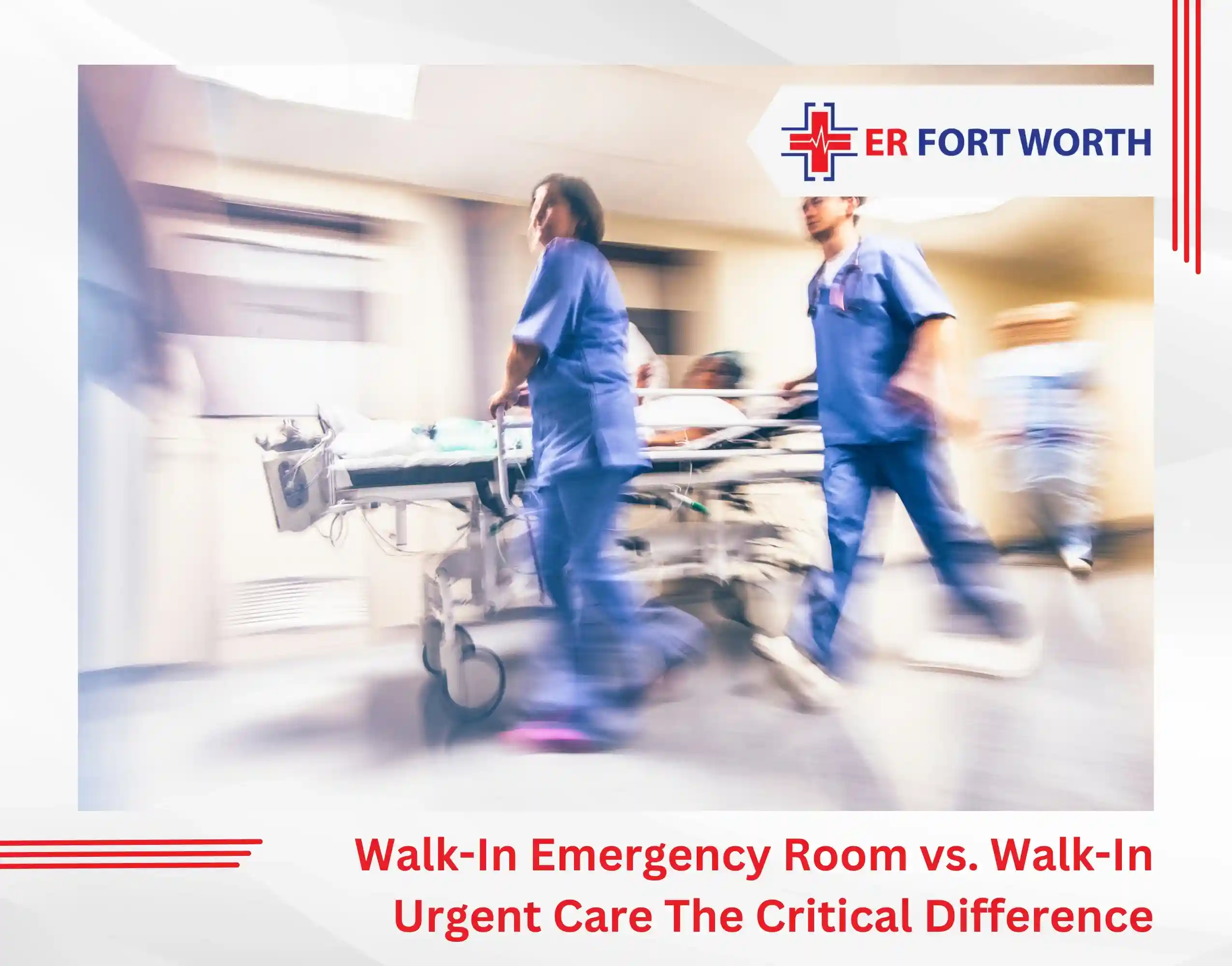
This is the single most important distinction in this guide. Both freestanding ERs and urgent care centers accept walk-ins. They are not the same thing — and choosing the wrong one can mean serious delays in care.
Walk-In Urgent Care
- Best for minor issues: sore throats, mild ear infections, simple sprains, basic flu
- Limited hours — most close by 8 or 9 p.m.
- No CT scanner, often no in-house lab beyond basic tests
- Typically staffed by physician assistants or nurse practitioners, not emergency physicians
- Cannot treat strokes, heart attacks, severe trauma, or critical pediatric cases
- Will transfer or refer you to an ER if symptoms turn out to be serious — adding hours of delay
Walk-In Emergency Room (Freestanding ER like ER of Fort Worth)
- Built to diagnose and treat true emergencies of any severity
- Open 24/7, 365 days a year — including overnight and holidays
- On-site CT, X-ray, ultrasound, EKG, and full clinical lab
- Staffed by board-certified emergency physicians on every shift
- Equipped for chest pain, stroke evaluation, severe abdominal pain, pediatric emergencies, allergic reactions, fractures, and lacerations
- Coordinates direct hospital admission and transfer when needed
Simple Rule of Thumb
If the situation could plausibly be serious — chest pain, severe abdominal pain, head injuries, severe fevers in children, deep cuts, suspected fractures, breathing difficulty — go to the walk-in ER, not urgent care. The cost difference is often smaller than people assume, and the diagnostic difference is enormous.
3. The ER of Fort Worth Walk-In Process — Step by Step
If you’ve never walked into a freestanding ER, here’s exactly what happens, in order, from the moment you arrive.
Step 1 — Arrive and Enter
Park in our lot directly at the front entrance. Walk through the front door at any hour — day, night, weekend, holiday. Doors are open and staffed 24/7.
Step 2 — Initial Check-In
Approach the front desk. Provide your name and a brief description of why you’re here. If you have ID and an insurance card, hand them over now — if you don’t, that’s fine, we continue anyway.
Step 3 — Rapid Triage by a Nurse
Within minutes, a registered nurse evaluates your symptoms, takes vital signs, and determines clinical priority. Critical cases bypass paperwork entirely and move straight to a treatment room.
Step 4 — Brought to a Treatment Room
You’re escorted into a private treatment room, not a shared waiting area. This typically happens within minutes of arrival.
Step 5 — Physician Evaluation
A board-certified emergency physician examines you, asks about your symptoms and history, and develops a working diagnosis. Imaging or labs are ordered as needed.
Step 6 — Diagnostics and Treatment
CT, X-ray, ultrasound, EKG, and lab tests are performed on-site. Results are reviewed during your visit — usually within the same hour.
Step 7 — Treatment Plan and Discharge
Most patients are diagnosed, treated, and discharged the same visit with clear next-step instructions, prescriptions, and follow-up recommendations. If hospital admission is required, we coordinate a smooth transfer to your preferred local hospital.
4. What to Bring When You Walk In

None of these are required to be seen — you will be evaluated and stabilized regardless. But bringing them speeds the process, helps the clinical team make accurate decisions, and reduces administrative back-and-forth later.
Essentials If You Have Them
- Photo ID — driver’s license, state ID, or passport
- Insurance card (front and back)
- List of current medications, including doses and frequency
- List of known allergies — medications, foods, latex, environmental
- Relevant medical history — surgeries, chronic conditions, recent hospitalizations
Helpful Extras
- Recent lab results, imaging, or discharge summaries if related to the current issue
- Primary care doctor’s name and contact information
- A short timeline of when symptoms started and how they’ve changed
- Phone charger if you can grab one — visits sometimes take longer than expected
For Pediatric Patients
- Immunization records if accessible
- Comfort items — favorite stuffed animal, blanket, or pacifier
- A bottle, formula, or snack for younger children
- Names and doses of any current medications, including over-the-counter
If You Don’t Have Any of This
Walk in anyway. Federal law requires us to screen and stabilize any patient with a potential emergency, regardless of documentation, insurance, or ability to pay. Paperwork follows the care — not the other way around.
5. When to Walk In vs. When to Call 911
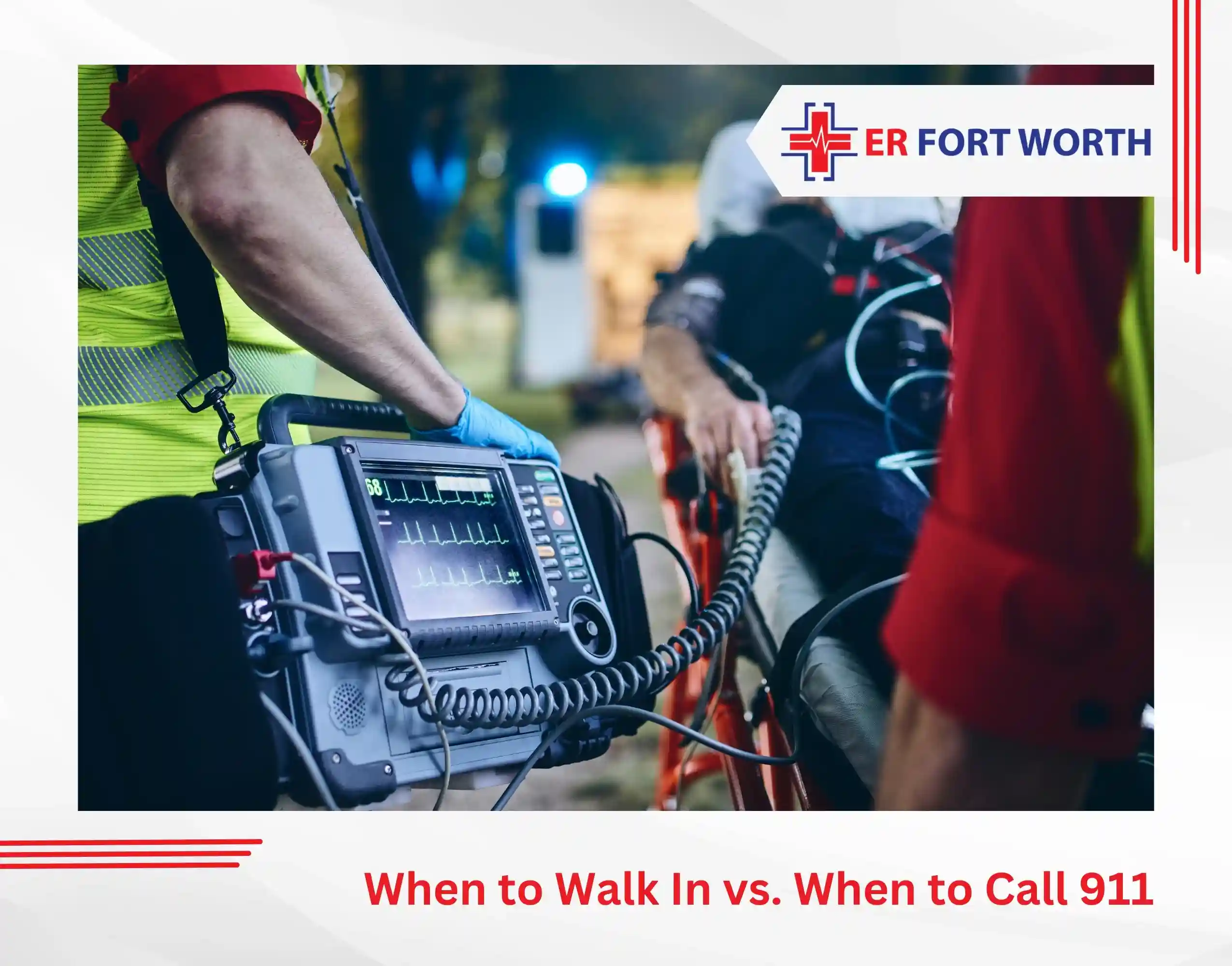
Walking in is the right move for most emergencies. For a small but critical set of situations, calling 911 is safer — because EMS can begin treatment in the ambulance and radio ahead, so the receiving facility is fully ready when you arrive.
Walk Into the ER Yourself If
- Symptoms are concerning but stable — fevers, cuts, fractures, abdominal pain, dehydration
- Pediatric emergencies that aren’t actively life-threatening
- Sports and accident injuries — sprains, suspected breaks, lacerations
- Migraines, kidney stone pain, ear infections, urinary infections
- Allergic reactions without throat swelling or breathing difficulty
- Burns that are localized and not deep or extensive
Call 911 Instead If
- Active chest pain, especially with shortness of breath or arm/jaw pain
- Sudden stroke symptoms — facial droop, slurred speech, one-sided weakness
- Difficulty breathing or severe wheezing
- Unresponsiveness, fainting, or severe confusion
- Major trauma — high-speed accidents, falls from height, suspected spinal injury
- Severe allergic reaction with throat or facial swelling
- Major bleeding that doesn’t slow with direct pressure
- Seizure lasting more than 5 minutes or repeating
Never Drive Yourself If
You’re experiencing chest pain, stroke symptoms, fainting, or severe shortness of breath. The risk of losing consciousness while driving is real. Call 911 or have someone else drive.
No Appointments. No Barriers. Just Walk In.
ER of Fort Worth was built to be exactly what “walk-in emergency room” should mean — open every hour, staffed by emergency physicians, equipped for any emergency, with no scheduling, no referrals, and no phone screening required.
📍 Address: 4561 Heritage Trace Pkwy, Suite 117, Fort Worth, TX 76244
📞 Call: +1 817-945-4200
🌐 Website: eroffortworthtx.com
🕐 Hours: Open 24/7, including overnight, weekends, and holidays
Walk in any time. Call +1 817-945-4200 if you’d like our team to prepare for your arrival. When you need help right now, just come in.
6. Frequently Asked Questions
Do I need an appointment to come to ER of Fort Worth?
No. We are a walk-in emergency room 24/7. Just come in — no appointment, no referral, no phone screening.
Can I walk in at any hour?
Yes. We are open 24 hours a day, 7 days a week, 365 days a year. The doors are staffed and unlocked overnight, on weekends, and on every holiday.
Do I need insurance to walk in?
No. Under federal EMTALA law, you have the right to emergency screening and stabilization regardless of insurance or ability to pay. We accept most major commercial insurance plans and offer self-pay options. We do not currently accept Medicare or Medicaid.
How long will I wait if I walk in?
Most patients are seen by a board-certified emergency physician within minutes of arrival — not hours like at many hospital ERs.
Can I walk in with my child?
Yes — we treat patients of every age, including infants and children. Our staff is trained in pediatric emergency care.
What if I’m not sure my situation is serious enough for an ER?
Walk in or call +1 817-945-4200. Emergency physicians are trained specifically to rule out serious conditions quickly. A walk-in visit that ends with reassurance is still a successful visit — and far better than ignoring something that turns out to be significant.
Should I call before walking in?
It’s helpful but not required. A short call lets our team prep the right room and equipment for your arrival. For life-threatening symptoms, call 911 instead — don’t spend time calling us.