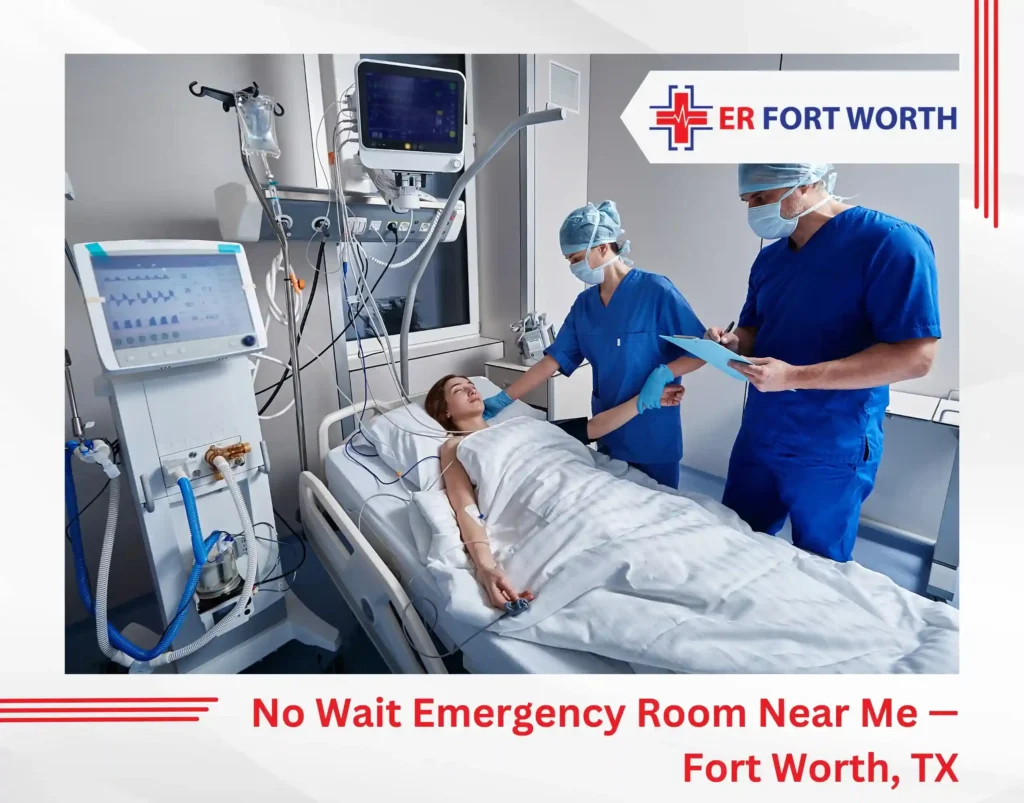
If you’re searching for a no wait emergency room near me, you’re really asking two questions at once: where do I go right now, and what kind of facility actually makes sense for my symptoms? Those aren’t small decisions — the wrong choice can cost you hours, hundreds of dollars, or in the worst case, real time on a serious condition.
North Fort Worth families have three realistic options when something’s wrong: a hospital emergency room, a freestanding emergency room (like ER of Fort Worth at 4561 Heritage Trace Pkwy, Suite 117), or an urgent care center. They look similar from a Google search, but they are wildly different in capability, wait time, and cost. Walk in any time or call +1 817-945-4200.
This guide is a side-by-side comparison. By the end, you’ll know exactly which option fits which situation, where each one falls short, and how to make the call confidently when minutes matter.
1. The Three “No Wait” Options Defined
Before comparing them, it’s important to understand what each facility actually is — because marketing language often blurs the lines.
Hospital Emergency Room
Part of a full hospital campus. Open 24/7, fully licensed, equipped to handle the most severe emergencies including major trauma and Level I cases. Also serves as the gateway for hospital admissions, which is why volumes are highest and wait times are longest.
Freestanding Emergency Room
A fully licensed emergency room operating independently of a hospital campus. Open 24/7, staffed by board-certified emergency physicians, equipped with on-site CT, X-ray, ultrasound, and full lab. Smaller footprint and lower volume mean faster door-to-doctor times for most patients. ER of Fort Worth is this type of facility.
Urgent Care Center
A walk-in clinic — not an emergency room — designed for minor, non-life-threatening conditions. Limited hours (typically closes by 8 or 9 p.m.), staffed primarily by nurse practitioners or PAs, no CT scanner, and very limited in-house lab capability. Cannot diagnose or treat true emergencies.
Key clarification: freestanding ERs and hospital ERs are both legally classified as emergency rooms. Urgent care is not. That single distinction drives most of the differences in this guide.
2. Side-by-Side Comparison: Wait Time, Capability, Hours, and Cost

Here’s the honest, head-to-head breakdown across the metrics that matter most.
| Factor | Freestanding ER | Hospital ER | Urgent Care |
| Wait Time | Minutes — most patients seen quickly | Often 2–4+ hours | 30 min – 2 hours |
| Hours | 24/7, 365 days | 24/7, 365 days | Limited — closes evenings |
| Physician On-Site | Board-certified ER physician every shift | Board-certified ER physician every shift | Usually NP or PA |
| CT Scanner | Yes, on-site | Yes, on-site | No |
| X-Ray & Ultrasound | Yes, on-site | Yes, on-site | Sometimes X-ray only |
| Full Lab | Yes, on-site | Yes, on-site | Basic tests only |
| Treats Strokes / Heart Attacks | Yes — stabilize & transfer | Yes — admit directly | No — must transfer out |
| Walk-In Friendly | Yes — no appointment | Yes — no appointment | Yes — no appointment |
| Cost Range | ER-level facility fee | ER-level facility fee | Clinic-level fee |
Bottom line on the table: freestanding ERs match hospital ERs on clinical capability while typically beating them on wait time. Urgent care is cheaper but capability-limited and not appropriate for genuine emergencies.
3. When Each Option Is the Right Choice
Choosing the right facility comes down to matching severity of symptoms to capability of facility. Use this framework:
Choose a Freestanding ER (Like ER of Fort Worth) When
- Symptoms could plausibly be serious and you want fast, complete evaluation
- It’s after hours, a weekend, or a holiday and urgent care is closed
- You need CT, ultrasound, or full lab work — not just a basic exam
- Your child has a fever, breathing difficulty, or persistent symptoms
- You have chest pain, severe abdominal pain, or possible stroke symptoms but are stable enough to be driven
- You want emergency-level care without a hospital-ER-length wait
Choose a Hospital ER When
- EMS recommends a Level I or Level II trauma center for major injuries
- You will almost certainly need surgical intervention or hospital admission
- Specialized services are required (advanced burn unit, OB emergencies, psychiatric holds)
- You are on Medicare or Medicaid (freestanding ERs in Texas generally don’t accept these)
Choose Urgent Care When
- Cold, sore throat, sinus infection, simple flu
- Minor sprains and small cuts that may need a stitch or two
- Ear infections and rashes in older children and adults
- Routine prescription refills you can’t get from your primary care
- Travel vaccines, basic STD testing, or work-required physicals
When in Doubt
Default toward the ER, not urgent care. A 30-minute ER evaluation that turns out to be reassuring is always better than a delayed diagnosis. Emergency physicians are specifically trained to rule out serious conditions quickly — that’s the entire specialty.
4. The Hidden Trade-Offs Most People Don’t See

On the surface, urgent care looks like the obvious budget choice and the hospital ER looks like the obvious capability choice. The reality is more nuanced. Here are the trade-offs the marketing doesn’t mention:
Urgent Care’s Hidden Cost: The Transfer
When an urgent care patient turns out to need real emergency evaluation, the standard outcome is a referral or transfer to an ER. That means you pay twice — urgent care fee plus ER fee — and you lose hours in the process. For anything that might be serious, the ER is faster and cheaper end-to-end.
Hospital ER’s Hidden Cost: The Wait
Long ER waits aren’t just inconvenient — they have a measurable clinical cost. Conditions like appendicitis, strokes, and heart attacks have time-sensitive treatment windows. Waiting 3–4 hours in a hospital lobby with chest pain is a worse outcome than being seen in 10 minutes at a freestanding ER and transferred if needed.
Freestanding ER’s Honest Trade-Offs
Freestanding ERs are billed at emergency-room rates, not urgent care rates. That cost is the same whether you go to a hospital ER or a freestanding ER, but it is notably higher than urgent care. Freestanding ERs also do not perform surgery on-site or have inpatient beds — if you need admission, we coordinate transfer to a hospital.
Insurance Reality Check
Under federal EMTALA law, your insurance must cover an emergency visit based on your presenting symptoms, not the final diagnosis. A reasonable belief that you’re having an emergency triggers coverage. We accept most major commercial insurance plans. We do not currently accept Medicare or Medicaid — patients with those plans should use a hospital ER.
5. Why ER of Fort Worth”No Wait” Choice
If a freestanding ER is the right option for your situation, here’s what makes ER of Fort Worth the clear choice for North Fort Worth, Heritage Trace, Alliance, Keller, Watauga, Park Glen, Haslet, Saginaw, and North Richland Hills:
Fast Door-to-Doctor Times
Most patients see a board-certified emergency physician within minutes of walking in — the core promise behind the phrase “no wait emergency room.”
Full Hospital-Grade Diagnostics On-Site
- CT scanner for stroke, internal bleeding, and trauma
- Digital X-ray for fractures and chest imaging
- Ultrasound for cardiac, abdominal, and obstetric exams
- Full clinical lab with rapid results
- EKG and continuous cardiac monitoring
True 24/7 — No Reduced Hours
Same staffing, same diagnostics, same physician coverage overnight, on weekends, and on every holiday.
Walk-In, No Appointment, Any Age
No referrals, no phone screening, no minimum age. Walk in directly at 4561 Heritage Trace Pkwy, Suite 117 — free parking right at the entrance.
Smooth Transfers If Needed
If your situation turns out to require hospital admission, we coordinate transfer to your preferred hospital — Texas Health Alliance, Texas Health Harris, Cook Children’s, or others — so you don’t lose time.
Frequently Asked Questions
Is a freestanding ER really the same as a hospital ER medically?
For diagnostic and stabilizing care, yes. Freestanding ERs have the same on-site imaging, lab, and board-certified emergency physicians. The main differences are that hospital ERs have inpatient beds and on-site surgery, while freestanding ERs transfer admitted patients to a hospital. For the majority of emergency presentations, that transfer happens after stabilization and doesn’t change outcomes.
Will I pay more at a freestanding ER than urgent care?
Yes — freestanding ERs bill at emergency-room rates, which are higher than urgent care. But they’re the same rates as a hospital ER. If your condition turns out to be a true emergency, the ER is the right cost-benefit choice. If it’s truly minor, urgent care is fine.
How do I know if it’s an emergency or an urgent care issue?
Rule of thumb: chest pain, stroke symptoms, severe abdominal pain, head injuries, infant fevers, difficulty breathing, and major lacerations all go to the ER. Sore throats, mild colds, simple ear infections, and minor sprains can go to urgent care. When in doubt, choose the ER.
Can I walk into ER of Fort Worth without an appointment?
Yes — we are walk-in 24/7. No appointment, no referral, no minimum age.
Do you accept my insurance?
We accept most major commercial insurance plans including Blue Cross Blue Shield, Aetna, Cigna, UnitedHealthcare, and Humana. We do not currently accept Medicare or Medicaid. If you’re uninsured, we offer self-pay options.
What happens if you can’t treat my condition?
We can stabilize and treat the vast majority of emergencies on-site. If you need hospital admission or specialized intervention, we coordinate a smooth transfer to your preferred local hospital.
Should I call 911 or come to ER of Fort Worth?
Call 911 for unresponsiveness, severe chest pain, stroke symptoms, severe breathing difficulty, or major trauma. EMS can begin treatment in the ambulance and radio ahead. For most other emergencies — fractures, lacerations, abdominal pain, fevers, infections — walking into ER of Fort Worth is the right call.
Make the Right Call — Before You Need To
The best time to decide which emergency facility to use is before you need one. For most North Fort Worth families, the answer is simple: ER of Fort Worth combines hospital-grade emergency care with the short door-to-doctor times that “no wait emergency room near me” is really asking for.
📍 Address: 4561 Heritage Trace Pkwy, Suite 117, Fort Worth, TX 76244
📞 Call: +1 817-945-4200
🌐 Website: eroffortworthtx.com
🕐 Hours: Open 24/7 — every day, every hour, every holiday
Save the address and number now. When the question comes up — “no wait emergency room near me” — you’ll already have the answer.