Call 911 immediately: For unconsciousness, seizures, severe difficulty breathing, chemical burns around the mouth, suspected button battery ingestion, or suspected intentional overdose. Do not drive yourself.
Call Poison Control first: For most other ingestions, dial 1-800-222-1222. Free, 24/7, staffed by toxicology experts. They will tell you whether to come to the ER or manage at home.
Chemical ingestion poisoning emergency response has changed dramatically in the last two decades, but a lot of families still act on outdated advice from a generation ago. Making someone throw up used to be standard first aid. Today it is the opposite. For most swallowed chemicals, forcing vomit causes more damage on the way back up than the ingestion itself.
This guide breaks down what chemical ingestion poisoning actually is, the household products people accidentally swallow most often, the symptoms that point to a serious ingestion, exactly what to do in the first few minutes, and how our board-certified emergency team at ER of Fort Worth evaluates and treats every case with on-site lab work and same-visit results.
What Should You Do for Chemical Ingestion Poisoning?
Here is what to do for chemical poisoning: move away from the source, check for life-threatening symptoms, call 911 for severe cases or Poison Control at 1-800-222-1222 for less severe. Do NOT induce vomiting. Bring the actual container to the ER for the chemical ingestion poisoning emergency workup.
1. What Is Chemical Ingestion Poisoning and Who Is Most at Risk?
Chemical ingestion poisoning happens when someone swallows a toxic substance. It affects more than 2 million people in the United States each year, with children under 5 accounting for most accidental poisoning ER visits. Adults face risk from medication mistakes, storage errors, and intentional overdose.
Understanding which category of ingestion you are dealing with shapes the correct response. Each type carries a different urgency profile and a different set of next steps.
Accidental pediatric ingestion
The most common category by far. Children ages 1 to 4 are in the exploration phase and put nearly everything into their mouths. Common events include drinking from a cleaner bottle stored under the sink, eating brightly colored laundry pods, chewing rodent bait, or getting into grandparent medications during a visit.
Accidental adult ingestion
Less common but real. Includes accidentally taking the wrong medication or wrong dose, drinking from a container holding a chemical (cleaners stored in food bottles is a top scenario), or mistaking one substance for another in poor light.
Intentional overdose
A medical emergency and a mental health emergency at the same time. Bring the person to the ER or call 911. Do not blame, lecture, or delay treatment. ER staff are trained to handle both the medical and emotional dimensions. The 988 Suicide and Crisis Lifeline is available anytime by dialing 988.
Who is at highest risk
- Children ages 1 to 4, the peak age for accidental swallowing
- Older adults with multiple medications or memory changes
- People experiencing a mental health crisis
- People with substance use disorders
- Adults working with industrial chemicals
2. What Are the Most Common Chemicals People Accidentally Swallow?

The most common chemicals people accidentally swallow include household cleaners, medications, pesticides, plants and mushrooms, personal care products, and button batteries. Each category requires a different response, and the actual container is the single most valuable piece of information you can bring to the ER.
Different chemicals cause dramatically different problems. What helps with one category can be deadly with another. This is why calling Poison Control before doing anything is safer than acting on assumption.
Caustic and corrosive substances
Cause chemical burns inside the mouth, throat, and stomach. Examples include bleach, drain cleaners, oven cleaners, toilet bowl cleaners, dishwasher detergent, and industrial acids or bases. Never induce vomiting with caustics. Forcing the chemical back up burns the esophagus a second time and can damage the airway.
Hydrocarbons
Petroleum-based liquids that can be inhaled into the lungs during vomiting. Examples include gasoline, kerosene, lighter fluid, furniture polish, lamp oil, and paint thinners. Aspiration into the lungs causes severe chemical pneumonia. Never induce vomiting with hydrocarbons.
Medications
Both accidental (especially in children) and intentional. Some cause immediate symptoms. Others, including common pain relievers and iron supplements, cause delayed organ damage with few early warning signs. Every case of unknown medication ingestion needs same-day evaluation.
Pesticides and other toxic exposures
Insecticides, rodent baits, and lawn chemicals cause distinct symptoms and require route-specific care. If the exposure involved skin, inhalation, or eye contact in addition to swallowing, read our companion guide on pesticide exposure symptoms. For toxic gas exposures like fumes from a running generator or a faulty heater, see our guide on carbon monoxide poisoning symptoms.
Plants, mushrooms, and other categories
- Household plants: lilies, dieffenbachia, pothos, philodendron
- Outdoor plants: oleander, foxglove, castor bean
- Wild mushrooms, especially in children playing outdoors
- Personal care products: hand sanitizer, mouthwash, essential oils
- Cannabis edibles that resemble candy or gummies
Button batteries: a true emergency
Coin-sized lithium batteries can burn through the esophagus within 2 hours of ingestion. They are commonly found in remotes, key fobs, watches, hearing aids, small toys, and greeting cards that play music. Any suspected button battery ingestion is an immediate 911 call, not a Poison Control call.
3. What Are the Symptoms of Chemical Ingestion Poisoning?
Chemical ingestion poisoning emergency symptoms include burns around the mouth, chemical odor on breath, drooling or difficulty swallowing, coughing, sudden vomiting, confusion, drowsiness, difficulty breathing, and unusual abdominal pain. Some serious poisonings cause NO immediate symptoms but lead to organ damage hours later.
Sometimes the ingestion is witnessed and the substance is known. Other times symptoms appear first and the cause becomes clear later. Certain container clues near the patient are just as important as the symptoms themselves.
Immediate warning signs
- Burns, redness, or blisters around the mouth or lips
- Chemical odor on breath or clothing
- Drooling or difficulty swallowing
- Coughing, choking, or breathing changes
- Burning sensation in the mouth, throat, or stomach
- Sudden vomiting, especially with unusual color or smell
Neurological symptoms
- Confusion, drowsiness, or unusual sleepiness
- Slurred speech or unsteady walking
- Seizures
- Loss of consciousness
- Strange behavior or hallucinations
Cardiovascular and respiratory symptoms
- Difficulty breathing or shortness of breath
- Rapid, slow, or irregular heartbeat
- Chest pain
- Pale, sweaty, or unusually flushed skin
Environmental clues
- Open or missing containers near the patient
- Spilled liquid or powder on clothing or floor
- Pills or capsules scattered near the patient
- Unusual smells in the room
- Pets in the household also acting sick, suggesting a shared exposure
Silent poisoning red flag: Some serious poisonings cause NO immediate symptoms but lead to severe organ damage hours later. Common pain relievers, iron supplements, antifreeze, and certain mushrooms all cause delayed effects. “They feel fine” does not mean “they are safe.” Every suspected chemical ingestion poisoning emergency warrants a call to Poison Control or the ER.
4. What Should You Do Right Now for a Chemical Ingestion?
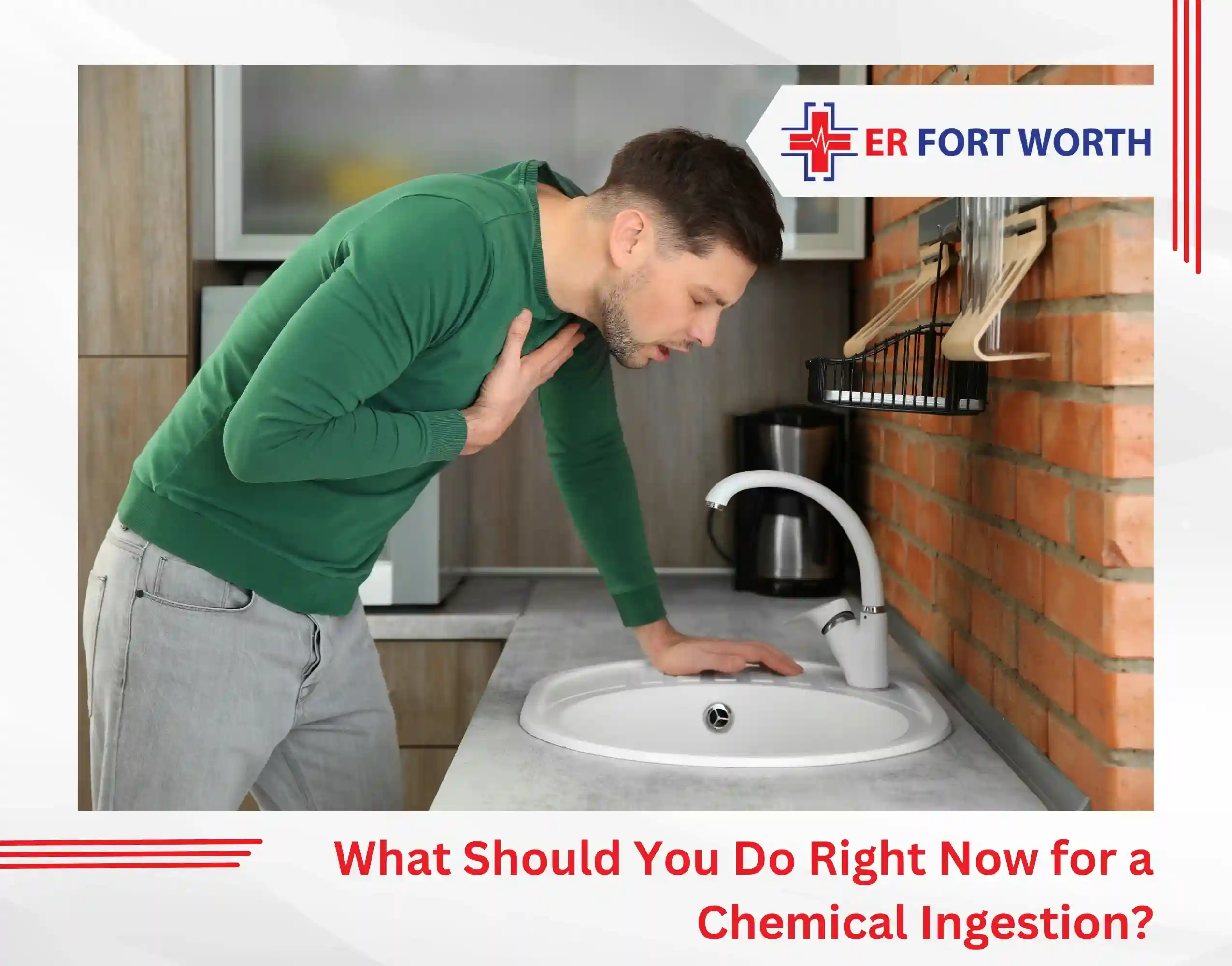
What to do for chemical poisoning: make sure the scene is safe, check for life-threatening symptoms, call 911 for severe cases or Poison Control at 1-800-222-1222 for less severe. Do NOT induce vomiting. Do NOT give anything by mouth without instruction. Bring the container to the ER.
The right sequence in the first few minutes changes outcomes. Old advice about making the person throw up is now known to cause additional harm in most cases. Follow the steps below.
Step 1. Make sure the scene is safe.
If there is a chemical spill, fumes, or gas in the air, move everyone including pets to fresh air first. Do not become a second patient by staying in the exposure zone.
Step 2. Check for life-threatening symptoms and call 911 if.
- The person is unconscious or barely responsive
- Having seizures
- Struggling to breathe
- Showing chemical burns around the mouth or face
- Suspected of swallowing a button battery
- Suspected of intentional overdose
Step 3. For anything less severe, call Poison Control first.
When to call Poison Control at 1-800-222-1222 is your default choice for any ingestion that is not immediately life-threatening. Toxicology experts triage based on what was swallowed, how much, and the patient’s age. Many cases can be safely managed at home under their guidance. Others need the ER, and Poison Control may call ahead with details.
Step 4. Do NOT induce vomiting.
This is the single biggest change from a generation ago. Inducing vomiting used to be standard advice. It is now strongly discouraged for nearly every ingestion. Caustic chemicals re-burn the esophagus on the way back up. Hydrocarbons get aspirated into the lungs during vomiting. The additional damage nearly always outweighs any benefit.
Step 5. Do NOT give anything by mouth without being told to.
Do not give water, milk, food, or activated charcoal unless Poison Control or 911 specifically instructs you to. Some “neutralizers” that pair an acid with a base create heat-producing reactions that cause more injury.
Step 6. Gather critical information.
- What was swallowed, and bring the original container
- How much (estimate even if uncertain)
- When it happened
- Age and weight of the patient
- Current medications, medical conditions, and allergies
- Symptoms observed so far
Step 7. Bring the container.
The label tells the ER team exactly what they are working with. Verbal descriptions are unreliable. If multiple items may be involved, bring them all.
Button battery emergency: Button batteries are an immediate 911 emergency. They can burn through the esophagus within 2 hours. For children over age 1 who swallowed a battery within the last 12 hours and can still swallow, the National Capital Poison Center recommends 2 teaspoons of honey every 10 minutes on the way to the ER. Do not delay transport. Bring a matching battery from the same package if possible.
5. How Does ER of Fort Worth Evaluate Chemical Ingestion Poisoning?
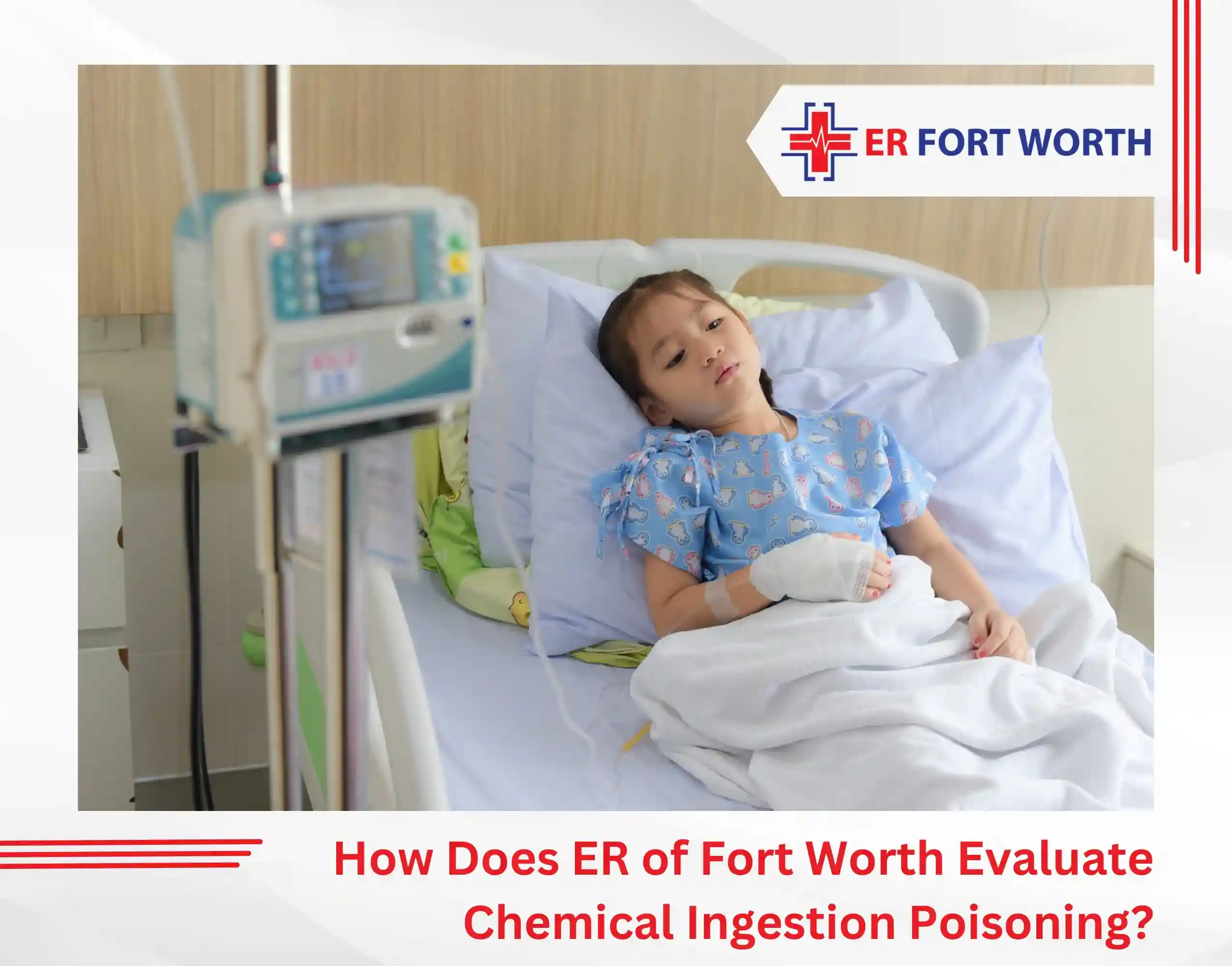
ER of Fort Worth evaluates chemical ingestion poisoning emergency cases with rapid triage, substance identification, targeted lab work, and continuous monitoring. Board-certified emergency physicians work directly with Poison Control and toxicology databases to identify the exact substance and start appropriate care within minutes.
When you arrive with any suspected chemical ingestion, our team’s evaluation is structured, sequential, and driven by what was swallowed. The container you bring guides much of the workup.
What happens when you arrive
- Rapid triage and stabilization. Vital signs, oxygen saturation, blood sugar, and a focused neurological exam completed within minutes. Airway support and IV access come first for unstable patients.
- Substance identification. The container is the most reliable source. Poison Control consultation runs in parallel with access to product databases covering hundreds of thousands of substances and their toxic thresholds.
- Focused lab work. Metabolic panel, complete blood count, common pain reliever and salicylate levels, kidney and liver function tests, drug screen when appropriate, and pregnancy testing in women of reproductive age.
- On-site imaging. X-ray when button batteries, magnets, or radio-opaque materials are possible. CT imaging when abdominal pain or aspiration is a concern.
- EKG monitoring. Continuous cardiac monitoring throughout the visit for cases where the substance can affect heart rhythm.
- Coordinated hospital transfer. For patients who need admission, endoscopy for button batteries, or specialty toxicology care, we arrange direct handoffs to hospital partners.
Mental health evaluation when appropriate
For intentional ingestions, a mental health assessment is part of standard care. Patients are treated with respect and privacy, then connected with mental health resources before discharge. The 988 Suicide and Crisis Lifeline is available anytime by dialing 988.
Get evaluated fast: ER of Fort Worth provides 24/7 accidental poisoning ER care with on-site lab, EKG monitoring, X-ray, and toxicology consultation, all with results in minutes. Walk in anytime or call +1 817-945-4200. Bring the container of whatever was swallowed.
For the full scope of our services, see our emergency care in Fort Worth page. If food or contaminated water is the suspected cause and severe dehydration is developing, our companion guide on food poisoning and severe dehydration covers that scenario in detail.
Frequently Asked Questions
Should I make my child throw up after they swallow something?
No. Inducing vomiting was standard advice decades ago, but current medical guidelines strongly discourage it. For caustic chemicals it causes additional burns. For hydrocarbons it risks aspiration into the lungs. Call Poison Control at 1-800-222-1222 first.
What number do I call for Poison Control?
1-800-222-1222. This is the U.S. national poison control hotline, free, available 24/7, and staffed by toxicology experts. When to call Poison Control is any time you suspect an ingestion that is not immediately life-threatening. Save the number in your phone now.
Should I give milk or water after chemical ingestion?
Only if Poison Control or 911 specifically tells you to. Water and milk help some ingestions and worsen others. Do not guess. When to call Poison Control is before doing anything except getting to safety in any chemical ingestion poisoning emergency.
My child seems fine after swallowing something. Do I still need the ER?
Often yes. Several dangerous substances including common pain relievers, iron supplements, antifreeze, mushrooms, and button batteries cause no early symptoms but lead to organ damage hours later. Always contact Poison Control or come to the ER after any suspected ingestion.
What about button batteries?
Treat as an immediate 911 emergency. Do not wait for symptoms. For children over age 1 who swallowed a battery within the last 12 hours and can swallow safely, give 2 teaspoons of honey every 10 minutes on the way to the ER, per National Capital Poison Center guidance.
What if it is an intentional overdose?
Bring the person to the ER or call 911 immediately. Do not argue, lecture, or wait. ER staff treat the medical and mental health components together. The 988 Suicide and Crisis Lifeline is also available by dialing 988.
People Also Ask About Chemical Ingestion Poisoning
These are the related questions Google’s People Also Ask feature and AI search engines commonly surface for chemical poisoning queries. Direct answers below.
How long does it take for chemical poisoning symptoms to appear?
It depends on the substance. Caustics cause immediate mouth and throat burns. Common pain reliever overdose may cause no symptoms for 24 hours before liver damage becomes visible. Antifreeze can look like alcohol intoxication for hours before kidney failure. Always call Poison Control regardless of how the person looks.
Can chemical ingestion cause delayed symptoms?
Yes. Delayed toxicity is one of the most dangerous features of certain ingestions. Common pain relievers, iron, antifreeze, some mushrooms, and slow-release medications can look harmless for hours or days before causing severe organ damage. This is why ER evaluation matters even when the person feels fine.
What household chemicals are most dangerous for children?
Button batteries top the list because they burn through the esophagus quickly. Laundry detergent pods, drain cleaners, prescription and over-the-counter medications, nicotine products, and essential oils are the most common accidental poisoning ER visits in children. Knowing what to do for chemical poisoning at home starts with calling Poison Control first.
Can activated charcoal be used at home?
No. Activated charcoal is only useful in specific ingestions within the first hour, and it is dangerous when misused. It should only be given in a medical setting under Poison Control or ER guidance. Never give activated charcoal at home unless specifically instructed.
Suspected Chemical Ingestion? Get Same-Day Answers in Fort Worth
Chemical ingestion poisoning emergency care depends on doing the right things in the first few minutes: no vomiting, no home remedies, and a fast call to Poison Control or 911. ER of Fort Worth provides 24/7 emergency evaluation with on-site lab, EKG, X-ray, and board-certified physicians available immediately. Walk in anytime or call ahead so our team can prepare.
- Address: 4561 Heritage Trace Pkwy, Suite 117, Fort Worth, TX 76244
- Phone: +1 817-945-4200
- Poison Control: 1-800-222-1222 (free, 24/7)
- Hours: Open 24 hours, every day of the year
- Insurance: Most commercial plans accepted. Medicare, Medicaid, and Tricare not accepted at this time.
Call 911 now if life-threatening: For unconsciousness, seizures, severe breathing difficulty, chemical burns to the mouth, suspected button battery, or intentional overdose. Bring the container of whatever was swallowed to the ER whenever safe to do so.