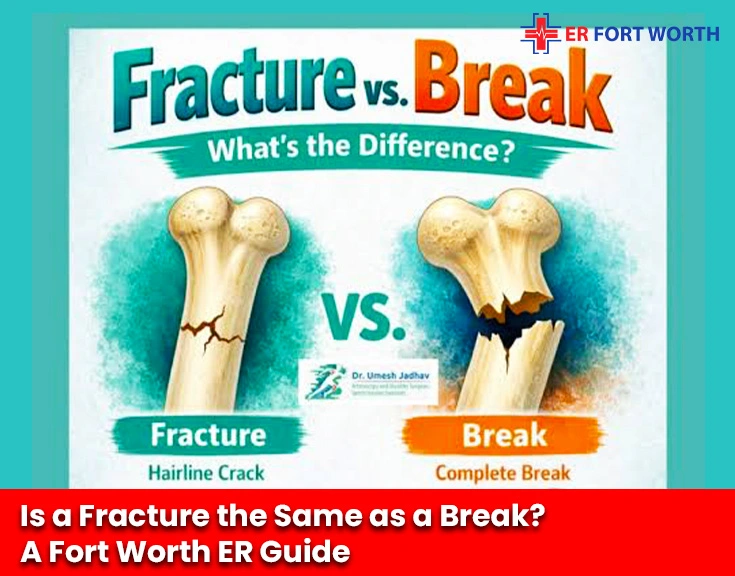
A fracture and a break are exactly the same thing. If your doctor said ‘fracture’ and you walked out thinking it sounded less serious than ‘broken,’ you’re not alone, a published study in the Annals of the Royal College of Surgeons found that 84% of fracture clinic patients believed there was a difference between the two terms, with most assuming a ‘break’ was worse. There is not one. Both words describe any disruption in bone continuity, from a hairline crack to a bone splintered in five pieces.
So: is a fracture the same as a break? Yes. Full stop. What actually matters, what changes your treatment, your recovery time, and whether you need to be in our ER tonight, is the type of fracture, where it is, and how it happened. That’s what this guide covers.
Here at ER of Fort Worth, we see bone injuries every single day, weekend athletes, high school football players from across Tarrant County, parents who slipped off a ladder, runners with nagging shin pain that turned out to be more than soreness. We have written this guide to give you the clear, honest information you need to understand what’s going on, and to make it simple to decide what to do next. If you’d like to explore fracture treatment in Fort Worth, we have got you covered any time of day or night.
What Is a Fracture?
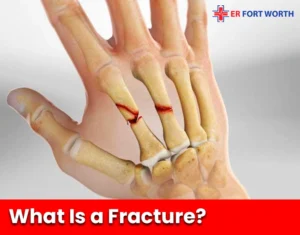
Think of bone like dense, living wood. It’s rigid, but under enough force, or repeated smaller forces over time, it can crack, split, or shatter. A fracture is any break in that continuity. It might go all the way through the bone or only partway. It might affect a tiny sliver or shatter the whole structure.
The medical definition, per MedlinePlus (NIH), is simply: a break in a bone. That’s it. The word ‘fracture’ comes from the Latin fractura, meaning ‘a break.’ Doctors use ‘fracture’ because it’s the clinical term, they mean exactly what you think they mean when they say ‘broken bone.’
So does the severity vary? Enormously. A tiny stress fracture in a runner’s shin is a fracture. So is a compound fracture where bone is visible through the skin. Same word. Very different situations.
Fracture vs Break: Why the Confusion Exists
Here’s the thing: the confusion is completely understandable. We have heard it in our Fort Worth ER waiting room more times than we can count. ‘The urgent care said fracture, is that the same as broken?’ It is. The reason patients assume they are different is mostly cultural. ‘Fracture’ sounds clinical, almost gentle. ‘Break’ sounds dramatic. But there’s no medical distinction whatsoever.
What there ARE are different types of fractures, and those do matter. Let’s walk through them.
Types of Fractures: Not All Breaks Are Equal
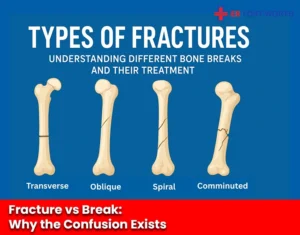
Fractures are classified by how the bone breaks and whether the skin is intact. Knowing the type helps determine treatment and healing time.
Stable (Non-Displaced) Fracture
The bone cracks but the pieces stay aligned. This is the most common type we see. A hairline crack in the foot after a fall. These often heal in a boot or cast without surgery.
Stress Fracture
No single traumatic event, just accumulated force over time. The bone develops microscopic cracks before it can repair itself. Runners, military recruits, and dancers are most vulnerable. The tibia and metatarsals are the most common sites.
Compound Fracture: What It Actually Means
Compound Fracture = ER Emergency
A compound fracture, also called an open fracture, is when the broken bone pierces or protrudes through the skin, or when a wound exposes the bone at the fracture site. This is not a ‘wait and see’ situation.
The danger is not just the bone itself. Once skin is broken, bacteria can enter and cause a bone infection (osteomyelitis) that is significantly harder to treat than the fracture. According to the AAOS, open fractures require urgent surgical washout and stabilisation. If you are looking at bone, or at an open wound near a fracture, go directly to an ER. Ours is open 24/7.
Greenstick Fracture
Common in children. Young bones are more flexible, they bend and crack incompletely rather than breaking all the way through. Think of snapping a green twig versus a dry one. The bone bends on one side and cracks on the other but stays in one piece.
Comminuted Fracture
The bone shatters into three or more pieces. This usually requires surgical fixation to reassemble the fragments. It’s more common with high-energy impacts, car accidents, and serious falls from height.
Transverse and Oblique Fractures
These describe the direction of the break, straight across the bone (transverse) or at an angle (oblique). They don’t change the basic treatment principles but do affect whether surgery is needed to hold the pieces in place.
When Should You Go to the ER for a Fracture? Stop and Read This.
Some injuries clearly need imaging. Others you can watch for a day. Here’s how to tell the difference, and please don’t scroll past this section if you’re sitting with a painful injury right now.
Go to the ER immediately if you have any of the following:
- Bone is visible through the skin, or an open wound sits near the injury site, this is a compound fracture, infection risk is serious
- The injured limb looks deformed, bent at an unnatural angle, or appears shorter than the other side
- Severe swelling or bruising appeared within minutes of the injury, not hours
- You cannot bear any weight on a leg, ankle, or foot
- You feel numbness, tingling, or loss of sensation near the injury, possible nerve involvement
- Wrist pain directly at the anatomical snuffbox (the hollow just below the base of your thumb) after a fall, this is a scaphoid fracture until proven otherwise
- A child is in significant pain and refusing to use a limb, paediatric fractures are not always obvious on physical exam alone
- The injury happened with major force, car accident, fall from height, direct impact to a large bone
If any of the above apply, come to ER of Fort Worth now.
We have on-site X-ray and imaging, open 24 hours a day, 7 days a week. No appointment. No referral needed.
You can probably wait, but still get checked within 24–48 hours, if:
- You can bear some weight with mild discomfort, and the swelling is gradual rather than immediate
- The pain is dull and came on slowly over days (possible stress fracture, still needs imaging, just not at 11 PM if you can help it)
- It’s a minor toe injury with no deformity and you can wiggle it
- You’re not sure if it’s a sprain or fracture, honestly, imaging is the only reliable way to know
Shin Fracture from Running, Is It a Stress Fracture?
What we see constantly at our Fort Worth ER is runners who waited two or three weeks on a stress fracture, assuming it was muscle soreness or shin splints. The pattern is almost always the same: the pain started subtle, got worse with every run, and now it hurts even walking to the car.
Stress fractures account for up to 20% of all sports medicine injuries, a figure consistent across multiple peer-reviewed studies including research published in StatPearls (NCBI). In runners specifically, the tibia is the most common site, followed by the metatarsals and fibula.
In Fort Worth and across the DFW area, we see a particular uptick in stress fractures during late summer and early fall, when runners are deep in half-marathon training or high school cross-country season starts. The Texas heat accelerates dehydration, which affects bone density and muscle fatigue. Fatigued muscles absorb less impact. More stress goes straight to bone.
What Does a Stress Fracture Feel Like?
The honest answer is: it starts like nothing special. A dull ache on the front of the shin or the top of the foot that eases with rest. You might run through it for a week. The tell is that it keeps returning, each time a little worse and a little earlier in your run. Eventually it hurts on your warm-up. Then it hurts walking.
A spot-tender point, one specific place that hurts when you press it, is one of the most reliable indicators on a physical exam. But an X-ray won’t always show early stress fractures. An MRI is the gold standard for diagnosis. At our Fort Worth ER, we can evaluate the clinical picture and recommend the right imaging path.
Most runners who come in tell us the same thing: ‘I thought it was shin splints.’ Shin splints (medial tibial stress syndrome) cause diffuse aching along the inner edge of the tibia. A stress fracture causes pinpoint tenderness at a specific spot. If you are not sure, come in. You cannot run a race on a fractured shin. We’d rather catch it early.
Not sure if it’s a stress fracture or shin soreness?
Our Fort Worth ER team can evaluate and image your injury today. Whether you’re training for the Cowtown Marathon or just walked in from the Trinity Trails, walk in any time. No appointment needed.
How Do You Know If You Fractured Your Wrist?
Wrist injuries are tricky. A sprain and a fracture can feel almost identical in the first hour, both swell, both hurt, both make you not want to move your hand. Here’s what we look for.
The anatomical snuffbox is the small hollow at the base of your thumb when you extend it, you can see it clearly if you do a ‘thumbs up.’ Press there gently. If that spot is painful after a fall on an outstretched hand, we treat it as a scaphoid fracture until imaging proves otherwise.
Why does that matter? The scaphoid is a small wrist bone with a tricky blood supply. If a fracture there goes untreated, part of the bone can die (avascular necrosis), leading to chronic wrist pain and arthritis. It’s one of those injuries where waiting two weeks before getting checked genuinely makes things worse.
In Tarrant County, we see a lot of wrist fractures from youth soccer falls, basketball catches gone wrong, and what we politely call ‘ladder-related adventures’ on weekends. The distal radius (the end of the forearm bone closest to the wrist) is the most commonly broken bone in adults. If you are swollen, can’t rotate your palm fully, and you fell on a hard surface, imaging is the only way to confirm. We have on-site X-ray ready.
Explore more about when to go to the ER vs urgent care for a fracture , sometimes it matters more than people realise.
Broken or Fractured Toe: Do You Need the ER?
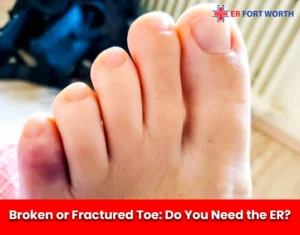
The short answer: it depends. And honestly, most people want permission to just buddy-tape it and move on. Sometimes that’s correct, and sometimes it’s not.
A minor fracture in the smaller toes (second through fifth) with no displacement and no significant deformity can often be managed with buddy-taping to the neighbouring toe, a stiff-soled shoe, and avoiding activity that causes pain. Most heal in three to four weeks.
But the big toe is different. It bears significant load and helps with push-off during walking. A displaced or articular big-toe fracture needs proper assessment and sometimes splinting or surgical fixation. And a broken fractured toe that looks crooked, is severely bruised, or is too painful to bear any weight at all, that’s worth imaging.
The other issue: what looks like a toe fracture might not be. We have seen metatarsal fractures, fractures further up the foot, present with toe-level pain. The 5th metatarsal base (just behind the little toe) fractures easily with ankle rolling injuries and is frequently missed without imaging.
Fractures of the Leg: Healing Times and What to Expect
Fractures of the leg cover a wide spectrum. A stress fracture in the tibia from overtraining is a very different injury than a mid-shaft tibia fracture from a collision. What they share: you can’t rush bone healing. Biology has a timeline.
Several factors influence how fast a fracture heals: your age (children heal faster), your nutritional status (calcium, vitamin D, and protein matter), whether you smoke (smoking significantly slows bone repair), and whether the fracture stays properly stabilised. Good compliance with treatment, wearing the boot, using the crutches, going to physical therapy, is not optional. It changes the outcome.
How Long Does a Fractured Bone Take to Heal?
| Bone / Location | Typical Healing Time | Notes |
| Finger / toe | 3–4 weeks | Often buddy-taped; imaging still recommended |
| Wrist (distal radius) | 6–8 weeks | Cast or splint, watch for scaphoid fractures |
| Ankle | 6–12 weeks | Depends on severity, boot or cast |
| Shin / tibia (stress) | 6–8 weeks | Rest critical, ignore it and it worsens |
| Leg (tibia shaft) | 3–6 months | Often requires surgical fixation |
| Hip / femur | 3–6 months | High-risk in older adults, often surgical |
| Rib | 6–8 weeks | Managed conservatively, breathing exercises key |
These are general ranges, your specific situation may differ. Healing is not finished just because pain is gone. Many fractures feel comfortable to walk on weeks before the bone is fully remodelled. Returning to full activity too early risks re-injury or malunion (the bone healing in the wrong position).
What Happens at Our Fort Worth ER for Fractures
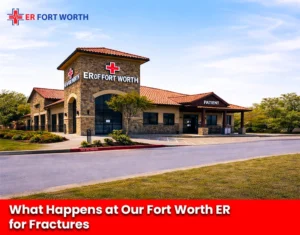
People avoid the ER for fractures partly because they don’t know what to expect. Here’s exactly what happens when you walk in to our Fort Worth location, no ambiguity.
First, our team does a rapid triage and assessment. We all ask how it happened, what the pain feels like, and whether you can bear weight. We examine the injury, looking at swelling patterns, skin integrity, sensation, and circulation distal to the fracture. Then we move to imaging.
We have on-site X-ray at our Er Of Fort Worth, available immediately, no sending you across town to a radiology centre, no waiting for a referral. Most fractures are clearly visible on X-ray within minutes of taking the image.
Depending on what we find: a simple fracture gets splinted on site, we discuss weight-bearing restrictions, and we give you clear written aftercare instructions along with an orthopaedic follow-up referral. A more complex fracture, or anything that looks like it may need surgical assessment, gets appropriate consultation initiated before you leave. A compound fracture is treated as the emergency it is.
What we see across Tarrant County on a typical Sunday: basketball ankle rolls, soccer collisions, fall-from-a-ladder wrist fractures, and youth sport injuries from the dozens of rec leagues running across Fort Worth. Whether you are driving in from Burleson, Keller, Mansfield, or Crowley, our ER is close, and we are ready. You won’t wait days for imaging and you won’t leave without a plan.
What Fort Worth Patients Say
“I landed wrong at my son’s football game and my wrist swelled up immediately. I wasn’t sure if I’d broken it or just sprained it, but my wife drove me to ER of Fort Worth and they had X-rays done within the hour. Turned out it was a fracture. They splinted me right there and I walked out knowing exactly what to do next.”
— Kevin R., 44, Mansfield, TX
“I’m a runner and I kept pushing through what I thought was shin soreness. A friend told me to get it checked before my next race. The ER team confirmed it was a stress fracture, caught early enough that I didn’t need surgery. I’m really glad I didn’t wait.”
— Priya M., 31, Keller, TX
Ready When You Are — 24/7 Fort Worth ER
ER of Fort Worth: No Appointment. No Wait for Imaging.
Whether you are a runner with a shin that’s been nagging for two weeks, a parent whose kid came off the football field limping, or someone who just slipped and landed hard on a wrist, we are here. Our Fort Worth ER has on-site X-ray and imaging, available right now, 24 hours a day, 7 days a week. No referral. No appointment.
Come in today. We will image it, assess it, and get you sorted, with a clear plan before you leave.
ER of Fort Worth | eroffortworthtx.com | Open 24/7
Frequently Asked Questions
Is a fracture the same as a break?
Yes, completely. A fracture and a break are medically identical terms. Both describe any disruption in bone continuity, from a hairline crack to a shattered bone. The AAOS confirms doctors use both terms interchangeably. If your doctor said ‘fracture,’ it means broken. It doesn’t mean less serious or more serious, it depends entirely on the type.
What is a stress fracture?
A stress fracture is a small crack caused by repetitive force rather than a single blow. It’s extremely common in runners, soldiers, and dancers. The tibia (shinbone) is the most frequently affected site. The bone hasn’t fully broken apart, but it will if you keep loading it. Early detection and rest are critical. Ignored stress fractures become complete fractures.
How long does a fractured bone take to heal?
It depends on which bone and how severe the fracture is. Fingers and toes typically take 3–4 weeks. Wrists and ankles: 6–12 weeks. Leg fractures of the tibia or femur: 3–6 months. Age, nutrition, smoking, and compliance with treatment all affect healing speed. Pain often disappears before the bone is fully healed, that’s not clearance to return to full activity.
What is a compound fracture?
A compound fracture, also called an open fracture, is when the broken bone pierces through the skin, or a wound exposes the bone directly. It is an ER emergency. Once skin integrity is lost at the fracture site, the risk of serious bone infection rises dramatically. Surgery to clean the wound is usually required. Do not wait. Come in immediately.
Can a broken fractured toe heal on its own?
Minor fractures of the smaller toes often heal with buddy-taping and a stiff-soled shoe. But the big toe is weight-bearing and needs careful assessment. If the toe looks deformed, you can’t bear weight, or pain is severe, imaging is needed. Also, what seems like a toe injury could be a 5th metatarsal fracture, which frequently accompanies ankle rolls. Don’t guess, get it imaged.
When should you go to the ER for a fracture?
Go immediately if: bone is visible, the limb is deformed or shorter than normal, you feel numbness or tingling, you cannot bear weight at all, or major force was involved. A child refusing to use a limb also needs ER evaluation, paediatric fractures aren’t always obvious. Our Fort Worth ER has on-site X-ray 24/7. Walk in any time.