
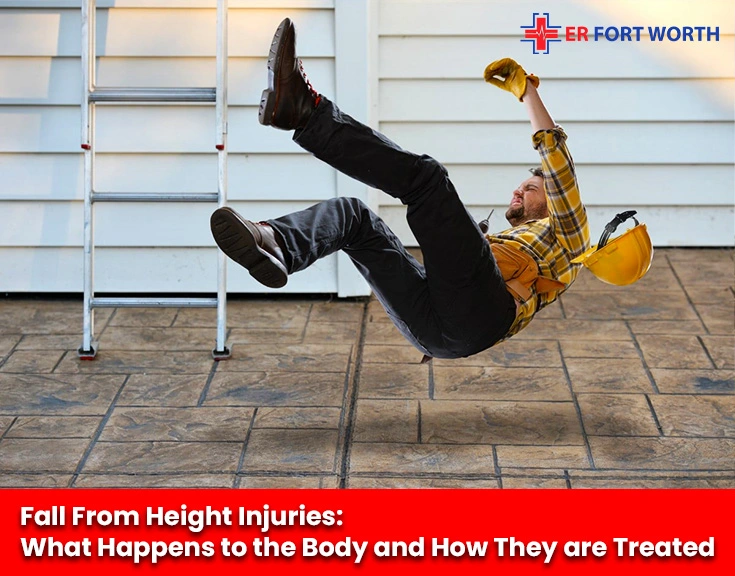
Fall from height injuries are a different problem from a trip on the sidewalk, because the body absorbs far more force when it lands from a greater distance. That extra force changes the injury pattern, the testing, and the treatment. A fall from six feet isn’t the same as a fall from six inches. Treat it differently.
Maybe you slid off a ladder while clearing the gutters. Maybe someone you love missed the last step on the stairs and now insists they are “fine.” Either way, you are sore, a little shaken, and trying to work out whether this is a walk-it-off kind of day.
That’s a fair question, and the honest answer is that it depends on how far, how hard, and where the impact landed. What we see constantly at our Fort Worth ER is someone who fell, felt okay enough to walk it off, and came in a day or two later once the real pain or swelling set in. If any real height was involved, ER of Fort Worth’s emergency services team can evaluate a fall from height properly and tell you what’s actually going on.
Not every fall needs an ER visit. But it’s worth knowing which ones do, and that’s what the rest of this guide sorts out.
Slip and Fall Injuries vs. Fall From Height Injuries: What’s the Difference?
These are two different categories, and mixing them up is where people get into trouble. Slip and fall injuries usually happen at ground level, on a wet kitchen floor, a patch of ice during one of our rare Fort Worth winter storms, or an uneven sidewalk. Falls from height start above standing level, like a ladder, a roof, scaffolding, or a long flight of stairs.
What does a slip and fall injury usually look like?
At ground level, your reflexes get a split second to help. You throw out a hand, twist, or tuck your chin. That’s why a typical slip and fall injury shows up in the wrist, hip, tailbone, ankle, or knee.
Most of these are bruises, sprains, strains, and the occasional broken wrist. Older adults are the exception, since a simple ground-level fall can break a hip. And honestly, that group is where a “small” fall deserves the most respect.
What changes when the fall is from height?
Height adds energy. The farther you drop, the more force your body has to absorb on landing, and reflexes can’t soak up that much. That’s why falls from height are linked to more fractures, more internal injury, and longer hospital stays than same-level falls.
Height isn’t the only variable, though. What you land on, how you land, and your age and health all matter. A fall from just a few feet onto concrete can hurt more than people expect.
Stairs sit in the gray zone. A couple of steps usually behaves like a ground-level fall, but a long flight can produce force closer to a fall from height, especially if you tumble.
So here’s the working rule. Ground-level falls with mild soreness can usually be watched at home. Anything from a height deserves a proper look.
How Does the Body Absorb an Impact From Height?

What Happens to the Body During a Fall From Height?
Trauma teams call this the mechanism of injury, and it’s one of the first things we ask about. How far was the drop? What was the landing surface? Which part of the body hit first?
Those three answers steer almost everything that follows. Landing on the feet sends force up through the heels, legs, pelvis, and spine. Landing on an outstretched hand sends it through the wrist, forearm, elbow, and collarbone.
Distance matters in a measurable way. A 2022 trauma-center study of 65 fall survivors found that people who fell more than about 6 meters (roughly 20 feet) had significantly more lower-limb fractures, and longer ICU and hospital stays, than people who fell shorter distances. It’s a small study, and the link between distance and length of stay was weak, so read it as a pattern, not a prediction.
Distance wasn’t the whole story, either. The same study found no significant difference in head, chest, or abdominal injuries between the two groups. A shorter fall can still hurt the head or the belly.
Here’s how force tends to show up, region by region:
- Feet, legs, and pelvis: heel, ankle, and leg fractures are common when the legs take the landing.
- Wrists and arms: instinct sends the hands out first, so wrist, forearm, elbow, and collarbone breaks are common.
- Spine: force travels upward, and compression fractures in the lower back can happen without any obvious deformity.
- Chest and abdomen: rib fractures, bruised lungs, and injuries to organs like the spleen, liver, or kidneys, which can bleed inside with little to see on the outside.
- Head and neck: concussion, bleeding around the brain, and neck injuries, even when the person seems alert at first.
Several of these can stay quiet for hours. Someone can feel “mostly just sore” while an internal injury is developing, which is exactly why height changes the rules.
Medicine has a formal label for the serious end of this range. According to Wikipedia’s overview of major trauma, major trauma is any injury with the potential to cause prolonged disability, and researchers usually use an Injury Severity Score above 15 as the cutoff. Falls are listed among its leading causes.
When a Fall Needs More Than Home Care
Most slips and minor falls don’t belong on this list. These do. If any of the following describes your situation, stop wondering and come in:
- You fell from higher than standing level: a ladder, stairs, a roof, or scaffolding.
- You hit your head in any way, including a brief loss of consciousness, confusion, repeated vomiting, or a headache that’s getting worse.
- You can’t bear weight, stand up, or move a limb normally.
- You see visible deformity or severe swelling, or you suspect a fracture.
- Your abdominal pain is severe or getting worse after the fall, which can signal an internal injury.
- You have back or neck pain along with numbness, tingling, or weakness in your arms or legs.
- You take blood thinners, or you’re an older adult with any new symptom after a fall.
That’s the whole list. For any of it, our emergency services team at ER of Fort Worth is open around the clock, with imaging on site.
| If any of the above apply, come to the ER of Fort Worth. We can evaluate the injury properly and make sure nothing’s been missed, open 24 hours a day, 7 days a week. No appointment. No referral needed. |
This is probably fine to manage at home if…
Not every stumble is an emergency, and we’d rather you feel confident about that. A fall is likely fine to manage at home when all of these are true:
- The soreness is mild, and there’s no head injury and no back or neck pain.
- You can move normally and put full weight on the area.
- Your symptoms are improving each day instead of worsening.
In that case, rest, ice for the first day or two, and an over-the-counter pain reliever used as the label directs are usually the plan. If anything gets worse instead of better, that’s your cue to come in.
How Long Does Healing Really Take?

How Long Does It Take for Your Body to Heal After a Fall?
The short answer is that it depends on what was injured. A bruise takes days, a sprain takes weeks, and a broken bone takes months. “A few days” simply doesn’t apply to everything.
Here are the ranges we typically talk through with patients:
- Bruises and minor soreness: usually one to two weeks.
- Sprains and strains: often two to six weeks, and longer for moderate or severe ones.
- Simple fractures: commonly six to twelve weeks for the bone to heal, followed by rehab to regain strength.
- Complex fractures or surgical repairs: several months, sometimes longer, before full function returns.
- Concussion: many people improve within a few weeks, but some symptoms can linger longer.
Those are ranges, not promises. Age, overall health, smoking, and how well the injury was protected in the first few days all move the numbers. If healing seems slower than it should be, that’s worth a check.
Healing can also drag when someone gets back to ladders, lifting, or sports too early. Bone needs protection, and a rushed sprain can turn into a sprain that never quite settles. Activity limits from your provider aren’t suggestions.
| Not sure how serious a fall was, or how it’s actually healing? Our Fort Worth ER team can evaluate the injury and give you a clear plan today, walk in any time. |
What Will the ER Actually Do?
Fall From Height Injuries: Treatment
Treatment starts with a trauma assessment. We check vital signs, breathing, circulation, and nerve function, then examine you from head to toe. The goal is to find the injuries you know about and the ones you don’t.
Why not just examine you and send you home? Because a physical exam only goes so far. Small fractures, spine injuries, and internal bleeding can hide behind ordinary-looking soreness, and imaging answers the question quickly.
Imaging comes next. X-rays show most broken bones. A CT scan gives a closer look at the head, spine, chest, or abdomen when your symptoms or the way you fell call for it.
From there, care follows the findings, and it’s easiest to describe by category:
- Pain and inflammation management so you can move and rest comfortably.
- Fracture stabilization with splints or immobilization until the bone can heal or be repaired.
- Wound care for cuts and scrapes.
- Observation and repeat exams when a head or internal injury is possible.
- A follow-up plan, including physical therapy when it will help.
Some injuries need more than an ER can finish. If imaging shows an unstable fracture, internal bleeding, or a serious head or spine injury, we coordinate the next step, which may mean hospital admission or specialist surgical care. Once the urgent part is handled, physical therapy often helps people get strength and movement back.
What Should You Watch for Once You are Home?
Post-Fall Symptoms You Shouldn’t Ignore
Some of the most important symptoms show up late. Adrenaline can mask pain for hours, so a person can feel fine at the scene and rough the next morning.
Watch for these post-fall changes over the next several days:
- Pain or swelling that’s getting worse instead of better.
- A headache that keeps growing, repeated vomiting, unusual sleepiness, confusion, or trouble with balance or vision.
- Belly pain that builds, especially with dizziness or a pale, clammy look.
- New numbness, tingling, or weakness in an arm or leg.
- Trouble walking or putting weight on a limb that worked fine right after the fall.
Any one of those means a second look, even if the fall seemed minor at the time. Better to get checked than to keep guessing.
Who Needs to Be Extra Careful After a Fall?
Some people carry more risk from the same fall. Older adults are the clearest example. Bones are more brittle, balance is less forgiving, and a quiet hip fracture can look like a bad bruise for a day or two.
Blood thinners are the other big one. Even a modest bump to the head can cause bleeding that doesn’t announce itself right away. If you take them and you’ve fallen, get checked, even if you feel okay.
Kids fall constantly and bounce back fast, which is mostly good news. Still, a child who’s unusually sleepy, keeps vomiting, or won’t use an arm after a fall needs an exam. Parents know their own kid’s normal, so trust that instinct.
There’s an emotional side too. Slip and fall injuries often leave a loss of confidence behind, not just a loss of movement. Plenty of people get anxious about stairs, ladders, or walking alone after a bad fall. That fear is common, it usually eases with time and rehab, and it’s fair to mention it to your provider.
How Common Are Falls, Really?
Fall Injury Statistics: Why Fall Accidents Are Worth Taking Seriously
Falls are among the most common reasons people end up in an emergency room. According to the CDC, more than 14 million older adults, about 1 in 4, report falling every year. In 2024, emergency departments recorded about 4.5 million visits for older adult falls.
Those numbers only count older adults. Falls hit every age group, from kids on playground equipment to adults on ladders, which is why the same habits and the same warning signs apply across the board.
Workplace falls count too. OSHA calls falls among the most common causes of serious work-related injuries, and it requires fall protection at four feet in general industry and six feet in construction. Across DFW job sites, from roofing crews to framing crews, that line exists for a reason.
The good news is that most fall accidents are preventable. A few habits do most of the work:
- Set ladders on firm, level ground, and keep three points of contact.
- Don’t carry heavy loads up a ladder or stairs. Use a tool belt or a hoist instead.
- On a roof, use the harness and anchors your job requires, every time.
- At home, fix loose rugs, clear the stairs, and light the hallways.
- Wear shoes with real grip, especially on wet or icy days.
None of that is glamorous. All of it works.
What Happens at Our Fort Worth ER After a Fall Accident

Here’s what a visit actually looks like. You walk in, any hour, with no appointment and no referral. A nurse checks you in, a provider examines the injury, and we order imaging if it’s needed.
Imaging is on site, so you are not waiting days to learn whether a fall did more damage than it seemed. You leave with answers the same day: what’s injured, what isn’t, and what comes next.
Bring a few things if you can: a list of your medications, especially any blood thinners, and a quick note on how far you fell and what you landed on. Those details help us read the injury faster. If you can’t remember them, that’s fine. We’ll work it out from the exam.
We see falls year-round across Tarrant County. Ladder falls during weekend home projects, roofing and construction falls, kids hurt in youth sports, and plenty of plain old slips. Whether you are in Burleson, Keller, Mansfield, or Crowley, it’s a short drive to us.
Not every visit ends in a cast. Sometimes the best news we can give is that the fall caused a bad bruise and nothing more. Either way, you walk out knowing.
| “After I fell from a ladder, I had severe pain in my back and leg and was worried I had a serious injury. I went to ER of Fort Worth, where the team evaluated me and arranged the imaging I needed. They explained everything clearly and helped me understand the next steps for recovery. I’m grateful for how quickly and professionally they handled my fall from height injuries.” — Christopher, Fort Worth, TX |
| “I injured my ankle and wrist after falling from a height and knew I needed to get checked right away. The staff at ER of Fort Worth were thorough, professional, and reassuring throughout the visit. They evaluated my injuries, provided appropriate treatment, and explained what I should do after leaving. I would recommend them to anyone who needs prompt medical attention after a fall from height injury.” — Elizabeth, Keller , TX |
Come In Today
If you are in Fort Worth, Burleson, Keller, Mansfield, Crowley, or anywhere across Tarrant County and a fall has you worried, come in today. ER of Fort Worth is open 24/7, and we’ll evaluate the injury, explain what we find, and give you a clear plan, not just treatment. We are ready when you are. Keller
Frequently Asked Questions
How long does it take for your body to heal after a fall?
It depends on the injury. Bruises usually fade within one to two weeks, sprains take two to six weeks, and simple fractures often need six to twelve weeks. Head injuries and complex fractures can take longer, so if healing stalls or pain worsens, get it checked.
How is a fall from height injury different from a slip and fall injury?
Height means more force on landing. A slip and fall injury is usually a sprain, bruise, or single fracture, while a fall from height can injure several parts of the body at once. That’s why height calls for a full ER evaluation, even when you feel mostly okay.
What does treatment look like after a fall from height?
Treatment starts with a trauma assessment, then imaging such as an X-ray or CT scan. Care follows the findings: pain and inflammation management, fracture stabilization, and observation. Serious injuries may need hospital admission or surgery, and physical therapy often helps recovery afterward.
What post-fall symptoms should I watch for?
Watch for worsening pain or swelling, a growing headache, repeated vomiting, confusion, belly pain, or new numbness or weakness. These symptoms can appear hours or days later. Any of them means it’s time for a medical check, even if the fall seemed minor.
When does a fall accident need ER evaluation instead of home care?
Come in after any fall from above standing height, any head injury, or if you can’t bear weight, see deformity, or have severe abdominal pain. Blood thinners and older age lower the bar. Mild soreness that’s improving can usually be managed at home.
Do I need an X-ray after every fall?
No, not every fall needs imaging. Mild soreness with full movement that’s improving each day often doesn’t. An X-ray makes sense if you can’t put weight on a limb, the area looks deformed, or the pain is severe, and a provider can usually decide quickly after examining you.
Can I wait a day to see if a fall injury gets better?
For a minor ground-level fall with mild symptoms, watching for a day or two is reasonable. After a fall from height, a head injury, or any red-flag symptom, don’t wait. Delayed symptoms are common, and early evaluation catches problems before they grow.