
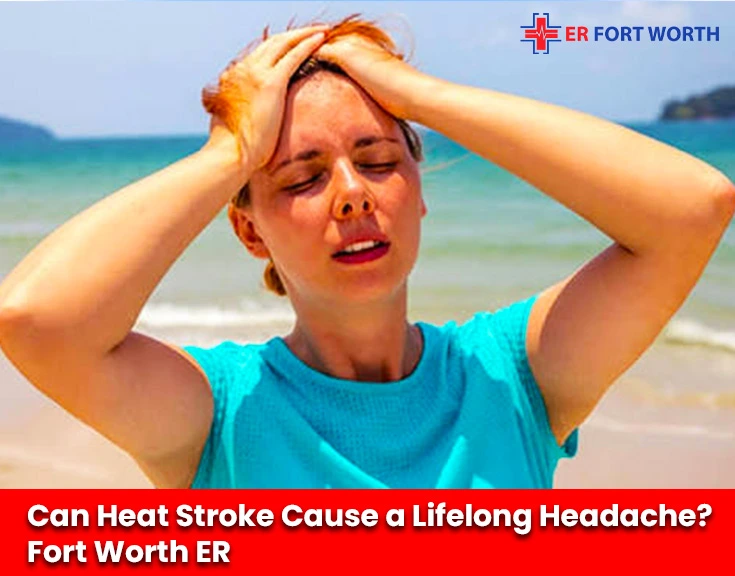
Can heat stroke cause lifelong headache? The honest answer is yes, for a meaningful minority of people, current research links heatstroke to a real, measurable increase in long-term headache risk, though it’s genuinely not what happens to most people who recover from one. If you are reading this because you had heatstroke weeks or months ago and the headaches just haven’t stopped, that distinction matters, and we’ll walk through exactly what the research shows. If you are reading this because someone’s temperature is spiking right now and something feels seriously wrong, skip ahead, the red-flag section below tells you exactly when this is a 911 situation, not a wait-and-see one. What we see at our Fort Worth ER during the worst of summer is heatstroke arriving exactly the way the textbooks describe it, and, sometimes, the same patients coming back months later with a headache that just won’t quit.
What Is Heat Stroke?
Heat stroke happens when your body’s temperature-regulation system fails completely, not just overwhelmed, but shut down. Your core temperature climbs to 104°F or higher, sweating often stops working, and the brain starts showing it: confusion, slurred speech, agitation, sometimes seizures. That’s genuinely different from heat stroke‘s milder cousin, heat exhaustion, where you are sweating heavily, you feel awful, but your mental status stays normal. Heat stroke is a true medical emergency. Heat exhaustion, treated early, usually isn’t.
What Are the Symptoms of Heatstroke?
So how do you actually recognize it? Look beyond the thermometer, the neurological signs are what set heatstroke apart from ordinary overheating.
- A core body temperature of 103°F or higher
- Confusion, slurred speech, agitation, or behavior that’s just off
- Hot, dry, flushed skin, or sometimes heavy sweating that suddenly stops
- A rapid, strong pulse and fast breathing
- Severe headache, nausea, or vomiting during or right after heat exposure
- In the worst cases: seizures or loss of consciousness
Headache shows up early and often in this list, which is exactly why the question of lasting headaches afterward comes up so much. We’ll get there. First, the part that can’t wait.
Heat Stroke Is a Medical Emergency, Know the Signs
Heat stroke is not something to wait out at home, and if any of the signs below apply, ER of Fort Worth’s emergency services team can treat heat stroke the moment you arrive,but you need to recognize the signs first.
- A body temperature above 103°F (39.4°C)
- Hot, dry, flushed skin, or, in some cases, heavy sweating that suddenly stops
- Confusion, slurred speech, agitation, or unusual behavior
- Rapid, strong pulse or rapid breathing
- Seizures or loss of consciousness
- Severe headache with nausea or vomiting during or right after heat exposure
This is probably just a heat headache if it’s mild, throbbing pain with normal mental status, no fever, and it improves within a couple of hours once you have cooled down and had some water. That pattern doesn’t need an ER. The list above does.
If any of the above apply, call 911 or come to ER of Fort Worth now. Heat stroke is a medical emergency, and we’re ready 24 hours a day, 7 days a week. No appointment. No referral needed.
Can a Heat Stroke Have Long-Term Effects?
Heat stroke ends. Sometimes the complications don’t. Documented long-term effects can include lasting neurological changes, kidney strain, liver stress, and cardiovascular effects, the body systems that take the hardest hit during the acute event are the ones most likely to show lingering effects afterward. Most people who recover from heat stroke don’t go on to develop any of these. But a real subset of patients do, and headache is one of the more common ones worth knowing about specifically.
Can Heat Stroke Cause Lifelong Headache?
Here’s what the actual research says: a 2025 German retrospective cohort study, Kostev, Rodemer, Konrad & Bohlken, Brain Sciences , followed 5,794 people diagnosed with heatstroke and 28,970 closely matched people who hadn’t had one. Within five years, 8.8% of the heatstroke group was diagnosed with migraine, compared to 4.0% of the matched group, more than double the risk (HR 2.26, 95% CI 2.00 — 2.57), and the pattern held up across both sexes and most age groups.
So does that mean every heatstroke patient ends up with chronic migraines? Not even close. Over 91% of the heatstroke group in that study were not diagnosed with migraine within five years. What the research shows is a real, statistically solid increase in risk, not a guarantee, and not the typical outcome.
Why would this even happen? Severe heatstroke can disrupt the blood-brain barrier and trigger inflammation in the brain, changes researchers think may lower the threshold for migraine in people who are already somewhat prone to it, a mechanism described in both the cohort study above and in general overviews of heat stroke‘s neurological effects. That’s the honest, current state of the evidence: a real mechanism, a real association, and real limitations, it’s a retrospective study, which means it shows association, not proof that heatstroke directly causes every one of those migraine diagnoses.
How Long Can a Headache From Sunstroke Last?
An ordinary sunstroke or heat headache, the kind that comes with simple overheating, dehydration, or too much sun glare, usually clears up within a couple of hours once you cool down and rehydrate. That’s the typical case, and it’s not what we’re talking about with the cohort study above.
The smaller, different situation is a headache that develops into an actual persistent or chronic headache disorder after a heatstroke episode, showing up repeatedly over weeks or months rather than resolving in an afternoon. If your headaches have outlasted the heatstroke itself by weeks, that’s not the same thing as a one-off sunstroke headache, and it’s worth treating as its own question, not just “the heatstroke still lingering.”
Still dealing with headaches since a past heatstroke episode? Our Fort Worth ER team can evaluate what’s going on and help build an actual treatment plan, walk in any time.
Heat Headache vs. Post-Heatstroke Headache: What’s the Difference?
A heat headache and a post-heatstroke headache aren’t the same animal, even though they get talked about like they are. An ordinary heat headache comes from dehydration, sun exposure, or general overheating, it’s triggered by the heat itself, shows up the same day, and resolves within hours once you cool off and drink water. A post-heatstroke headache is different: it shows up after you have already recovered from the acute emergency, sometimes weeks or months later, and it doesn’t go away with a glass of water and some shade.
Telling them apart matters for what you actually do next. A heat headache needs fluids and cooling. A persistent headache that started after a heatstroke episode needs an actual evaluation,not because it’s automatically dangerous, but because it’s worth ruling other things out and building a real treatment plan instead of just living with it.
What Is Heat Pooling, and How Is It Connected to Headaches?
Heat pooling refers to blood pooling in your legs when heat causes your blood vessels to widen (vasodilation) to help release heat through your skin. When that happens, especially if you have been standing still in the heat, gravity pulls more blood down into your legs than your circulatory system can easily pull back up. That’s the mechanism behind heat syncope, fainting from heat, and in that moment, reduced blood flow back to the brain can genuinely trigger head pain alongside the dizziness and lightheadedness.
It’s not the same mechanism as the blood-brain-barrier disruption discussed in the cohort study above, and it’s worth being precise about that difference. Heat pooling explains an acute, in-the-moment headache tied to a drop in blood flow. It isn’t itself a documented cause of a chronic, months-later headache disorder, that’s a separate question, and the honest answer is the connection there is still being studied, not fully settled.
Does Heat Increase the Risk of Stroke?
Heat stroke and an actual stroke share a word, and that causes real confusion, so let’s be clear about the difference before anything else. Heat stroke is your body’s temperature-control system failing under heat exposure. A stroke is blood flow to the brain being cut off or a blood vessel bleeding, from a blood clot or a ruptured vessel, and it has nothing to do with outdoor temperature at its core.
That said, there’s a real, separate question worth answering honestly: does hot weather itself raise stroke risk? CDC’s guidance on extreme heat and health notes that extreme heat puts real strain on the cardiovascular system, it can affect blood pressure and how hard your heart has to work, and that strain is part of why heat waves are associated with more cardiovascular events generally, stroke included. It’s a real, documented pattern. It’s also a modest, population-level effect, not something that means any one hot day meaningfully raises your personal stroke risk. The clearer, more direct risk from extreme heat is heat stroke itself, and that’s the one worth acting on fast.
What Happens at Our Fort Worth ER for Heat Stroke and Persistent Headaches
North Texas summers are long, and they are intense enough that heat stroke is a real recurring concern here, not a rare event, across Tarrant County, we see it regularly enough every summer that these long-term questions come up all the time. Whether you are in Burleson, Keller, Mansfield, or Crowley, our ER is minutes away, and that matters when minutes are exactly what heat stroke doesn’t give you much of.
For an active heat stroke emergency, treatment starts with rapid cooling, getting your core temperature down fast is the single most important thing we can do, alongside IV fluids and close monitoring of how your organs are handling the stress. Outdoor workers, athletes, and older adults are the patients we see most often during peak summer months, and we’re built for exactly that volume during Fort Worth’s worst heat.
For a lingering headache after a past heatstroke episode, the visit looks different: our emergency services team can evaluate a headache that hasn’t let up since your heatstroke, rule out anything else that could be causing it, and help build an actual headache management plan rather than sending you home to just keep dealing with it. Most people who recover from heatstroke don’t go on to develop chronic headaches, but if you are one of the people who did, that’s real, and it deserves a real answer.
What Fort Worth Patients Are Saying
“I started experiencing warning signs of heatstroke and realized I needed medical attention right away. I came to ER of Fort Worth, where the medical team acted quickly to evaluate me and begin treatment to safely cool my body. They closely monitored my condition and made sure I was stabilized before I left. I’m very thankful for the prompt care I received when I needed it most.”
— David , Fort Worth, TX
“After experiencing heatstroke, I continued having headaches that didn’t seem to go away. When the symptoms persisted, I decided to get evaluated at ER of Fort Worth. The medical team listened to my concerns, evaluated my symptoms, and explained what could be causing the ongoing headaches. They gave me a clear treatment plan and guidance on what to watch for moving forward.”
— Amanda , Fort Worth, TX
We are Ready When You Are
Heat stroke is a 24/7 emergency, full stop, if that’s what’s happening right now, call 911 or come in immediately, no appointment needed. And if you are one of the people still dealing with headaches weeks or months after a past heatstroke episode, that’s worth a real evaluation too, not something to just keep living with. Whether you are in Fort Worth, Burleson, Keller, Mansfield, or Crowley, we are ready when you are, 24 hours a day, 7 days a week, come in today.
Come In ER Of Fort Worth
Can Heat Stroke Cause Lifelong Headache? FAQs From Our ER Team
Here’s what Fort Worth patients ask us most about heat stroke and the headaches that sometimes follow it.
What are the symptoms of heatstroke?
Heatstroke symptoms include a core body temperature of 103°F or higher, confusion or slurred speech, hot and dry (or suddenly non-sweating) skin, a rapid pulse, severe headache, nausea, and in severe cases, seizures or loss of consciousness. The neurological signs, confusion, agitation, slurred speech, are what separate it from ordinary overheating.
Can heat stroke cause lifelong headache?
For most people, no, but a 2025 cohort study found heatstroke patients were more than twice as likely to be diagnosed with migraine within five years (8.8% vs. 4.0% of matched controls). It’s a real, documented risk for a minority of patients, not a guaranteed outcome, and it’s treatable rather than something to just live with.
How long can a headache from sunstroke last?
An ordinary sunstroke or heat headache typically resolves within a couple of hours once you cool down and rehydrate. A smaller number of people develop a persistent headache that continues for weeks or months after the heatstroke itself has resolved, that’s a different situation and worth getting evaluated.
Can a heat stroke have long-term effects?
Yes, in a subset of cases, documented long-term effects can include neurological changes, kidney and liver strain, cardiovascular effects, and an increased risk of developing migraine. Most people who recover from heatstroke don’t experience lasting effects, but it’s worth monitoring for new symptoms in the months afterward.
What’s the difference between a heat headache and a stroke?
A heat headache comes from heat exposure, dehydration, or heatstroke and affects head pain specifically. An actual stroke is a disruption of blood flow to the brain from a clot or bleed, and it’s unrelated to outdoor temperature at its core, though extreme heat does put added strain on the cardiovascular system generally.
What is heat pooling?
Heat pooling is blood pooling in your legs when heat-driven vasodilation widens your blood vessels to release heat, and gravity pulls more blood down than your circulation easily pulls back up. It’s the mechanism behind heat syncope (fainting from heat), and the reduced blood flow to the brain in that moment can trigger head pain.
Does heat increase the risk of stroke?
Extreme heat puts real strain on your cardiovascular system and is associated with more cardiovascular events generally during heat waves, stroke included, but this is a modest, population-level pattern, not a sign that any one hot day meaningfully raises your personal risk. Heat stroke itself remains the more direct, urgent heat-related risk.