Reviewed by the emergency care team at ER of Fort Worth | 4561 Heritage Trace Pkwy, Suite 117, Fort Worth, TX 76244 | +1 817-945-4200
Call 911 immediately: For stridor (high-pitched squeaking) at rest, bluish lips or face, severe difficulty breathing, drooling with inability to swallow, chest sinking in with each breath, or your child appearing limp or unresponsive. These signs mean the airway is dangerously narrow.
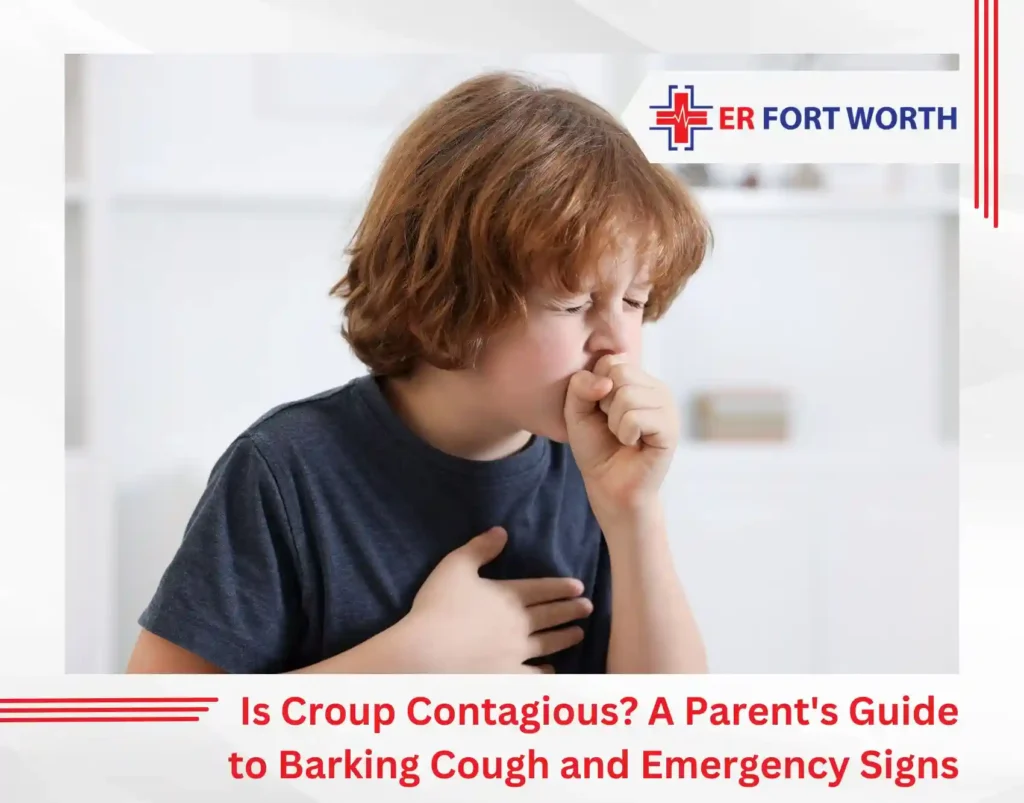
Is croup contagious? Yes. The viruses that cause croup spread easily through coughing, sneezing, and shared surfaces, which is why it often moves through daycares and households in waves. The croup barking cough itself is not contagious, but the virus behind it absolutely is.
Most croup resolves at home with cool air and comfort, but some cases turn into airway emergencies within hours. Below is a parent-first guide to recognizing croup, understanding how it spreads, and knowing exactly when to walk your child into our Fort Worth ER.
Is Croup Contagious? The Direct Answer
Yes, croup is contagious. The parainfluenza virus causes most cases and spreads the same way as a common cold: respiratory droplets from coughing or sneezing, and touching contaminated surfaces then face, nose, or mouth. Children spread the virus most during the first three days of symptoms.
The barking cough and hoarse voice that define croup are symptoms, not the infection itself. A child cannot catch croup from another child’s cough directly. They catch the underlying virus, which then triggers their own croup response, or in some cases just a plain cold.
The American Academy of Pediatrics HealthyChildren.org confirms that most croup is caused by common respiratory viruses including parainfluenza, RSV, influenza, and adenovirus, all of which spread easily among children under age 5.¹
How Long Is Croup Contagious? The Contagion Clock

How long is croup contagious depends on which virus caused it, but most children spread the infection most strongly during the first three days. The clock below shows the full contagion window so parents know when daycare or school can resume.
Day 0-2 Pre-Symptom Spread (Silent Phase)
Your child has been exposed but may not have symptoms yet. They are already shedding virus and can spread it. This is why croup often circulates in waves: by the time one child shows symptoms, others have already been infected.
Day 3-5 Peak Contagious Window
This is when the barking cough usually starts, often at night. Viral shedding is at its highest. Keep your child home from daycare, school, and playdates. Fever is common during this window. Most emergency ER visits for croup happen during this phase.
Day 5-7 Winding Down
The barking cough is easing. Viral shedding is dropping fast. Your child may still feel tired or have a normal cough and runny nose. Fever is usually gone. Return to daycare is reasonable once the child is fever free for 24 hours and breathing comfortably.
Day 7-10+ Recovery
Your child is usually not contagious by this point. Any remaining cough is a leftover tissue irritation, not spreading virus. Full recovery expected unless a secondary bacterial infection has developed, which is rare but possible.
Rule of thumb: Keep your child home from daycare or school until they have been fever free without medication for 24 hours and are breathing normally. The barking cough itself can linger past the contagious window and does not require ongoing isolation.
What Does Croup Sound Like? The Cough Sound Severity Ladder
Recognizing croup symptoms in kids starts with the cough itself. The sound ladder below walks you from classic croup to true emergency. Each level is louder, tighter, and more urgent than the one before it.
LEVEL 1. Classic Barking Cough: Sounds like a seal or small dog barking. Harsh, dry, repetitive. Usually worse at night. Child may have a hoarse voice. This is classic croup and often manageable at home.
LEVEL 2. Barking Cough with Mild Stridor on Activity: Barking cough plus a high-pitched whistling sound (stridor) heard only when the child cries, laughs, or is active. Resolves when the child is calm. Still usually manageable at home with cool air.
LEVEL 3. Stridor at Rest: The high-pitched squeak or whistle happens even when the child is calm. Chest may sink in slightly with each breath (retractions). Nostrils flare. This is a same day ER visit.
LEVEL 4. Severe Airway Distress: Loud stridor, chest sinking deeply with every breath, bluish lips or face, drooling with inability to swallow, confusion, or child appearing exhausted from the work of breathing. Call 911 immediately.
The Nemours KidsHealth guide to croup explains that stridor at rest is the single most important warning sign that croup has crossed from mild into dangerous airway narrowing. Trust what you hear, not what the child says they feel.²
The Parent Playbook: What to Do at Home Right Now

Most croup symptoms in kids can be comforted at home with specific techniques. These steps often calm the barking cough within 20 minutes. If they do not, the next section covers when to switch to ER mode.
STEP 1: Stay Calm (Your Child Reads Your Face)
Crying and panic tighten the airway further. Sit with your child, hold them upright on your lap, speak quietly, and avoid rushing around. A calm parent lowers stridor faster than almost any home remedy.
STEP 2: Cool Air for 10-20 Minutes
Wrap your child warmly and step outside into cool night air, or open a window. Cool air shrinks swollen airway tissue. In winter, many parents notice the cough calms during the car ride to the ER before they even arrive. Alternative: open the freezer and have the child breathe the cool air for a few minutes.
STEP 3: Humid Air (Optional, Secondary)
Warm steam from a hot shower in a closed bathroom also helps some kids. Have your child breathe the humid air for 10 to 15 minutes. Do not use hot steam directly, which risks burns. Cool mist humidifiers work for ongoing nighttime comfort.
STEP 4: Raise the Head for Sleep
Prop your child’s head slightly higher with a pillow (only for children over age 1). An inclined position reduces post-nasal drip and eases breathing. Sleep in the same room so you can monitor the cough at night.
STEP 5: Offer Clear Fluids
Small frequent sips of water, breastmilk, or formula. Dehydration thickens mucus and worsens coughing. Avoid dairy if it seems to thicken secretions. Popsicles work well for toddlers who refuse other fluids.
STEP 6: Watch for Escalation
If 20 minutes of cool air and calm have not reduced stridor, if stridor is present at rest, or if your child is working hard to breathe, switch from home care to ER care. Do not wait to see if it gets worse overnight.
When Is Croup an Emergency?
When is croup an emergency is one of the most searched questions by parents during a croup night, and for good reason. Mild croup is scary but safe. Severe croup needs professional airway support.
Come to the ER now for any of these
- Stridor (high-pitched squeak) that happens while your child is calm, not just crying
- Chest sinking in with every breath (retractions)
- Nostrils flaring with each breath
- Difficulty speaking in short sentences
- Child appears exhausted or lethargic from the effort of breathing
- No improvement after 20 minutes of cool air and calming
- Croup symptoms in kids under 6 months
- Fever above 103 F combined with the barking cough
Call 911 immediately for these
- Bluish or gray lips, tongue, or fingernails
- Drooling and inability to swallow (possible epiglottitis)
- Child unable to speak or cry
- Loss of consciousness or extreme drowsiness
- Severe chest sinking in with each breath
Epiglottitis, a rare but life threatening bacterial infection, looks similar to croup at first but gets dangerous much faster. Drooling, inability to swallow, and sudden high fever are the key differences.
Who Is Most Likely to Catch Croup?
Croup mostly affects children between 6 months and 3 years old, though it can happen up to age 6 or so. Some kids are more susceptible than others.
- Age 6 months to 3 years: Peak risk due to small airway diameter; even mild swelling causes big symptoms
- Children in daycare or with older siblings: Higher exposure to circulating viruses
- Fall and winter months: Peak season for parainfluenza and other triggering viruses
- Children with prior croup episodes: Some kids are prone to recurrent spasmodic croup
- Boys slightly more than girls: Statistically higher incidence, though reason is unclear
- Kids with asthma or allergies: Underlying airway inflammation worsens croup response
For related respiratory virus questions, see our guides on how long does it take for RSV to go away and how to stop whooping cough at night. These overlap with croup in both season and symptoms, so our pediatric team sees them often during the same outbreak period.
What Happens at ER of Fort Worth for Croup?

At ER of Fort Worth, evaluation for croup starts with oxygen saturation, a focused airway assessment, and listening to the quality of the stridor. Our team specializes in pediatric respiratory emergencies and has treatment available on site that most pediatric offices do not stock.
Immediate airway assessment
- Visual check for retractions, nasal flaring, and skin color
- Pulse oximetry to measure oxygen saturation
- Listening to breath sounds and stridor at rest
- Mental status check for signs of fatigue from work of breathing
Treatment options on site
- Supplemental oxygen if saturation drops
- Humidified or cool air delivery
- Nebulized treatments for airway swelling
- Steroid dose to reduce inflammation (rapid acting)
- Observation period to confirm response before discharge
For broader viral infection patterns, our acute upper respiratory infection and rhinovirus or enterovirus guides walk through the common viruses that trigger croup. If your child also has wheezing, our silent asthma attack symptoms guide covers the asthma overlap we also evaluate.
For children with severe croup requiring extended observation, oxygen, or admission, our board certified emergency physicians coordinate direct transfer to a pediatric hospital partner with records sent ahead.
Walk in for evaluation: ER of Fort Worth is open 24/7 for pediatric croup with same visit airway assessment, oxygen, and nebulized treatments. Call +1 817-945-4200 or walk in anytime.
Common Questions
Is croup contagious to adults?
The virus is contagious to adults, but adults rarely develop the barking cough version because their airways are larger. An adult may catch a cold from a child with croup without ever sounding croupy themselves.
How long is croup contagious for siblings?
How long is croup contagious depends on the virus but is typically 3 to 7 days from symptom onset. Siblings are at highest risk during the first 3 days. Hand washing, separate drinking cups, and covering coughs reduce spread.
Can my child get croup more than once?
Yes. Croup can happen multiple times during early childhood. Some children have recurrent spasmodic croup, which shows up suddenly at night without a preceding cold. Most children outgrow croup by age 6.
What are the earliest croup symptoms in kids?
Early croup symptoms in kids usually start as a regular cold: runny nose, mild cough, low fever, and a scratchy throat. The signature barking cough appears 1 to 2 days later, often at bedtime, and is worse during the night.
When is croup an emergency versus just loud?
When croup is an emergency is when stridor happens at rest, chest sinks in with breathing, lips turn bluish, or your child cannot catch their breath. Loud barking alone is not an emergency. Stridor at rest is.
Child’s Barking Cough in Fort Worth? Walk Into Our ER 24/7
Is croup contagious? Yes. Is it dangerous? Usually no, but severe cases require fast professional airway care. Our Fort Worth ER provides same visit pediatric respiratory evaluation, nebulized treatments, oxygen, and rapid response for croup emergencies, with board certified physicians available around the clock.
- Address: 4561 Heritage Trace Pkwy, Suite 117, Fort Worth, TX 76244
- Phone: +1 817-945-4200
- Hours: Open 24 hours, 7 days a week, 365 days a year
- Insurance: Most major commercial plans accepted
- Wait time: Rapid triage with typical door to provider time under 15 minutes
Visit ER of Fort Worth for directions and facility details. Proudly serving Heritage Trace, Alliance, Keller, Watauga, Park Glen, Haslet, Saginaw, North Richland Hills, and surrounding North Fort Worth communities.
Call 911 now: For bluish lips, stridor at rest, drooling with inability to swallow, severe chest retractions, or loss of consciousness. Do not drive yourself.