Reviewed by the emergency care team at ER of Fort Worth | 4561 Heritage Trace Pkwy, Suite 117, Fort Worth, TX 76244 | +1 817-945-4200
Call 911 immediately: For severe lower abdominal pain right side with fever, vomiting, inability to pass stool or gas, a rigid board-like belly, fainting, confusion, or a pregnant patient with sudden sharp pain. These may indicate appendicitis rupture, bowel obstruction, or ectopic pregnancy.
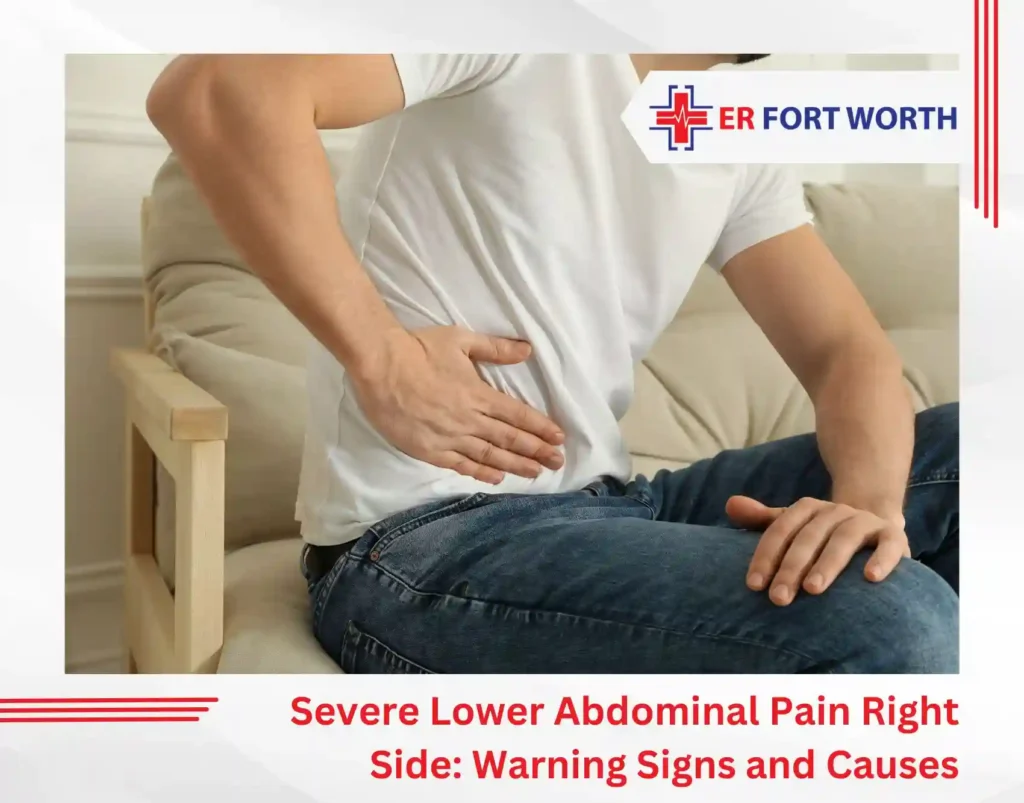
Severe lower abdominal pain right side is one of the most common emergencies our team sees, and it almost always needs same day evaluation. Appendicitis is the first concern, but ovarian cysts, kidney stones, ectopic pregnancy, hernias, and bowel conditions can all cause right-sided pain.
This guide answers the top questions about right-sided lower abdominal pain, so you know what the warning signs mean and when to walk into our Fort Worth ER.
What Causes Severe Lower Abdominal Pain on the Right Side?
Severe lower abdominal pain right side most commonly points to appendicitis, but other right lower quadrant pain causes include ovarian cysts, ectopic pregnancy, kidney stones, hernias, bowel inflammation, and in children, mesenteric adenitis. Rapid evaluation separates urgent from life threatening.
The right lower abdomen holds the appendix, part of the colon, the right ovary and fallopian tube in women, the right ureter, and sometimes a hernia opening. Each structure can produce pain with a different pattern.
According to the Mayo Clinic, appendicitis typically starts as vague pain around the belly button that migrates over several hours to a sharp focused pain in the lower right abdomen. That migration pattern is one of the most reliable clinical clues.
What Does the Pain Pattern Tell You?

Pain pattern narrows the cause fast. Appendicitis: pain migrates to the right lower quadrant with fever and nausea. Ovarian cyst: sudden sharp pain in women, often mid-cycle. Kidney stone: wave-like pain radiating to the groin. Hernia: pain worse with lifting or straining.
The table below groups the most common right lower quadrant pain causes by their signature pattern, so you can match what you feel to what deserves immediate attention.
| Likely Cause | Pain Pattern | Urgency |
| Appendicitis | Starts near belly button, moves to lower right over hours, worsens with movement, fever and nausea | Immediate ER |
| Ovarian Cyst Rupture | Sudden sharp pain in a woman, often mid-cycle, may come with light bleeding or dizziness | Immediate ER |
| Ectopic Pregnancy | Severe one-sided pain in a pregnant patient, often with light vaginal bleeding | 911 or Immediate ER |
| Kidney Stone | Wave-like pain in the flank and lower abdomen, radiates to the groin, often with blood in urine | Same day ER |
| Inguinal Hernia | Visible bulge in the groin, pain worse with lifting or coughing | Same day ER |
| Bowel Inflammation (Crohn) | Cramping pain plus diarrhea, sometimes blood in stool and weight loss | Same day ER |
| Mesenteric Adenitis (kids) | Pain after recent viral illness in children, lymph nodes in the belly inflamed | Evaluate soon |
No pattern is a perfect diagnosis. Imaging and lab work at the ER are what confirm the cause.
What Are the Appendicitis Warning Signs?
Appendicitis warning signs include pain that starts near the belly button and migrates to the lower right abdomen, worsens with movement or coughing, loss of appetite, low fever, nausea, vomiting, and tenderness when pressure is released from the lower right belly (rebound tenderness).
Classic appendicitis follows a predictable timeline. Not every patient fits the pattern, but these signs together raise strong suspicion:
- Pain starting near or around the belly button
- Pain shifting to the lower right abdomen within 12 to 24 hours
- Pain worse with walking, coughing, or sudden movement
- Loss of appetite
- Low grade fever, usually 99 to 101 F
- Nausea and sometimes vomiting
- Rebound tenderness (pain gets worse when pressure is released)
- Difficulty passing gas
The Cleveland Clinic notes that appendicitis affects about 5 to 9 percent of people in their lifetime and most commonly strikes between ages 10 and 30, though it can happen at any age.
When Is Abdominal Pain a 911 Emergency?
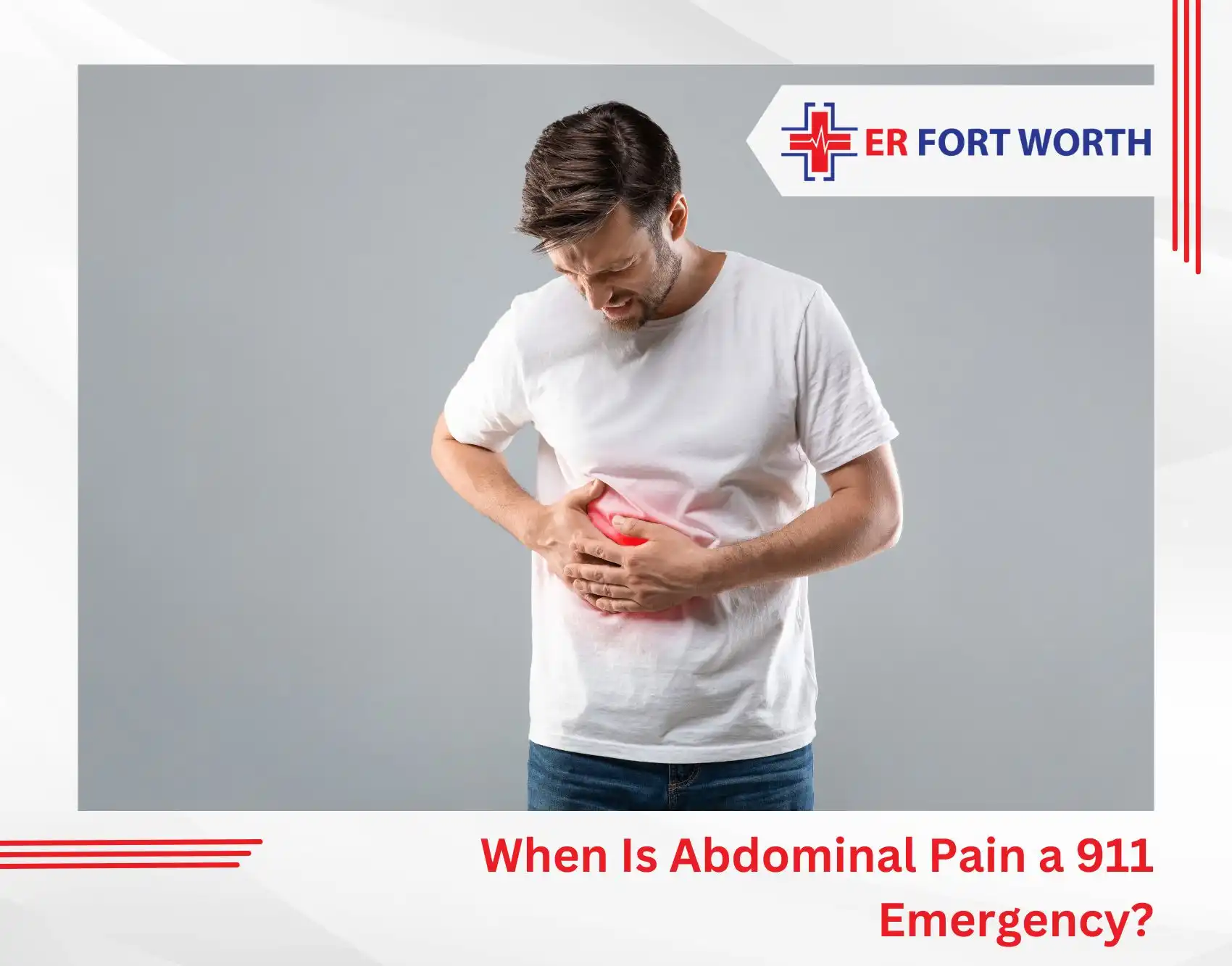
When abdominal pain is emergency level, call 911 for a rigid board-like belly, severe pain with fever, inability to pass gas or stool, bloody vomit or stool, fainting, confusion, pregnancy with sudden sharp pain, or any sign of shock like cold clammy skin and rapid heartbeat.
These features move the situation from urgent to immediate 911. Knowing when abdominal pain is emergency level means acting fast rather than observing:
- Rigid, hard, or board-like abdomen
- Severe pain with high fever over 102 F
- Vomiting blood or passing blood in stool
- Inability to pass gas or stool for more than 24 hours
- Fainting, confusion, or severe weakness
- Rapid heartbeat with cold clammy skin
- Pregnancy with sudden sharp one-sided pain
- Severe pain plus a visible bulge that cannot be pushed back
- Yellowing of the skin or eyes with abdominal pain
These signs may indicate a ruptured appendix, bowel obstruction, internal bleeding, or peritonitis. Do not drive yourself.
For a broader view of how our team differentiates causes of belly pain, our companion diagnosis for chest pain and abdominal pain guide walks through the imaging and lab workflow we use.
Who Is at Higher Risk?
Right-sided lower abdominal pain can strike anyone, but some groups face higher risk of serious causes. Knowing your profile changes how quickly you should come in.
- People aged 10 to 30 (peak appendicitis age)
- Pregnant patients (ectopic pregnancy risk, atypical appendicitis presentation)
- Women of reproductive age (ovarian cyst, pelvic inflammatory disease)
- Patients with inflammatory bowel disease history
- People with prior abdominal surgery (adhesions, obstruction risk)
- Children with recent viral illness (mesenteric adenitis)
- Older adults (appendicitis presents more subtly and is often diagnosed late)
- Anyone with a known hernia that becomes painful
For pediatric belly pain evaluation, our pediatric care in Fort Worth service page details how our team evaluates children with abdominal emergencies.
What Should You Do Before Coming to the ER?
For severe lower abdominal pain right side, do not eat or drink anything (surgery or imaging may need an empty stomach), do not take pain medication (it masks exam findings), do not apply heat to the belly, note when pain started and how it progressed, and come in right away.
- Nothing by mouth. Skip food and water. Imaging or surgical evaluation needs an empty stomach.
- No pain medication. Pain pattern is a key diagnostic clue. Masking it with over the counter pills can delay the real diagnosis.
- No heat on the belly. A heating pad can worsen inflammation if appendicitis is the cause.
- Note the timeline. When did the pain start? Where did it begin? How has it changed? Did you have fever, vomiting, or diarrhea?
- List your medications and conditions. Bring any prescription list, allergy list, and relevant medical history.
- Do not drive yourself if severe. Fainting from pain or dehydration is a real risk. Have someone drive you or call 911.
What Happens at ER of Fort Worth for Right-Sided Belly Pain?

At ER of Fort Worth, evaluation for severe lower abdominal pain right side begins with vital signs, a focused abdominal exam, and same visit lab plus imaging. CT scan and ultrasound are available on site to identify appendicitis, ovarian cysts, kidney stones, and other urgent causes within one visit.
Immediate workup
- Vital signs and oxygen saturation check
- Focused abdominal exam including rebound tenderness check
- IV access and fluid support
- Pregnancy test in women of reproductive age
- Pain assessment and anti nausea support
Same visit lab and imaging
- Complete blood count and metabolic panel
- Urinalysis to check for kidney stones or infection
- CT scan of the abdomen for appendicitis, bowel obstruction, or stones
- Ultrasound for pelvic causes in women and pediatric patients
If appendicitis, bowel obstruction, ectopic pregnancy, or another surgical emergency is confirmed, our board certified emergency physicians coordinate direct transfer to a hospital partner for surgical care. Our team stabilizes the patient, provides IV fluids and pain support, and sends imaging results with the patient.
For patients whose belly pain started with bloating and gas, our companion blog on bloated stomach treatment walks through non surgical causes we evaluate the same way.
Walk in for evaluation: ER of Fort Worth is open 24/7 for severe abdominal pain with on site CT, ultrasound, and lab. Call +1 817-945-4200 or walk in anytime. Do not eat or drink on the way in.
Common Questions
How can I tell if right-sided belly pain is appendicitis?
Classic appendicitis warning signs include pain that migrates from the belly button to the lower right over 12 to 24 hours, fever, nausea, loss of appetite, and worsening pain with movement. Only imaging and exam confirm the diagnosis.
Can gas cause severe right-sided lower abdominal pain?
Gas can cause sharp cramping that mimics other causes. The difference is that gas pain usually moves around and improves with passing gas or a bowel movement. Pain that stays in the same spot and worsens needs ER evaluation.
Is right lower quadrant pain always appendicitis?
No. Right lower quadrant pain causes include ovarian cysts, ectopic pregnancy, kidney stones, hernias, Crohn disease, and in kids, mesenteric adenitis. Imaging and exam at the ER confirm which cause applies.
Can I treat appendicitis at home?
No. Appendicitis almost always requires surgical removal of the appendix. Delaying care raises the risk of rupture, which turns a routine procedure into a life threatening complication. Any suspected appendicitis is a same day ER situation.
What if the pain comes and goes?
Intermittent pain can still be serious. Early appendicitis, kidney stones, and ovarian cysts often start with waves of pain before becoming constant. If episodes last longer or get worse, come in for evaluation. For a related overview, see our guide on
stomach pain patterns in our why does my stomach hurt when I cough article.
Severe Right-Sided Belly Pain in Fort Worth? Walk Into Our ER 24/7
Severe lower abdominal pain right side deserves same day ER evaluation, especially when fever, vomiting, or inability to pass gas is also present. On site CT, ultrasound, and lab mean most patients get answers within one visit. For appendicitis or any surgical cause, our team coordinates fast hospital transfer.
- Address: 4561 Heritage Trace Pkwy, Suite 117, Fort Worth, TX 76244
- Phone: +1 817-945-4200
- Hours: Open 24 hours, 7 days a week, 365 days a year
- Insurance: Most major commercial plans accepted
- Wait time: Rapid triage with typical door to provider time under 15 minutes
Visit ER of Fort Worth for directions and facility details. Proudly serving Heritage Trace, Alliance, Keller, Watauga, Park Glen, Haslet, Saginaw, North Richland Hills, and surrounding North Fort Worth communities.
Call 911 now: For rigid belly, severe pain with fever, bloody vomit or stool, fainting, confusion, or pregnancy with sudden sharp pain. Do not drive yourself.